Peru Cuts Diplomatic Ties with Mexico
Foreign Minister De Zela confirmed that Peruvian authorities learned earlier in the day that former PM Chávez entered the Mexican embassy to seek asylum.
November 4, 2025
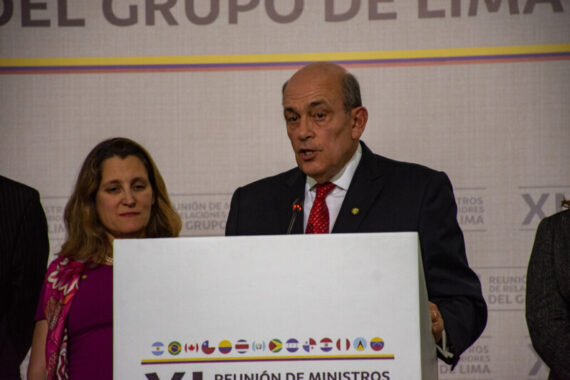
Peru has severed diplomatic relations with Mexico after former Prime Minister Betssy Chávez, a close ally of ousted President Pedro Castillo, fled to the Mexican embassy in Lima to request political asylum, officials said on Monday.
Foreign Minister Hugo de Zela announced the decision at a press conference in Lima, calling the move a response to “an unfriendly act” by Mexico. The rupture marks the lowest point yet in already fraught relations between the two Latin American nations, which have clashed repeatedly since Castillo’s dramatic removal from office in late 2022.
“In response to this unfriendly act and taking into account the repeated occasions in which the current and former presidents of that country have interfered in the internal affairs of Peru, the Peruvian government has decided today to break diplomatic relations with Mexico,” de Zela said.
De Zela confirmed that Peruvian authorities learned earlier in the day that Chávez, who had been facing criminal charges related to Castillo’s failed attempt to dissolve Congress, entered the Mexican embassy to seek asylum.
The announcement came hours after local media reported a heavy police presence outside the embassy compound in Lima’s San Isidro district. Officers were seen guarding the perimeter while government vehicles arrived and left throughout the afternoon.
Mexico’s Foreign Ministry did not immediately respond to requests for comment. The Mexican government, under President Andrés Manuel López Obrador, has previously granted asylum to several members of Castillo’s administration, deepening tensions with Lima.
López Obrador has repeatedly criticized Castillo’s ouster, describing it as a coup and refusing to recognize the legitimacy of President Dina Boluarte’s government. Peru’s leaders have accused the Mexican president of “persistent interference” and “ideological bias” in domestic affairs.
Monday’s decision to break diplomatic relations effectively halts official communication between the two nations and will likely result in the closure of embassies in both capitals.
Betssy Chávez, 34, served as prime minister for just over four months in 2022 before Castillo’s attempt to dissolve Congress sparked a constitutional crisis that ended with his arrest and impeachment.
Chávez, a lawmaker and labor minister before rising to the premiership, was among several high-ranking officials accused of conspiring with Castillo to illegally dissolve the legislature and rule by decree.
Prosecutors have charged her with rebellion and conspiracy, seeking a 25-year prison sentence. She was detained in June 2023 but released three months later while her trial was ongoing.
Her lawyer, Raúl Noblecilla, told local radio station RPP that he had not been in contact with his client for several days and could not confirm whether she had officially requested asylum. “I have no knowledge of her current situation,” he said.
According to court documents, Chávez’s driver testified that during Castillo’s failed power grab in December 2022, she asked him to drive her to the Mexican embassy before returning to her office. Chávez has denied that account and maintains she had no prior knowledge of Castillo’s plan to dissolve Congress.
Diplomatic ties between Mexico and Peru have been deteriorating since Castillo’s ouster in December 2022, when he was arrested after attempting to dissolve the opposition-controlled Congress and rule by decree.
Castillo, a rural schoolteacher and leftist union leader, won the presidency in 2021 amid widespread frustration with the political elite. His government was plagued by corruption scandals, political instability, and clashes with Congress throughout his 17 months in office.
After his arrest, Castillo sought refuge in the Mexican embassy but was intercepted by security forces before he could enter. Mexico later offered asylum to members of his family, who fled to Mexico City in December 2022.
President Boluarte’s government has accused Mexico of meddling in Peru’s internal affairs by sheltering Castillo’s relatives and publicly questioning the legitimacy of her presidency. In December 2022, Peru expelled the Mexican ambassador, and relations have remained strained ever since.
Recommended
Regional analysts say the diplomatic rupture could have broader implications for Latin American relations, especially within the Pacific Alliance — a trade bloc that includes Peru, Mexico, Chile, and Colombia.
“Peru’s decision underscores how deeply polarized the region has become,” said political analyst Giovanna Peñaflor. “Mexico has taken a strong ideological stance defending Castillo, while Peru’s current government sees this as a direct challenge to its sovereignty.”
The fallout may also affect bilateral trade and consular cooperation, including visa services and protection for citizens residing in each country.
As of late Monday, there were no reports of Peruvian diplomatic personnel departing Mexico City, but officials said they were preparing to recall staff “in the coming hours.”
If Mexico grants asylum to Chávez, it could further inflame tensions and complicate efforts to restore diplomatic communication. Peru may also request her extradition, though international law and diplomatic protocols could make that process lengthy and politically charged.
Chávez’s case remains emblematic of Peru’s ongoing political turmoil, with dozens of former ministers and officials facing legal proceedings linked to Castillo’s presidency. Castillo himself remains in pretrial detention, facing multiple corruption and rebellion charges.
Peru’s government appears intent on signaling that it will no longer tolerate foreign interference. “This decision was not taken lightly,” De Zela said. “Peru values its sovereignty and the rule of law, and we expect other nations to respect that.”
(Source: Reuters)

Politics Today is dedicated to publishing insightful analyses in order to understand the changing nature of contemporary politics. It aims to contribute to the sound and constructive discussion of international affairs.
You can see how this popup was set up in our step-by-step guide: https://wppopupmaker.com/guides/auto-opening-announcement-popups/

Stay informed by subscribing to
our weekly newsletter.
You can see how this popup was set up in our step-by-step guide: https://wppopupmaker.com/guides/auto-opening-announcement-popups/
You can see how this popup was set up in our step-by-step guide: https://wppopupmaker.com/guides/auto-opening-announcement-popups/
You can see how this popup was set up in our step-by-step guide: https://wppopupmaker.com/guides/auto-opening-announcement-popups/
You can see how this popup was set up in our step-by-step guide: https://wppopupmaker.com/guides/auto-opening-announcement-popups/