The Mecca Agreement and the Rebuilding of Regional Security

August 13, 2026

The Mecca Joint Defense Agreement can be seen as a concrete outcome of the quest to reduce dependence on external security guarantees and to build an intra-regional deterrence mechanism amongst regional actors.
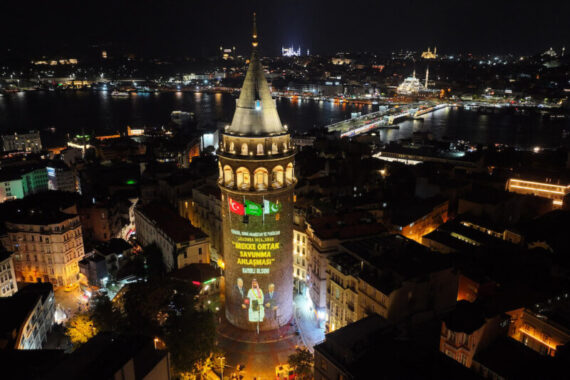
A special projection highlighting the Mecca Joint Defense Agreement illuminates Istanbul's iconic Galata Tower as part of a communication campaign organized by the Republic of Turkiye Directorate of Communications, on August 09, 2026 in Istanbul, Turkiye. Photo by Anadolu Images.

T

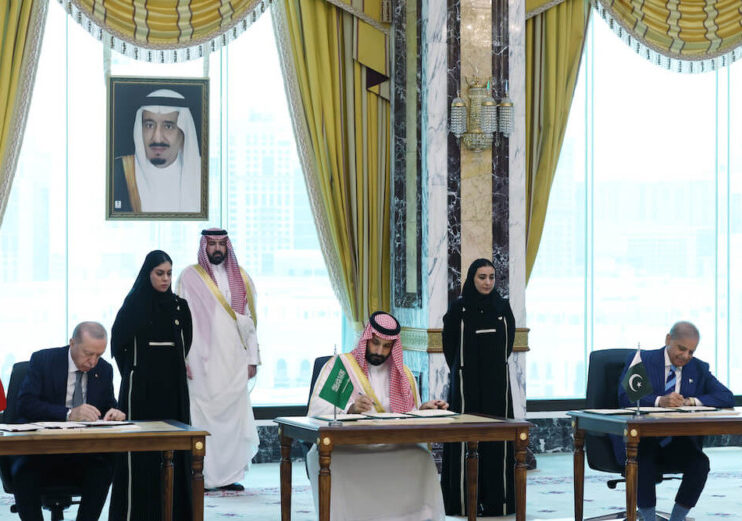
he diplomatic initiatives that have been ongoing for some time between Türkiye, Saudi Arabia and Pakistan have now materialized into a concrete security architecture with the Joint Defense Agreement signed today in Mecca. Although the agreement in question may appear to be a manifestation of the historical and religious ties between the three countries in foreign policy, it can in fact be regarded as part of a much broader regional transformation. This agreement, signed by President Recep Tayyip Erdoğan, Crown Prince Mohammed bin Salman and Prime Minister Shahbaz Sharif at the Safa Palace in Mecca, the holy city of the Muslim world, constitutes a full-fledged ‘collective defense’ pact, as it stipulates that an armed attack against any one of the three states shall be deemed an attack against all of them.

Furthermore, the fact that the agreement is based on Article 51 of the United Nations Charter, which governs the right to self-defense, can be seen as a reflection of the initiative led by the three countries’ quest for legitimacy within the framework of international law. Consequently, the resulting joint defense mechanism aims to serve as a deterrent not only at the regional level but also in the eyes of global actors.

Outcome of regional developments

It is evident that the agreement goes beyond a merely symbolic initiative. In this regard, the normalization process between Turkey and Saudi Arabia since 2022 and the subsequent acceleration of strategic cooperation, followed by Saudi Arabia’s move to expedite its rapprochement with Pakistan in the security context, culminating in the signing of the Joint Strategic Defense Agreement in 2025, have been the key driving forces behind this process. President Erdoğan’s emphasis on defense industry cooperation during his visit to Saudi Arabia at the start of the year, along with signals of joint investment in the KAAN National Fighter Aircraft, also demonstrate that the signing in Mecca was the result of a process that had been under way for some time.

Beyond its strategic and symbolic significance, the Mecca Agreement is of critical importance given the context in which it emerged. The growing regional instability following the war launched by the US and Israel against Iran on 28 February has led all countries to seek alternatives. When compounded by Israel’s continued pursuit of aggressive and expansionist policies and Washington’s silence in the face of these developments, the confidence of many regional actors, particularly the Gulf states, in the traditional security architecture has been permanently shaken. Furthermore, the US’s failure to provide the expected security umbrella to the Gulf states, whose vulnerabilities were laid bare by Iran’s attacks, has eroded these actors’ trust in traditional security guarantors. Consequently, Washington’s inconsistency in providing protection to its allies during times of crisis has driven regional capitals to diversify their own security arrangements.

Signed against this backdrop, the Mecca Joint Defense Agreement can be seen as a concrete outcome of the quest to reduce dependence on external security guarantees and to build an intra-regional deterrence mechanism amongst regional actors. From Türkiye’s perspective, this step constitutes a key pillar of its long-stated vision for a regional security architecture. In line with the initiatives it has taken in recent years, Ankara has played a critical role in intensifying cooperation amongst regional actors. During this process, Türkiye has strengthened its cooperation with countries including the Gulf states, as well as Egypt and Pakistan, and has sought to implement partnerships across various sectors.

During this process, one of the areas on which Türkiye has placed particular emphasis has been partnerships in the defense industry. Viewed in this context, it should also be noted that, beyond its security dimension, the Mecca Agreement provides a framework for deepening cooperation in the defense industry. Saudi Arabia’s preference and policies in recent years to transition from the role of a customer to that of a co-producer in the procurement of defense industry products have led to concrete steps being taken in this context between Ankara and Riyadh. In this regard, Türkiye has demonstrated its commitment by signing agreements with Saudi Arabia on the joint production of unmanned aerial vehicles, radar technologies, anti-tank guided missiles and other defense industry products.

Defense projects between Türkiye and Saudi Arabia

Indeed, Türkiye has successfully concluded its negotiations with Saudi Arabia regarding the co-production of the Gökbey national helicopter project, and an agreement was signed in February 2026 between TUSAŞ and the Saudi Arabian Defense Industries Organization. It is expected that the Mecca Agreement will not only strengthen the joint security mechanism but also increase such collaborations in the defense industry sector. It can be argued that, in the coming period, this initiative will not only go beyond security cooperation but also pave the way for deepening economic ties between the three countries.

Although the Mecca Agreement was signed between the three countries, President Erdoğan stated in his announcement that this security initiative is open to the participation of all countries. At this stage, it can be said that countries such as Qatar and Egypt are likely to be among those adopting a positive stance towards this security architecture in the initial phase. Given that it adopts an inclusive approach rather than an exclusionary one, unlike certain alliances that have emerged in the region in the past, it can also be noted that this alliance is set to play a strategic role in the future of the regional security architecture.

On the other hand, it remains unclear what impact the differences in foreign policy priorities and the relative divergence in threat perceptions between Türkiye, Saudi Arabia and Pakistan will have within the context of the agreement. Indeed, the fact that Turkey’s security priorities, centered on Syria and the Eastern Mediterranean, do not align with Saudi Arabia’s threat perception, which is largely centred on Iran, or with Pakistan’s security reflexes, which are focused on India, may be seen as a constraint. However, it can be argued that the impact of this divergence on the practical feasibility of the agreement will also be limited. Indeed, the fundamental dynamic behind the tripartite alliance is not so much divergent perceptions as shared, concrete threats. This situation forms the basis for the consolidation of power and a shared security vision along the Ankara-Riyadh-Islamabad axis.

The Joint Defense Agreement signed in Mecca stands out as an initiative that clearly sets out the signatory countries’ perspectives. This agreement, which can be seen as the tangible outcome of regional actors’ quest to build their own security amongst themselves, a quest directly influenced by the hardships caused by the interventions of external actors, serves as the nucleus of a far more comprehensive regional security architecture. At this juncture, it seems inevitable that Türkiye, Saudi Arabia and Pakistan, which have so far acted within the framework of a shared vision, will move towards a much stronger alliance should they align their foreign policy orientations, harmonize their strategic objectives and integrate their security capabilities.

(Originally published in Turkish by Kriter)

Ismail Numan Telci is the Vice President of Center for Middle Eastern Studies (ORSAM). He is also an Associate Professor at the Middle East Institute (ORMER) and at the Department of International Relations at Sakarya University. He is the author/editor of many books including 'Dictionary of the Egyptian Revolution', 'Eastern Mediterranean in International Politics' and 'Gulf Foreign Policy'. His comments appeared on international outlets including Al Jazeera, BBC, Le Monde, TRT World and Deutsche Welle.