The New Transcontinental Partnership: What Does the Future Hold for Türkiye-Canada Relations?

November 5, 2026

Perhaps the recent visit by Canada's Prime Minister to Türkiye could mark the beginning of a new partnership between Türkiye and Canada amid the turmoil and conflicts shaping the global order.
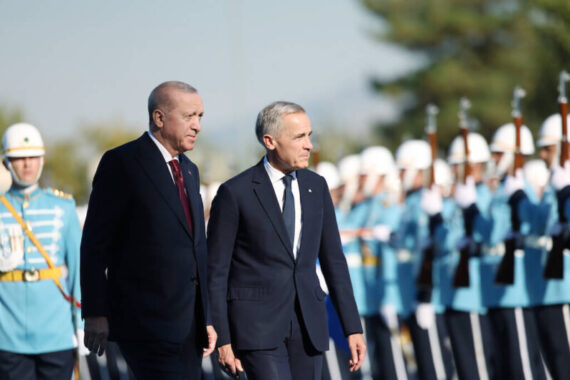
Turkish President Recep Tayyip Erdogan welcomes Canadian Prime Minister Mark Carney with an official ceremony at the Presidential Complex during his official visit to Turkiye, in Ankara, Turkiye on October 22, 2026. PHoto by Anadolu Images.

W

“e have finally addressed a long-standing disconnect between Türkiye and Canada. Today, we are beginning a new chapter between our two countries.”

These remarks by President Recep Tayyip Erdoğan at a joint news conference held during Canadian Prime Minister Mark Carney’s visit on October 22 were more than routine diplomatic courtesies. The first-ever official visit between the two countries at the heads-of-state level was marked by the signing of three separate agreements. The deals covering defense, transportation, and energy represent important milestones in defining the future direction of bilateral relations.

The decision to elevate ties to the level of a strategic partnership also points to the potential for a stronger consensus in the new era. The positive atmosphere evident in the joint news conference and meetings between the two delegations offered further signs of a new transatlantic dynamic taking shape.

Canada’s new foreign policy doctrine

Canadian Prime Minister Mark Carney has drawn considerable attention through a series of speeches since taking office 18 months ago. His addresses, particularly at the World Economic Forum in Davos and the United Nations General Assembly, have highlighted the systemic deadlock in the international order and the search for alternatives.

The concepts of “values-based realism” and “variable geometry,” which he has emphasized in these speeches, are central to his approach. They reflect the idea that middle powers such as Canada should increase their political influence while developing new mechanisms among themselves to reduce their dependence on major powers.

Carney argues that this combination of values, which he describes as both “principled and pragmatic,” offers a results-oriented approach to crises and challenges that the current international political system has been unable to address.

His reference in Davos to Czech dissident Václav Havel was particularly significant. It suggested that individuals and societies unaware of their own power can remain trapped in an illusion for extended periods.

In this respect, Carney’s approach has found common ground with President Erdoğan, who has for years called for reform of the United Nations system and the removal of the veto powers held by the five permanent members of the UN Security Council.

The fact that two leaders from very different political environments are advancing similar arguments in different contexts points both to shared needs and to the possibility of establishing a new geopolitical partnership in the coming period. The areas of cooperation between the two countries also have the potential to give this broader framework concrete substance.

Seeking new alliances in the energy landscape

Canada is the world’s second-largest country by land area, after Russia. Although much of its territory remains undeveloped because of its geographic conditions, the country’s wealth of natural resources has increasingly elevated its international standing. Canada is a major player in sectors such as oil, natural gas, liquefied natural gas (LNG), and mining.

Approximately 14 percent of the country’s electricity comes from nuclear power. Its position in the global critical minerals ecosystem further reinforces its strategic importance. Canada ranks first worldwide in potash production, second in uranium, and fourth in gold.

Although challenges such as limited processing capacity and legal disputes with Indigenous communities, which create uncertainty over land ownership and use, can reduce efficiency, recent efforts have sought to build momentum in these areas as well. Some of the most tangible results of Türkiye-Canada cooperation are expected to emerge in these sectors.

The Canadian government aims to significantly expand its nuclear capacity. Its short- and medium-term goals include building around 10 new large-scale reactors by 2040, alongside the wider deployment of small modular reactors (SMRs). Canada also aims to export CANDU technology, a domestically developed pressurized heavy-water reactor design that uses natural uranium and heavy water. Türkiye is considered a potential candidate for a future agreement.

Türkiye has long sought to expand its investment in nuclear energy and has been engaged in discussions with several countries for years. Russia, South Korea, China, and Canada are among the countries that have emerged as leading potential partners for new investments. Turkish officials have indicated that progress has been made in long-running negotiations with Canada.

At the time this article was written, President Erdoğan’s planned visit to South Korea, expected to take place on November 2-4, had not yet occurred. Nuclear energy cooperation is also expected to be one of the key items on the agenda during that visit.

Canada, meanwhile, stands out for its proven expertise in nuclear energy. Its technological capabilities, financing opportunities, and ability to provide nuclear safety assurances are seen as major advantages. The 17 nuclear reactors currently operating in the country, including those involving cooperation with countries such as China and Romania, also demonstrate its existing capacity.

Türkiye aims to secure cooperation on between two and six reactors. While cooperation with Russia on the Akkuyu Nuclear Power Plant continues, Türkiye is also seeking to build new high-capacity plants in locations such as Sinop and Tekirdağ. These projects are among the main priorities shaping the country’s energy strategy.

As the potential nuclear cooperation agreement between Türkiye and Canada moves rapidly toward its final stages, the possibility of negotiating the entire project as a single package is also under discussion. Identifying the countries and investors that would provide the financing is another issue being considered. If the negotiations and feasibility studies produce positive results, further arrangements will be made concerning technology transfer and the deployment and training of human resources.

During Prime Minister Carney’s visit to Türkiye, the two delegations also discussed the possibility of cooperating in third countries. In particular, opportunities for joint projects with third parties in regions such as Central Asia and the Middle East were identified, especially in sectors such as mining.


Could the defense partnership grow stronger?

Defense industry cooperation has a long history in Türkiye-Canada relations. However, the relationship was damaged in 2019 when Canada imposed restrictions on the export of critical products, citing Türkiye’s military operations in Syria as justification.

Following global developments in recent years, ties are now expected to regain momentum in the new era. Indeed, the two countries signed a Memorandum of Understanding on Defense Industry Partnerships during the visit.

Prime Minister Carney’s remarks were particularly noteworthy: “Türkiye produces approximately 80 percent of what it needs for its own defense domestically. Canada is not in the same position. We have a great deal to learn.”

His comments point to a partnership in which Türkiye is likely to occupy a strong position.

During his visit, Carney also toured institutions such as ASELSAN and BAYKAR under the coordination of Türkiye’s Presidency of Defense Industries (SSB). At ASELSAN, the focus was on work involving electro-optical systems, radar, and avionics. At BAYKAR, discussions centered on unmanned aerial systems and autonomous software technologies.

With the SSB coordinating an ecosystem of approximately 4,500 companies, closer cooperation between the two countries, both of which operate within NATO standards, could take on a more concrete form in the coming period.

The Canadian government established the Defense Investment Agency last year to accelerate defense procurement. Canada aims to increase the share of its domestic industry in defense spending to 70 percent over the next decade.

Canada’s efforts to join Europe’s Security Action for Europe (SAFE) defense procurement framework and reduce its dependence on the United States in this area also offer important insights into the emerging security architecture.

Will the new era see the rise of Middle Powers?

The efforts of countries below the superpower level, including Türkiye and Canada, to achieve greater strategic autonomy are increasingly forming a recognizable pattern. Canada’s pursuit of this autonomy has undoubtedly been influenced by the aggressive foreign policy and tariff measures adopted by the United States during President Donald Trump’s second term.

However, the pursuit of political autonomy cannot be separated from economic realities. Given that approximately 70 percent of Canada’s exports go to the United States, it is not difficult to foresee that developing a new strategic direction will be a challenging process.

Prime Minister Carney is not an outsider to the established political and financial order. He has served as governor of both the Bank of Canada and the Bank of England. Nevertheless, a statement he made earlier this year, “If the rules do not protect you, you must protect yourself”, has become a clear expression of a growing realization about the nature of the global system.

Türkiye appears likely to become one of the most reliable partners in this emerging network of alliances.

Casablanca (1942), one of the most famous films in cinematic history and particularly notable for its political undertones, is set against the backdrop of World War II. Following the film’s depiction of the conflict between Nazi Germany and the “free and prosperous world,” its final scene features an exchange between two characters that ends with the line: “Louis, I think this is the beginning of a beautiful friendship.”

Perhaps the recent visit, too, could mark the beginning of a new partnership between Türkiye and Canada amid the turmoil and conflicts shaping the global order.

(Originally published in Turkish by Kriter)

Emre Karaca worked for Haber Global TV Channel. Previously, he worked at Anadolu Agency as a diplomatic correspondent. Karaca graduated from Exeter University with an MA in Middle East Politics and International Relations.