Trump Cuts India Tariffs to 18% as New Delhi Ends Russian Oil Buys

February 3, 2026

Trump said the agreement followed a call with Indian Prime Minister Narendra Modi and would see India replace Russian oil with purchases from the United States and potentially Venezuela.
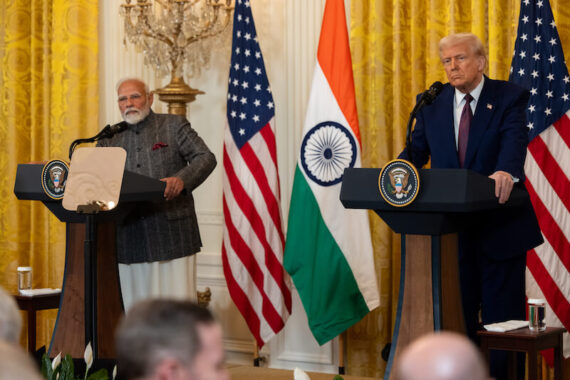
Indian Prime Minister Narendra Modi and US President Donald Trump held a joint press conference in the East Room of the White House in Washington, D.C., the capital of the United States. Photo by Anadolu Images.

T

he United States has agreed to cut tariffs on Indian goods to 18% from as high as 50% in exchange for India halting purchases of Russian oil and lowering trade barriers, US President Donald Trump announced on Monday.

Trump said the agreement followed a call with Indian Prime Minister Narendra Modi and would see India replace Russian oil with purchases from the United States and potentially Venezuela.

A White House official told Reuters the US would remove a punitive 25% duty imposed over India’s Russian oil imports, which had been added to a separate 25% “reciprocal” tariff.

Markets rally

US-listed shares of major Indian firms rose sharply after the announcement. Infosys gained 4.3%, Wipro rose 6.8%, HDFC Bank climbed 4.4%, and the iShares MSCI India ETF jumped 3%.

The deal also boosted broader US market sentiment, particularly among technology and semiconductor stocks.

Trump said India would “BUY AMERICAN at a much higher level,” including more than $500 billion in US energy purchases, as well as technology, agricultural, and other products. He added that India would move to reduce tariffs and non-tariff barriers on US goods to zero.

However, few details were provided on implementation timelines, enforcement mechanisms, or the scope of India’s commitments. As of Monday afternoon, no presidential proclamation or Federal Register notice had been issued to formalize the changes.

India’s commerce and foreign ministries did not immediately comment, and Russia’s embassy in Washington also declined to respond.

Mixed reaction in the U..S

Economists said the deal brings India closer to tariff levels faced by other major Asian exporters.

“This puts India broadly in line with its Asian peers on tariff rates,” said Madhavi Arora of Emkay Global, adding that it would ease pressure on Indian exports and the rupee after months of investor outflows triggered by higher U.S. tariffs.

US business groups reacted cautiously. The US Chamber of Commerce called the announcement a positive step toward a broader trade agreement.

But a coalition of more than 800 small businesses, operating under the name “We Pay the Tariffs,” warned the deal still represents a sharp increase in costs for US importers, noting tariffs on Indian goods were around 2% to 3% in 2024.

Modi welcomed the announcement, thanking Trump for lowering tariffs on Indian products.

“Delighted that Made in India products will now have a reduced tariff of 18%,” Modi wrote on X, calling the move beneficial for India’s 1.4 billion people.

India’s Trade Minister Piyush Goyal said the deal would deepen economic ties and help India access US technology.


Oil geopolitics

India, the world’s third-largest oil importer, relies on imports for about 90% of its needs. Cheaper Russian crude has been central to its energy strategy since the war in Ukraine, though purchases have begun to decline in recent months.

Analysts said U.S. and Venezuelan oil could partly replace Russian supplies, reshaping energy flows as Washington pushes trade partners to distance themselves from Moscow.

The agreement comes amid a broader push by the Trump administration to finalize trade frameworks with key partners ahead of a US Supreme Court ruling on the legality of Trump’s “reciprocal” tariffs.

(Source: Reuters)

Politics Today is dedicated to publishing insightful analyses in order to understand the changing nature of contemporary politics. It aims to contribute to the sound and constructive discussion of international affairs.