How Has the Russia-Ukraine War Affected NATO?
The statement in the Ankara Summit Declaration that Ukraine is contributing to transatlantic security by fighting against Russia is significant.
August 7, 2026
T
he Russia-Ukraine War continues to be the primary catalyst for the process of change and adaptation that NATO is currently undergoing. Russia’s loss of its status as a partner within the Western security architecture following the attack it launched in February 2022, and its subsequent classification as a ‘threat’, has shaped the political and geopolitical dimension of the issue, whilst the military and technological aspects of the war’s conduct have also presented challenges to the Alliance’s defense and deterrence capabilities. Measures relating to this process featured as key issues on the agenda of the Ankara Summit and in the Summit Declaration.
It comes as no surprise that the Ankara Summit Declaration defines Russia as a long-term threat to Euro-Atlantic security and stability, as the prevailing view amongst the vast majority of allies is that Russia’s objectives are not limited to Ukraine. This view underpins the rapid increase in defense spending across the Alliance, the removal of barriers to defence industry production, and the strong continuation of military and non-military support for Ukraine.
Since February 2022, NATO’s top priority has been to strengthen the Alliance’s capabilities, whilst the second has been to ensure the sustainability of Ukraine’s combat capabilities. To date, 99 per cent of the military aid provided to Ukraine has come from NATO allies. We can see that this resolve has been maintained at the Ankara Summit, as evidenced by the scale of the support package announced. Whilst the allies have pledged 70 billion euros’ worth of military aid to Ukraine for 2026, this figure has also been set as the baseline for the following year.
What is particularly noteworthy here is that this aid will be funded largely by the European Union (EU). With the Ukraine Support Facility adopted in April 2026, the EU had decided to provide Ukraine with 30 billion euros in financial aid and 60 billion euros in military aid for the period 2026–2027. It should be recalled that in March 2025, all US military aid to Ukraine was cut off, and the flow of American weapons to Ukraine could only be maintained through the intervention of European countries.
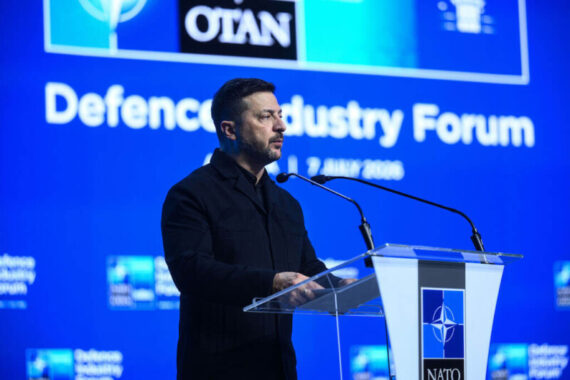
On the other hand, the statement in the Ankara Summit Declaration that Ukraine is contributing to transatlantic security by fighting against Russia is significant, as it indicates that the allies recognize Ukraine as a major military power. Speaking at the Defence Industry Forum held on the sidelines of the summit, Ukrainian President Zelensky emphasized that his country is no longer an actor seeking security but one that produces it, and that Ukraine has become an ‘extraordinary source of defense capability’ for Europe. Whilst there is some truth in Zelensky’s remarks, linking this to NATO membership does not seem realistic at this stage, as the war is ongoing and, even if a lasting peace were to be achieved, the US administration’s unequivocally negative stance on the matter is well known.
The Russia-Ukraine War has highlighted the critical importance of defense industry production and innovation in the theatre of war. With the intensive use of unmanned aerial vehicles (UAVs), artillery munitions and various missile systems, the war has turned into an industrial race in design and production. The rapid, innovative and high-volume production of these systems has had a direct impact on the combatants’ success on the ground. This can be seen in the changing nature of UAV warfare. Today, on the battlefield, UAV systems are being used not merely to target isolated tactical elements, but to shape the battlefield itself.
New-generation UAV systems have played a major role in the war taking on a distinctly positional character from late 2023 onwards and in manoevristic operations coming to a virtual standstill. The ‘kill zones’—areas 10–15 kilometers deep where artillery fire and electronic warfare have intensified alongside the use of UAV systems—have transformed the war into a series of battles taking place in isolated areas. Efforts by the opposing sides to gain the upper hand, whether through kamikaze attacks using UAVs or by deploying them to drop explosives from above, are concentrated in these zones.
The race for innovation, which is characterized by constant dynamism on the Russia-Ukraine warfront, is also taking place in the field of unmanned maritime and land vehicles. For example, whilst it has been observed over the past year that Ukraine has begun to utilize unmanned maritime systems (UMS) much more intensively and effectively, we are now seeing new-generation amphibious operation trials aimed at deploying unmanned ground vehicles (UGVs) – transported by UMS – to critical areas. Ukraine’s recent operation on the Kinburn Peninsula has been described as the first unmanned amphibious operation in history.
Looking at the current course of the war, it is clear that Ukraine has, over the past few months, acquired an increasing ability to strike targets within Russia. Ukraine is specifically targeting bridges, motorways, railways and fuel tankers with the aim of disrupting Russia’s logistical capabilities. The reason for this is to thwart Russia’s ability to launch a new offensive during the spring and summer months. Similarly, these attacks aim to isolate the Donbas region from occupied Crimea through the selection of specific geographical targets (thereby blocking the use of the corridor between them). Judging by the results of Ukraine’s attacks and the pace of Russian advances, it appears that this objective has so far been achieved with considerable success.
The impact of these systems on the war extends beyond the battlefield. As a result of drone and missile attacks by both sides, the agricultural sectors of both Ukraine and Russia have suffered serious damage. Long-range missile and UAV attacks are disrupting the production of grain, wheat and sunflower oil, either directly or indirectly, whilst the targeting of Russian ships carrying wheat in the Sea of Azov by UAV systems is also producing negative consequences for the global market.
Similarly, it must be noted that unmanned systems are also having an impact on the sociological dimension of the war. For example, it is well known that UAV systems flying at low altitude and then diving create great fear amongst the civilian population. Last week, a spokesperson for the Ukrainian Air Force highlighted this situation, emphasizing that Russia’s jet-powered Shahed UAVs were flying at high speed at low altitude and that Russia’s aim was to force the residents of Kyiv to flee the city. In this regard, the prospect of unmanned systems becoming part of systematic intimidation and terror-inducing operations targeting the civilian population in the medium to long term represents a critical risk.
Recommended
All these factors have led NATO to establish a comprehensive budget and adopt reform processes in the fields of unmanned systems and their countermeasures (counter-UAS). Whilst it was announced at the Ankara Summit that the Alliance would undertake defense procurement worth 50 billion dollars, the ‘Drone Edge’ initiative, worth 40 billion dollars, was also launched to support anti-UAV systems. By the end of 2027, the allies have committed to increasing the number of UAV operators fivefold. Consequently, unmanned systems – which are shaping modern warfare – constitute a significant part of NATO’s military capability requirements, an issue that has largely been brought to the fore through discussions on budget increases.
Similarly, new steps are being taken to remove obstacles to defense industry cooperation – an area Turkey has long advocated for, but whose importance within the Alliance has only become apparent in recent years, and which can be understood in the context of production shortcomings. Initiatives announced at the Ankara Summit, such as ‘NATO Front Door for Industry’ and ‘NATO Engine’, aim to achieve greater integration of defense industries on a transatlantic scale.
Until now, the focus within NATO has been on military interoperability; however, modern warfare has highlighted the necessity of industrial interoperability to meet defense industry requirements. Indeed, the interoperability issues observed with Western-manufactured 155-millimeter artillery ammunition in the Ukrainian theatre had already demonstrated the inevitable need for close coordination between military operations and defense production.
Consequently, the Russia-Ukraine War remains NATO’s top priority. Despite transatlantic divisions and pro-Russian allegations leveled at Donald Trump, the fact that Russia continues to be defined as a long-term threat in the Ankara Summit Declaration is noteworthy in this regard. Similarly, the continuation of strong support for Ukraine also points to the same conclusion. In this sense, whilst the dynamics of transatlantic relations will determine the political dimension of the transformation taking place within NATO, the Russia–Ukraine War and the war’s innovation dynamics will continue to shape the process of change and adaptation in the Alliance’s military capabilities.
(Originally published in Turkish by Kriter)

Rıfat Öncel is a PhD student in international relations at the Middle East Technical University and a researcher at the Foreign Policy Department of SETA Foundation. His academic research interests include defense policy, nuclear strategy, and emerging military technologies.
You can see how this popup was set up in our step-by-step guide: https://wppopupmaker.com/guides/auto-opening-announcement-popups/

Stay informed by subscribing to
our weekly newsletter.
You can see how this popup was set up in our step-by-step guide: https://wppopupmaker.com/guides/auto-opening-announcement-popups/
You can see how this popup was set up in our step-by-step guide: https://wppopupmaker.com/guides/auto-opening-announcement-popups/
You can see how this popup was set up in our step-by-step guide: https://wppopupmaker.com/guides/auto-opening-announcement-popups/
You can see how this popup was set up in our step-by-step guide: https://wppopupmaker.com/guides/auto-opening-announcement-popups/