Trump: Kazakhstan Joins The Abraham Accords
Vice President JD Vance said Kazakhstan’s entry “gives great momentum to the Abraham Accords,” emphasizing that “the momentum of the Abraham Accords is alive and well in the second administration.”
November 7, 2025

U
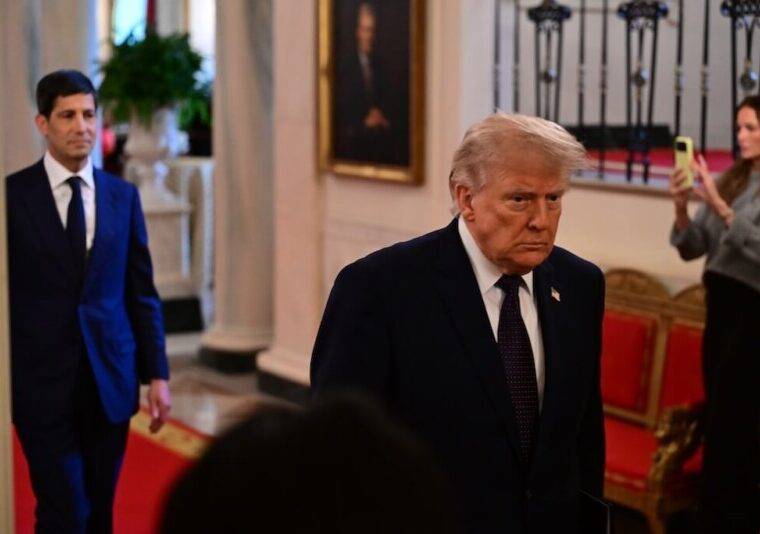
.S. President Donald Trump announced Thursday that Kazakhstan has agreed to join the Abraham Accords, marking the first expansion of the Middle East peace framework during his second term in office. The move, while largely symbolic given Kazakhstan’s existing ties with Israel, underscores the Trump administration’s renewed push to broaden normalization efforts between Israel and Muslim-majority countries.
“Kazakhstan is the first country of my Second Term to join the Abraham Accords, the first of many,” Trump wrote on his Truth Social platform. “This is a major step forward in building bridges across the world.”
He added that a formal signing ceremony would be held soon, saying, “Many more countries are lining up to embrace peace and prosperity through my Abraham Accords. This is real progress, real results.”
The announcement came hours before Trump hosted Kazakh President Kassym-Jomart Tokayev and four other Central Asian leaders for a dinner at the White House, part of a broader diplomatic engagement aimed at strengthening U.S. influence in the region amid China and Russia’s expanding presence.
The Abraham Accords, launched in 2020 during Trump’s first term, established diplomatic and economic ties between Israel and several Arab or Muslim-majority countries — the United Arab Emirates, Bahrain, Morocco, and Sudan. The initiative was hailed by Trump as a major achievement in Middle East diplomacy and a cornerstone of his foreign policy legacy.
Kazakhstan’s inclusion adds a Central Asian dimension to the accords, but its significance differs from previous members. The country, a majority-Muslim former Soviet republic, already recognized Israel in 1992 and has maintained steady diplomatic and economic relations for more than three decades.
Still, U.S. officials framed the decision as a sign of renewed momentum for the accords and evidence that “Washington’s regional partnership model remains attractive.”
Vice President JD Vance said Kazakhstan’s entry “gives great momentum to the Abraham Accords,” emphasizing that “the momentum of the Abraham Accords is alive and well in the second administration.”
Secretary of State and National Security Advisor Marco Rubio said the new partnership would enhance economic collaboration between Kazakhstan and Israel. “Through this agreement, Kazakhstan joins a partnership that brings special and unique opportunities for development — in energy, technology, agriculture, and water management,” he told reporters.
Read: Gaza and Trump 2.0
While the practical implications of Kazakhstan’s move are limited, analysts say the decision carries strategic value for both Washington and Nur-Sultan. For Trump, it revives a diplomatic brand closely associated with his presidency, offering a visible foreign policy success amid shifting alliances in the Middle East and Central Asia.
For Kazakhstan, participation may strengthen ties with Washington and open doors for investment and technology transfer at a time when it seeks to balance relations among major powers — including Russia, China, and the U.S.
“Kazakhstan’s entry doesn’t represent normalization per se, but rather political alignment,” said Ariel Cohen, a senior fellow at the Atlantic Council’s Eurasia Center. “By joining, Kazakhstan signals that it supports Trump’s broader regional strategy while positioning itself as a bridge between Muslim nations, Israel, and the West.”
The announcement also reflects Trump’s ambition to expand the Abraham Accords beyond the Middle East. His administration has long expressed interest in bringing additional nations — including Saudi Arabia, Oman, Indonesia, and, into the framework.
Trump has repeatedly said that adding Saudi Arabia to the accords remains a top priority. Riyadh came close to joining in 2023 before talks stalled over Palestinian statehood issues and shifting regional dynamics following the Gaza genocide.
Now, with Crown Prince Mohammed bin Salman scheduled to visit Washington later this month, speculation is mounting that Trump may attempt to revive the deal. “We have a great relationship with Saudi Arabia,” Trump said Thursday. “We’ll see what happens.”
Even more striking is the potential inclusion of Syria under President Ahmed al-Sharaa, who took power following the collapse of Bashar al-Assad’s regime earlier this year. When asked whether he planned to discuss the accords with al-Sharaa during their upcoming meeting on Monday, Trump was evasive but upbeat. “He’s doing a very good job,” Trump said. “It’s a tough neighborhood, and he’s a tough guy — but a lot of progress has been made with Syria.”
Recommended
The Israeli government welcomed Kazakhstan’s announcement, with Prime Minister Benny Gantz calling it “another sign of the growing circle of peace” and saying Israel “looks forward to deepening cooperation with the Kazakh people.”
Palestinian officials, however, criticized the move as further entrenching normalization without addressing core political grievances. “Joining the Abraham Accords without ending Israel’s occupation or recognizing Palestinian rights only rewards apartheid,” said a statement from the Palestinian Ministry of Foreign Affairs.
A signing ceremony for Kazakhstan’s entry into the accords is expected to take place in Washington later this month, possibly coinciding with other diplomatic announcements. Trump hinted that “many more” countries are preparing to follow suit, suggesting that his administration intends to use the Abraham Accords as a key instrument of its foreign policy revival.
For now, Kazakhstan’s participation may be largely symbolic — but it signals that Trump’s signature diplomatic initiative is not only alive, but expanding into new regions once considered outside its reach.
(Source: Anadolu Agency)

Politics Today is dedicated to publishing insightful analyses in order to understand the changing nature of contemporary politics. It aims to contribute to the sound and constructive discussion of international affairs.
You can see how this popup was set up in our step-by-step guide: https://wppopupmaker.com/guides/auto-opening-announcement-popups/

Stay informed by subscribing to
our weekly newsletter.
You can see how this popup was set up in our step-by-step guide: https://wppopupmaker.com/guides/auto-opening-announcement-popups/
You can see how this popup was set up in our step-by-step guide: https://wppopupmaker.com/guides/auto-opening-announcement-popups/
You can see how this popup was set up in our step-by-step guide: https://wppopupmaker.com/guides/auto-opening-announcement-popups/
You can see how this popup was set up in our step-by-step guide: https://wppopupmaker.com/guides/auto-opening-announcement-popups/