Turkey-Europe Relations in the Light of New Geopolitical Realities

June 15, 2026

Although Turkey’s well-intentioned appeals have failed to yield results, the shifting geopolitical balances in the world are ultimately teaching the Berlin-Paris axis that it must come to terms with Turkey.
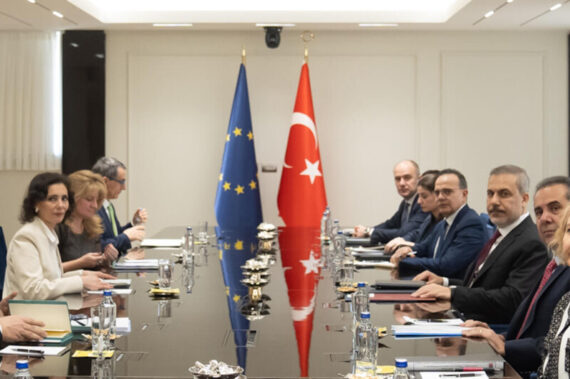
urkish Foreign Minister Hakan Fidan meets with the Hadja Lahbib, European Commissioner for Preparedness, Crisis Management and Equality, in Ankara, Turkiye on January 20, 2025. Photo by Anadolu Images.

T

o see what effects the shift of the world’s centre of gravity from the Europe-Middle East axis towards the People’s Republic of China-South Asia axis has brought about, it is sufficient to note the visits to Beijing by US President Trump and, shortly afterwards, Russian President Putin within the space of a week, and to realize that Europe was not even mentioned during these visits. We can see how Europe’s equilibrium has been disrupted by developments in Beijing through the shifting stance of European Commission President Ursula von der Leyen over the course of a month.

In a speech delivered on 20 April 2028 at the 80th anniversary event of the newspaper Die Zeit, she stated: “We must succeed in uniting the European continent as a whole so that it does not fall under Russian, Turkish or Chinese influence. We must think on a larger, geopolitical scale,” Von der Leyen stated. She must have quickly realized that the so-called power she represents does not belong in the league of superpowers, neither in terms of energy, defense nor technology, as she received the necessary lesson regarding the strategic importance of Turkey-EU relations during her telephone conversation with President Erdoğan on 19 May. In fact, this fundamental lesson was the result of a series of Turkey-centered developments throughout May.

The hard mathematics of geopolitics

Looking at the sequence of events, the visit to Turkey on 11 May by Queen Mathilde of Belgium, accompanied by a large delegation of businesspeople, can be considered the first link in this chain of developments. During the visit, Belgian Foreign Minister Maxime Prevot, responding to questions from TRT Haber, made the following remarks that explicitly targeted the President of the European Commission, serving as proof of how the EU’s perspective on Turkey has shifted: “Of course, the European Union needs Turkey. Turkey also needs Europe. In my view, it was illogical to use a phrase that places Turkey, China and Russia on the same level, on the same platform, as stated by European Commission President Ursula von der Leyen. You are a stabilizing force. For this reason, we must take Turkey’s strategic role in Europe’s future security architecture into account more than ever before.”

The developments necessitating a reorientation of von der Leyen’s course did not end there. On Monday 18 May, as part of Foreign Minister Hakan Fidan’s visit to Germany, the third meeting of the Turkey-Germany Strategic Dialogue Mechanism was held after a 12-year hiatus. The fear of Russia and US pressure must have put Berlin in such a state that German Foreign Minister Wadephul felt compelled to make the following remarks regarding this meeting: “After many years, we have re-engaged in strategic dialogue with Turkey. We wish to devote more time to this, as we want to examine the issues in greater depth. I am pleased that we have re-engaged on this path; we have reached a new level of quality in bilateral relations.”

For Wadephul’s quest for quality to achieve its aim, he must first begin with self-criticism. For instance, he could start by addressing the covert embargoes imposed on Turkey’s submarine manufacturing and the Akkuyu nuclear power plant. Or, if he were to explain how the investigation files regarding the NSU (National Socialist Underground) terrorist organization’s murder of eight Turks were deleted on 11 November 2011 – the very day the Federal Prosecutor’s Office took over the case – we might be able to move a little closer to the desired quality in Turkey-Germany relations. To understand Germany’s real concern, it is sufficient to look at the Welt newspaper’s report, also dated 18 May. Following the US’s suspension of Tomahawk missile deliveries to Germany, Berlin is seeking a solution in the Turkish defense industry.

What is interesting is that the Berlin-Paris duo, which has favored Greece since the 1970s under the banner of Hellenic romanticism, still cannot raise its voice against Athens, which is blocking Turkey’s participation in the Security Action for Europe (SAFE) program. On the contrary, the overwhelming majority of member states are now aware that this 150-billion-euro program for joint defense procurement cannot achieve its objectives without Turkey, and have adopted the approach of bypassing the Greek obstacle by entering into independent agreements with Turkey. Indeed, reports have begun to emerge in the press suggesting that France is also making moves to join this initiative. However, it has been made clear to Paris, which is attempting, on the one hand, to stir up trouble in the Caucasus and, on the other, to upset the balance in the Eastern Mediterranean to Turkey’s detriment by aligning with the Greek Cypriot administration, that cooperation with Turkey in this area is impossible.


The Berlin-Paris axis: Coming to terms with Turkey

Although Turkey’s well-intentioned appeals have failed to yield results, the shifting geopolitical balances in the world are ultimately teaching the Berlin-Paris axis that it must come to terms with Turkey. The European Union, led by Germany, has now realized that it will be on the menu in any potential global power-sharing agreement between the United States and the People’s Republic of China. What they must now do is make up for the time and money they have squandered so generously since the collapse of the Union of Soviet Socialist Republics in 1992. Furthermore, they must admit that the energy they have expended on stalling Turkey has also been in vain.

The current state of the European Union was summarized by Germany’s former Chancellor, Olaf Scholz, on 4 May 2026 during a program he attended at the Harvard Kennedy School, part of Harvard University in the US. “The US and Germany have become a nation of lawyers. Other countries can build a national railway network in 20 years. Why can’t we build an urban rail line in 20 years?” As can be seen, Scholz, unlike von der Leyen, prefers to turn the spotlight on himself rather than targeting Turkey.

I do not believe Scholz chose this phrase, ‘a country of lawyers’, by chance. This phrase reminded me of Zbigniew Brzezinski’s 1993 book *Out of Control: Global Turmoil on the Eve of the 21st Century*, in which he served as National Security Advisor to former US President Carter. In this work, Brzezinski warned the US administration, which was intoxicated by the victory of the First Cold War, that it needed to redirect its resources towards structural reforms as a matter of urgency. Had this warning been heeded, it is certain that we would not be seeing Donald Trump in the White House today.

In his book, Zbigniew presented a 20-point list of measures that needed to be implemented for the structural reforms the US required. The tenth item on this list concerns the issue of becoming a ‘nation of lawyers’, to which Scholz also refers. Brzezinski summarizes his complaint about this situation under the heading ‘The Presence of Parasites in the Legal System’ as follows: ‘One-third of the world’s lawyers work in the US. Legal fees paid in tort cases alone amount to three per cent of the US gross domestic product. This ratio is three times higher than in the countries with which the US competes. This high ratio has a deterrent effect on investors.”

Borrell’s garden has become a jungle

Instead of investing in technology and industry, or establishing a common defence and energy policy, the European Union, which offers those living within its borders a fantasy paradise, is now at a loss as to what to do in the face of developments centred on the People’s Republic of China. Yet on 13 October 2022, Josep Borrell, then the European Union’s High Representative for Foreign Affairs and Security Policy, addressed students at the European Union Diplomatic Academy and brazenly likened the world beyond the European Union’s borders to a wild forest.

According to Borrell, the European Union represented a well-tended garden, that is, the best political harmony humanity could achieve. However, there was a danger that the forest might invade the garden, and according to Borrell, the European Union’s gardeners should go into the forest and engage with the rest of the world. Fortunately, thanks to the inflation driven by rising energy prices over the past four years, we now have the opportunity to observe a Europe that has turned into a jungle, where the far right is constantly gaining strength, from the island of stability that is Turkey.

(Originally published in Turkish by Kriter)

Turkish author and security expert who writes on Ukraine, Russia, NATO and African politics. Prigozhin Died for Wagner to Live On.