UK Court Upholds Ban on Palestine Action Under Terrorism Laws

June 16, 2026

The British government moved to outlaw Palestine Action following a high-profile incident in June 2025 when activists entered a Royal Air Force base to protest Britain's support for Israel's genocide in Gaza.
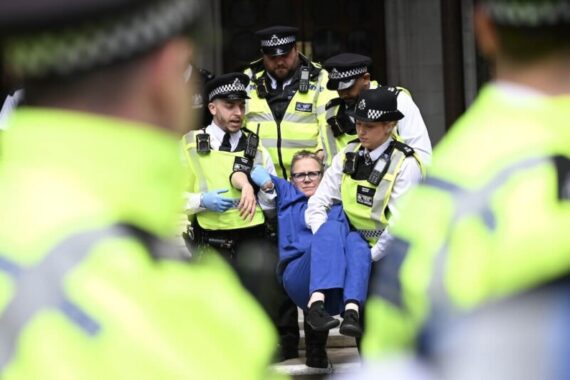
Metropolitan Police officers detain a pro-Palestine demonstrator outside the Royal Courts of Justice in London, United Kingdom on June 15, 2026. A protest was staged following the UK Court of Appeal's decision to uphold the government's ruling to designate the activist group Palestine Action as a terrorist organization, leading to police intervention and multiple arrests. Photo by Anadolu Images.

B

ritain’s Court of Appeal has ruled that the government’s decision to ban the pro-Palestinian protest group Palestine Action as “a terrorist organization” was lawful, marking a major victory for the government and a significant setback for campaigners who argue the move threatens free speech and the right to protest.

In a judgment delivered on Monday, Chief Justice Dame Sue Carr rejected the group’s claim that it was primarily engaged in non-violent civil disobedience, concluding instead that its activities involved organized and deliberate acts of property destruction targeting military facilities and defense companies.

The ruling overturns a February decision by the High Court, which had found that although some of Palestine Action’s activities involved criminal conduct, the scale and nature of its actions did not justify designation under Britain’s terrorism legislation.

The government appealed that decision, and the ban remained in force while the legal challenge proceeded.

Court rejects non-violence argument

Delivering the judgment, Carr said the court found significant flaws in Palestine Action’s argument that it should be viewed as a peaceful protest movement.

“In our judgment, that premise was seriously flawed,” she said. “It was not a sustainable proposition to portray Palestine Action as a non-violent organization.”

The court concluded that the organization operated through covert networks that carried out coordinated attacks on defense contractors and military sites, causing substantial property damage and disruption.

Government lawyers argued that the group’s activities went beyond legitimate protest and amounted to actions that threatened national security and public safety.

The ruling effectively places Palestine Action in the same legal category as proscribed organizations such as Al-Qaeda and Hamas under British law.

Membership of, or support for, a proscribed organization is a criminal offense in the United Kingdom and can carry a prison sentence of up to 14 years.

Group vows further legal challenge

Following the judgment, Palestine Action co-founder Huda Ammori said the organization would continue its legal battle.

“We will fight proscription all the way,” Ammori said, pledging to challenge the ruling before the UK’s Supreme Court and, if necessary, the European Court of Human Rights.

She described the ban as “one of the most extreme attacks on free speech and the right to protest in modern British history.”

Supporters of the group argue that Palestine Action’s activities are a form of direct action aimed at disrupting companies linked to Israel’s military operations in Gaza rather than acts of terrorism.

Civil liberties organizations have also criticized the government’s approach, warning that the designation could set a precedent for treating political protest movements as terrorist organizations.

Origins of the ban

The British government moved to outlaw Palestine Action following a high-profile incident in June 2025 when activists entered a Royal Air Force base to protest Britain’s support for Israel’s genocide in Gaza.

The action followed a series of demonstrations and acts of vandalism directed at defense facilities, particularly sites connected to Israeli weapons manufacturer Elbit Systems and its British subsidiaries.

Officials have said the group’s operations have caused millions of pounds in damage and disrupted facilities considered important to national security.

Palestine Action was established in 2020 and has become known for direct-action campaigns involving occupations, blockades, and damage to property associated with defense and security industries.

Government ministers argued that the cumulative impact of those actions justified proscription under terrorism legislation.

Mass arrests spark free speech debate

The ban has generated widespread controversy across Britain, particularly because of the number of arrests linked to demonstrations supporting the group.

According to campaign organizations, more than 3,300 people have been arrested while participating in protests or displaying signs expressing support for Palestine Action.

More than 700 individuals have reportedly been charged under the UK’s Terrorism Act, though no convictions for support-related offenses have yet been secured.

Many protesters have carried placards reading: “I oppose genocide. I support Palestine Action.”

Supporters argue that such statements represent political expression protected under democratic principles rather than support for terrorism.

The campaign group Defend Our Juries criticized Monday’s ruling, saying it would likely result in additional arrests of peaceful demonstrators.

“It appears the courts have been instrumentalized to suppress opposition to genocide, when they should be doing the precise opposite,” the organization said in a statement.


Recent convictions

The legal scrutiny surrounding Palestine Action intensified further last week when four members of the organization were sentenced to prison for their involvement in an attack on an Elbit factory in Bristol in 2024.

The activists broke into the facility and damaged equipment during a protest action targeting the company’s role in supplying military technology.

During sentencing, the judge concluded that their actions constituted terrorism-related offenses.

The decision drew protests outside the court, where more than 100 Palestine Action supporters were arrested while demonstrating against the convictions.

The case has become a focal point in the broader debate over where authorities should draw the line between political protest, civil disobedience, and criminal activity.

Wider political implications

Monday’s judgment is likely to intensify an already heated national debate over civil liberties, national security, and the limits of protest.

Supporters of the government’s position argue that coordinated attacks on military infrastructure and defense companies cannot be treated as ordinary activism and that proscription is necessary to protect public safety and national interests.

Critics, however, contend that terrorism legislation is being applied too broadly and risks criminalizing political dissent.

The Court of Appeal’s decision ensures that Palestine Action remains a banned organization for now, but further appeals could keep the issue in the courts for months or even years.

As legal challenges continue, the case is expected to remain one of the most contentious disputes in Britain over the balance between security measures and democratic freedoms.

(Source: CNN)

Politics Today is dedicated to publishing insightful analyses in order to understand the changing nature of contemporary politics. It aims to contribute to the sound and constructive discussion of international affairs.