T
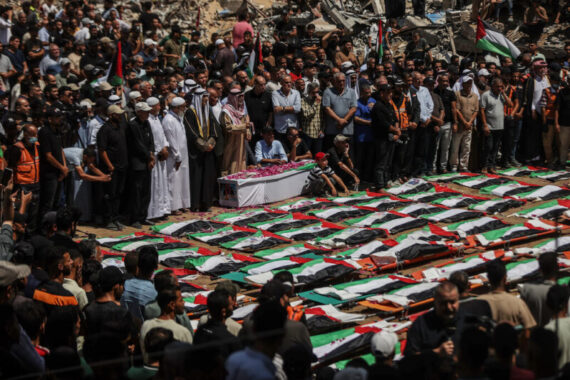
housands of Palestinians gathered in Gaza City on Tuesday for one of the largest mass funerals since the start of the genocide, mourning 112 members of the Abu Shreia and al-Hassaina families whose remains were recovered from beneath the rubble nearly three years after an Israeli airstrike destroyed their homes.
The funeral, held in the Sabra neighborhood, marked the first time many relatives had been able to bury their loved ones since the attack in November 2023, when entire extended families were killed and buried under collapsed buildings.
Rows of white body bags containing the recovered remains were carried through the streets as mourners wept, prayed and scattered flowers from balconies overlooking the funeral procession. The ceremony brought together thousands of relatives, neighbors and residents, many of whom said the burial reopened wounds that had never healed.
For 39-year-old Lara Abu Shreia, the funeral was the painful conclusion of nearly three years of waiting.
“Today felt like the first day I lost them,” she said. “It was a renewed grief, saying goodbye to them this way.”
The November 22, 2023 strike destroyed her family’s residential compound in Sabra while she, her husband and their five children had already been displaced to southern Gaza following Israeli evacuation orders issued at the start of the genocide.
Fourteen of her closest relatives were killed, including her mother, Nawal, eight siblings and several nieces and nephews.
“My family disappeared almost in one moment,” she said.
Everyone was trapped under the rubble
While displaced in southern Gaza, Lara remained in regular contact with one of her sisters whenever communications allowed. On the night the attack occurred, she learned that airstrikes had hit Sabra but initially hoped the silence from her family was due to communication outages that frequently affected Gaza during the genocide.
Instead, her husband received the devastating news that the family compound had been destroyed and everyone inside was trapped beneath the rubble.
For months, Lara struggled to accept the loss.
When she returned to northern Gaza after the fighting eased, she visited the destroyed home, hoping against all odds that someone had survived.
“I kept telling myself maybe they were playing a trick on me. Maybe someone was hiding,” she recalled. “Maybe I will find someone we didn’t know about.”
Instead, she found only ruins.
In recent weeks, Palestinian Civil Defense teams began extensive recovery operations at the site, eventually retrieving 112 sets of remains from buildings where officials believe 153 people had been buried.
The operation was among the largest recovery missions conducted since the war began.
Mahmoud Basal, spokesperson for Gaza’s Civil Defense, described the funeral as unprecedented.
“Today, 112 martyrs are being buried in one funeral for the first time in the history of the Palestinian cause,” he said.
8,000 bodies remain under the rubble in Gaza
According to Civil Defense estimates, more than 8,000 bodies remain trapped beneath collapsed buildings across Gaza.
Recovery efforts have been hampered by extensive destruction, damaged infrastructure and a shortage of heavy equipment needed to clear debris safely.
“We need the capabilities and equipment to enter Gaza so Civil Defense teams can carry out this humanitarian mission,” Basal said.
He added that in many cases identifying victims has become increasingly difficult after years beneath the rubble.
“Some bodies have disappeared. Some have evaporated. Some have been scattered into very small pieces, making identification extremely difficult,” he said.
For Lara, witnessing the recovery process became a personal necessity despite relatives urging her to stay away.
“I told them, ‘I want to see. Even if it is just a bone, I want to see something from them,'” she said.
Another relative, 50-year-old Ali Abu Shreia, also lost two brothers and their entire families in the attack.
He said the strikes unfolded rapidly as relatives moved between houses in search of safety before gathering in the home of Mufeed al-Hassaina, a former Palestinian minister of public works and housing.
“They thought they would be safe, but the war machine did not distinguish between civilians, homes or families,” he said.
Ali described the victims as ordinary civilians with no military role.
“They were business owners, traders, people active in their community,” he said. “Seven families were completely erased from the civil registry.”
The funeral highlighted the enduring humanitarian consequences of the war, which has left thousands of people officially listed as missing because their remains have never been recovered.

Recommended
More families on the waiting list
Families across Gaza continue to wait for excavation teams to reach destroyed neighborhoods where relatives are believed to remain buried.
Civil Defense officials say the search continues across multiple locations, although limited equipment means many recovery operations progress slowly.
Tuesday’s ceremony brought together grieving families who had lived for years without graves to visit or funerals to attend.
As the procession wound through Sabra, elderly relatives, parents and children walked behind the rows of white body bags, many overcome with emotion after years of uncertainty.
Women standing on balconies overlooking the funeral scattered flower petals onto the procession below while prayers echoed through the neighborhood.
For Lara, however, the burial offered little sense of closure.
Instead, it marked the beginning of another chapter of grief.
“I wanted to hug the bag,” she said quietly. “I wanted to hug whatever remained of them.”
(Source: Aljazeera English)