Ukraine Unveils 20-Point Peace Framework in Talks with United States

December 24, 2025

The plan also envisions Ukraine joining the European Union on a defined timeline, gaining short-term preferential access to EU markets, and receiving a global development package aimed at long-term economic recovery.
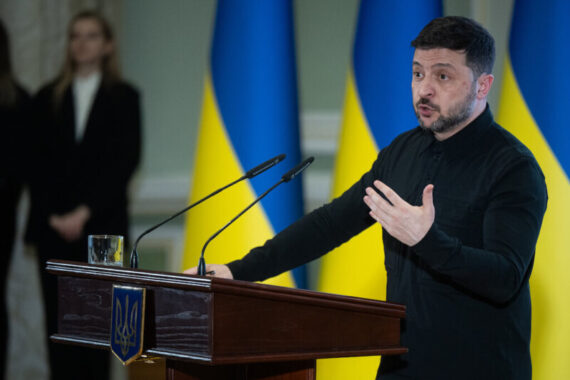
President of Ukraine Volodymyr Zelenskyy gives a speech during the event at the National Diplomatic Academy on the occasion of the Day of the Worker of Diplomatic Service in Kyiv, Ukraine on an December 22, 2025. Photo by Anadolu Images.

U

krainian President Volodymyr Zelenskiy has for the first time publicly outlined a 20-point draft peace framework being discussed with the United States, describing it as a potential foundation for ending the war with Russia.

Speaking after weeks of negotiations to revise an earlier 28-point proposal, Zelenskiy said Ukraine and Washington had significantly narrowed their differences. However, he confirmed that no agreement has yet been reached on two key issues: territorial control and the future of the Russian-held Zaporizhzhia nuclear power plant. Zelenskiy said further discussions with U.S. President Donald Trump would be necessary to resolve those matters.

The proposal reaffirms Ukraine’s sovereignty and calls for a comprehensive non-aggression agreement between Kyiv and Moscow, supported by space-based monitoring systems to oversee ceasefire lines and detect violations.

Security guarantees, reconstruction and EU membership

Under the framework, Ukraine would retain its current armed forces strength of around 800,000 personnel and receive security guarantees from the United States, NATO and European countries comparable to NATO’s Article 5 collective defense clause.

The plan also envisions Ukraine joining the European Union on a defined timeline, gaining short-term preferential access to EU markets, and receiving a global development package aimed at long-term economic recovery. Several reconstruction and humanitarian funds would be established with the goal of mobilizing up to $800 billion.

Ukraine would remain a non-nuclear state, while Russia would be required to formalize a policy of non-aggression toward Ukraine and Europe through binding domestic legislation.

Territorial issues remain the most contentious element. Kyiv supports halting fighting along current battle lines, while Russia demands Ukrainian withdrawal from parts of eastern Donetsk. The United States has proposed demilitarized zones and a free economic area in contested regions.

The proposal also includes provisions for full prisoner exchanges, the return of civilian detainees and children, freedom of navigation in the Black Sea and Dnipro River, post-war elections in Ukraine, and a legally binding enforcement mechanism overseen by a Peace Council chaired by President Trump.

A full ceasefire would take effect immediately once all parties approve the agreement.

(Source: Reuters)

Politics Today is dedicated to publishing insightful analyses in order to understand the changing nature of contemporary politics. It aims to contribute to the sound and constructive discussion of international affairs.