UK’s Starmer and Israel’s Herzog Clash in ‘Tough’ London Meeting
Israel's Herzog described the Downing Street meeting with UK's Starmer as “tough and strong,” adding that allies must be willing to argue.
September 11, 2025
B
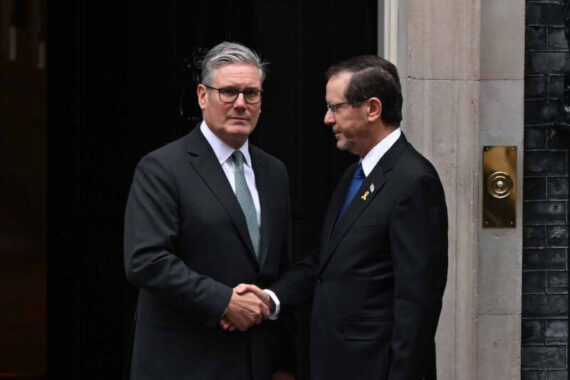
ritish Prime Minister Keir Starmer and Israeli President Isaac Herzog openly clashed during a tense meeting at Downing Street on Wednesday, laying bare deep divisions between the two allies over Gaza, Palestinian statehood, and Israel’s recent strike in Qatar.
The talks came just a day after Israel escalated its regional war by targeting Hamas’s political leadership in Doha, a move Starmer condemned as “completely unacceptable” and “a flagrant violation of a key partner’s sovereignty.”
Herzog later described the Downing Street meeting as “tough and strong,” adding that allies must be willing to argue. “Things were said that were tough and strong, and clearly we can argue, because when allies meet, they can argue. We are both democracies,” he told an audience at Chatham House following the meeting.
Tensions have been sharpened by Britain’s announcement that it will join France, Canada, and other Western nations in recognizing a Palestinian state later this month unless Israel agrees to key conditions, including a ceasefire in Gaza and greater humanitarian access.
Herzog said the prospect of British recognition of Palestinian statehood, along with Starmer’s criticisms of Israel’s handling of aid, formed the core of the disagreement. He invited London to send a fact-finding mission to Israel.
Starmer’s office confirmed he pressed Herzog to change course on Gaza, warning that Israel’s military operations were worsening the humanitarian catastrophe. He urged Israel to allow in more aid, halt offensive operations, and work toward a durable peace.
The meeting began with a brief handshake outside 10 Downing Street, notable for the absence of smiles or warmth between the two men. Inside, Starmer reiterated Britain’s commitment to Israel’s security but emphasized that only diplomacy could pave the way to peace.
“He said the strikes were a flagrant violation of a key partner’s sovereignty and do nothing to secure the peace we all desperately want to see,” a Downing Street spokesperson said, referring to the Qatar airstrike.
The Gaza war has strained Israel’s ties with Britain and other European nations. This week, the UK blocked Israeli officials from attending its largest defense trade show, signaling growing frustration in London over Israel’s conduct of the war.
Starmer is also under pressure at home. Activists and lawmakers within his Labour Party have demanded a tougher line on Israel. Health Minister Wes Streeting warned that Israel’s actions in Gaza were pushing it toward “pariah status.”
Starmer, however, defended his approach in parliament, insisting that diplomacy remained essential to securing a ceasefire and winning the release of Israeli hostages held by Hamas. “I will not give up on diplomacy,” he said, dismissing calls for symbolic gestures as “the politics of students.”
Recommended
The meeting with Herzog followed Starmer’s talks earlier this week with Palestinian Authority President Mahmoud Abbas, in which both leaders agreed there would be “absolutely no role” for Hamas in governing a future Palestinian state.
Britain has pledged to recognize Palestinian statehood ahead of the upcoming U.N. General Assembly, unless Israel fulfills four conditions: ending the war in Gaza, halting settlement expansion, allowing humanitarian aid, and committing to serious peace negotiations.
Herzog, whose role is largely ceremonial but whose comments carry political weight, has angered critics in the past, including when he declared that “all residents of Gaza” bore responsibility for the October 7, 2023, Hamas-led attacks on Israel.
For Starmer, the clash with Herzog underscored a delicate balancing act: maintaining Britain’s historic ties with Israel while responding to growing domestic and international pressure to recognize Palestinian rights and call out Israel’s genocide in Gaza.
(Source: Reuters)

Politics Today is dedicated to publishing insightful analyses in order to understand the changing nature of contemporary politics. It aims to contribute to the sound and constructive discussion of international affairs.
You can see how this popup was set up in our step-by-step guide: https://wppopupmaker.com/guides/auto-opening-announcement-popups/

Stay informed by subscribing to
our weekly newsletter.
You can see how this popup was set up in our step-by-step guide: https://wppopupmaker.com/guides/auto-opening-announcement-popups/
You can see how this popup was set up in our step-by-step guide: https://wppopupmaker.com/guides/auto-opening-announcement-popups/
You can see how this popup was set up in our step-by-step guide: https://wppopupmaker.com/guides/auto-opening-announcement-popups/
You can see how this popup was set up in our step-by-step guide: https://wppopupmaker.com/guides/auto-opening-announcement-popups/