Universities Become New Frontline in the US-Israel War Against Iran

April 1, 2026

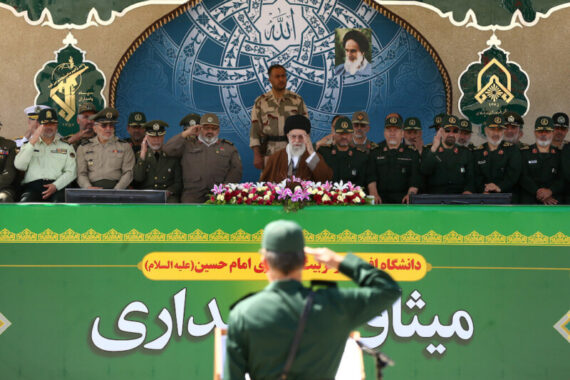
Israel argued that some university facilities—such as Tehran’s Imam Hossein University—were linked to military activities, including weapons development associated with Iran’s Islamic Revolutionary Guard Corps (IRGC).
Late Supreme Leader Ayatollah Ali Khamenei (C) speaks during a graduation ceremony at Imam Hossein University in Tehran, Iran. Photo by Anadolu Images.

A

widening war between the United States, Israel, and Iran is increasingly spilling into the academic sphere, with universities emerging as unexpected targets in recent days. Iranian officials say at least 21 universities have been damaged since the war began, raising alarm over the safety of educational institutions traditionally considered civilian spaces.

One of the most notable incidents involved the Iran University of Science and Technology in Tehran, where videos verified by CNN show research facilities reduced to rubble. Footage captured before dawn on Saturday revealed collapsed structures, scattered debris, and nearby buildings engulfed in flames. Despite the scale of destruction, university authorities reported no casualties.

Founded in 1929, the institution has long been a cornerstone of Iran’s engineering education. University officials condemned the strikes, calling them violations of international law and warning of the broader implications for academic life and scientific progress.

Legal and military justifications debated

The targeting of universities has sparked debate among legal experts and security analysts. According to Janina Dill, a professor at the University of Oxford, universities are generally protected under international law as civilian infrastructure.

However, she noted that such sites could become legitimate military targets if used for purposes like weapons storage or operational planning. Israel has argued precisely this point, stating that some university facilities—such as Tehran’s Imam Hossein University—were linked to military activities, including weapons development associated with Iran’s Islamic Revolutionary Guard Corps (IRGC).

Israeli Prime Minister Benjamin Netanyahu has also framed the broader campaign as an effort to weaken Iran’s nuclear capabilities, claiming that several nuclear scientists have been killed in the strikes.

Iranian academic leaders reject this justification. Manouchehr Moradi, a senior official at the University of Tehran, described universities as “homes of thought and dialogue,” arguing that attacks on them undermine both national development and human dignity.


Regional fallout and threats to global campuses

The escalation has not been contained within Iran’s borders. Iranian officials and the IRGC have warned that US- and Israeli-linked universities across the Middle East could be targeted in retaliation.

These threats have already disrupted higher education in several countries. Institutions such as the American University of Beirut and the Lebanese American University have temporarily shifted to remote learning. In Qatar, all universities—including campuses affiliated with Georgetown University, Texas A&M University, and Virginia Commonwealth University—remain online following government directives issued at the start of the war.

At Northwestern University’s Qatar campus, administrators have restricted access to facilities as a precaution, citing growing security concerns.

Analysts warn that any direct Iranian attack on foreign academic institutions could significantly damage its international standing. Still, the pattern of escalation suggests a calculated strategy—responding proportionally while leaving room for de-escalation.

Education disrupted as war deepens

Inside Iran, the war has already transformed academic life. Universities are preparing to begin the new term entirely online, reflecting both security risks and uncertainty about further strikes.

For many civilians, the attacks have also raised troubling questions. With campuses largely empty, some residents are wondering why they were targeted at all—fueling speculation about possible military uses and deepening public anxiety.

As the war intensifies, the involvement of universities underscores a broader shift: spaces once seen as neutral grounds for knowledge and exchange are increasingly being drawn into the logic of war.

(Source: CNN)

Politics Today is dedicated to publishing insightful analyses in order to understand the changing nature of contemporary politics. It aims to contribute to the sound and constructive discussion of international affairs.