US Declines to Extend North American Trade Deal, Opening Path for Renegotiation

July 2, 2026

Mexico has resisted U.S. proposals requiring North American-built vehicles to contain 50% U.S.-made components, a measure that would increase the overall regional content requirement to 82%.
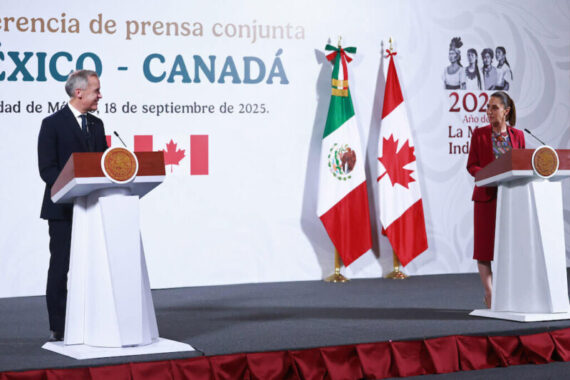
Prime Minister of Canada Mark Carney (L) and Mexican President Claudia Sheinbaum attend a joint press conference, at the National Palace, in Mexico City, Mexico on September 18, 2025. According to the Canadian Government, the visit aims to elevate and broaden the bilateral relationship, with a focus on security, infrastructure, investment, energy, and trade. Photo by Anadolu Images.

T

he United States has declined to extend the U.S.-Mexico-Canada Agreement (USMCA) in its current form, triggering a 10-year countdown toward the trade pact’s expiration while opening negotiations aimed at reshaping North America’s trading relationship.

The decision, announced Wednesday following the agreement’s first six-year review, keeps the USMCA in force until 2036 but subjects it to annual reviews unless the three member countries agree to renew and amend the pact.

The move reflects the Trump administration’s push to bring more manufacturing back to the United States, reduce trade deficits with Canada and Mexico, and tighten rules designed to limit China’s access to North American supply chains.

“The United States did not agree to renew the USMCA in its current form,” U.S. Trade Representative Jamieson Greersaid in a statement.

“As a result, the USMCA is not renewed. The United States will continue to engage with Mexico and Canada to address the agreement’s shortcomings and our trade deficits with these countries.”

The agreement, negotiated during President Donald Trump’s first administration and implemented in 2020, replaced the 1994 North American Free Trade Agreement (NAFTA). It governs approximately $1.6 trillion in annual trade among the three countries and underpins one of the world’s most integrated manufacturing and supply chains.

Although the decision does not immediately alter tariff-free trade across North America, it formally launches negotiations over revisions that Washington says are necessary to strengthen domestic manufacturing and improve economic security.

A senior U.S. administration official said bilateral negotiations with Mexico are scheduled to resume during the week of July 20 in Mexico City. The talks will focus on strengthening regional rules of origin for automobiles and other industrial products while preventing countries such as China from benefiting indirectly from preferential North American trade access.

The United States argues that stricter local-content requirements would encourage manufacturers to relocate more production and supply chains to the United States.


Mexico and Canada seek compromise amid industry concerns

Mexican Economy Minister Marcelo Ebrard acknowledged that negotiations remain divided over Washington’s demands for stricter automotive content rules but expressed confidence that a compromise remains achievable.

“There is no difference that I can identify between Mexico, the United States and Canada that is so big that we cannot resolve it,” Ebrard said after holding virtual discussions with Greer and Canadian trade minister Dominic LeBlanc.

Mexico has resisted U.S. proposals requiring North American-built vehicles to contain 50% U.S.-made components, a measure that would increase the overall regional content requirement to 82%.

“We wouldn’t allow our industry to be at a disadvantage,” Ebrard said, describing protection of Mexico’s automotive sector as the central issue in ongoing negotiations.

LeBlanc said Canada would continue discussions with Washington while seeking the removal of U.S. tariffs on Canadian steel, aluminum, automobiles and lumber.

The Trump administration has argued that additional time is needed to address persistent U.S. trade imbalances, noting that America’s goods trade deficit reached $197 billion with Mexico and $48.3 billion with Canada in 2025.

Officials acknowledge that much of the Canadian deficit reflects U.S. energy imports, while the growing deficit with Mexico has been driven partly by manufacturers relocating supply chains from China to Mexico in response to U.S. tariffs on Chinese goods.

Although Washington hopes to negotiate revised trade protocols with both neighbors, officials indicated President Trump remains skeptical about the long-term benefits of the agreement despite having negotiated it during his first term.

Trump has repeatedly argued that the United States would perform better economically without the USMCA, even while calling it “the best agreement we’ve ever made” when it entered into force.

Undermining North America’s competitiveness

Business groups across North America have urged governments to preserve the agreement’s tariff-free framework, warning that greater restrictions could undermine the region’s competitiveness against manufacturers in Asia and Europe.

Ivan Espinosa, chief executive of Nissan, warned that requiring substantially higher U.S. content in vehicles could worsen affordability for American consumers.

“You cannot build all the parts in the U.S. The supply chain is not set up to do that,” Espinosa told Reuters. “We need something that is actually executable.”

Agricultural organizations have also urged negotiators to preserve the agreement, noting that Canada and Mexico together purchase more than one-third of U.S. agricultural exports.

Bryan Goodman, spokesperson for the Agricultural Coalition for USMCA, said the agreement remains vital for farmers, ranchers and rural communities that depend on integrated North American markets.

The coming negotiations are expected to determine whether the three countries can modernize the agreement while preserving the free trade framework that has shaped North American commerce for more than three decades.

(Source: Reuters)

Politics Today is dedicated to publishing insightful analyses in order to understand the changing nature of contemporary politics. It aims to contribute to the sound and constructive discussion of international affairs.