V
enezuela’s devastating twin earthquakes have rapidly evolved from a humanitarian catastrophe into the most serious political challenge facing interim President Delcy Rodriguez, as criticism mounts over the government’s handling of rescue efforts and long-standing weaknesses in the country’s emergency response system.
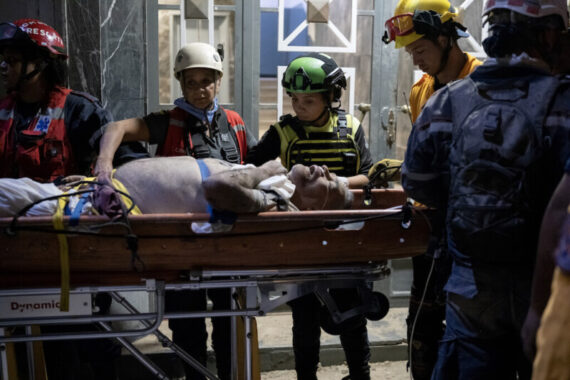
The twin earthquakes, which struck on June 24, have killed nearly 1,500 people, left tens of thousands missing and caused widespread destruction across parts of the country, particularly in the coastal state of La Guaira and the capital Caracas. Thousands remain displaced as emergency workers and volunteers continue searching through collapsed buildings for survivors.
While the initial public reaction focused on grief and shock, frustration has increasingly been directed at the government’s response, with residents, aid workers and analysts accusing authorities of reacting too slowly to one of the country’s worst natural disasters in decades.
For Rodriguez, who assumed the presidency following the removal of former President Nicolas Maduro earlier this year, the crisis represents the first major test of her administration.
In the immediate aftermath of the earthquakes, Rodriguez declared a national state of emergency, expressed condolences to victims’ families and appealed for international assistance.
However, critics argue that official rescue operations have failed to keep pace with the scale of destruction.
Residents from some of the worst-affected communities say they have relied largely on neighbors and volunteers rather than government emergency teams to search for trapped victims.
Mairet Perez, travelling from the Colombian border carrying relief supplies for relatives in La Guaira, described communities digging through rubble with little official assistance.
“Everyone in La Guaira is searching and digging out people with their bare hands,” she said. “And the government? What have they done? Nothing.”
She said some neighborhoods had still not been reached by government rescue teams days after the disaster.
The criticism has been echoed by political analysts who argue that years of economic decline, institutional weakness and underinvestment have left Venezuela poorly equipped to respond to a major emergency.
Phil Gunson, a senior analyst at the International Crisis Group, said the country’s emergency response capacity had deteriorated significantly over the past decade.
“The government response is anything from totally non-existent to, at best, completely inadequate,” Gunson said.
According to analysts, years of economic crisis, corruption, sanctions and declining public investment have weakened hospitals, emergency services, water systems and electricity networks, limiting the state’s ability to mount an effective disaster response.

International aid fills critical gaps
As domestic rescue efforts struggled, international assistance quickly became essential.
More than 20 foreign search-and-rescue teams have arrived in Venezuela, including personnel from the United States, Spain, Qatar and several Latin American countries.
The United States has deployed military aircraft carrying humanitarian supplies, medical equipment and specialist rescue personnel, while foreign governments have pledged additional financial and technical assistance.
Nevertheless, observers argue that the influx of international aid has also highlighted shortcomings within Venezuela’s own institutions.
Reports have emerged of delays affecting foreign rescue teams entering the country. Colombian firefighters were reportedly held for several hours at Caracas airport before receiving permission to proceed to affected areas.
Authorities have also restricted access to several disaster zones, requiring journalists and humanitarian organizations to receive official authorization before entering.
In some communities, frustrated residents reportedly broke through security cordons in an effort to begin rescue operations themselves.
Social media has also amplified criticism, with videos showing volunteers using basic tools to search collapsed buildings while appealing for additional equipment such as helmets, excavators and medical supplies.
The relative absence of Venezuela’s military from front-line rescue operations has drawn particular attention.
Civil society organizations noted that while soldiers have largely been deployed to regulate access into affected areas, many citizens expected a larger military role in search-and-rescue operations.
Some Venezuelans contrasted the limited deployment with the heavy military presence witnessed during political protests following the disputed 2024 presidential election.
Aid organizations also warn that previous legal restrictions imposed on nongovernmental organizations continue to complicate relief operations, as many community groups were weakened or forced to suspend activities in recent years.
Recommended
Political consequences may extend beyond the disaster
Beyond the immediate humanitarian crisis, analysts believe the earthquakes could reshape Venezuela’s political landscape.
Rodriguez inherited power only six months ago after Maduro’s removal during a US-backed operation that dramatically altered the country’s political trajectory.
Although her administration has sought closer cooperation with Washington and international partners, Rodriguez remains a divisive figure because of her long association with the ruling United Socialist Party of Venezuela (PSUV) and her previous role as Maduro’s deputy.
Political scientist Javier Corrales of Amherst College said many Venezuelans continue to associate Rodriguez with the country’s prolonged economic collapse and institutional decline.
“She is seen as part of the problem,” Corrales said, noting that even some within the ruling party question her political direction following closer cooperation with the United States.
The earthquakes have also renewed scrutiny of Venezuela’s infrastructure.
Civil engineers note that although seismic building regulations were strengthened following the devastating 1967 Caracas earthquake, enforcement has often been inconsistent.
Experts argue that weak inspections, poor urban planning and substandard construction practices contributed to the collapse of numerous residential buildings during last week’s disaster.
Gunson also suggested that large-scale public housing programs developed under the governments of Hugo Chavez and Nicolas Maduro may have left thousands living in buildings constructed below acceptable engineering standards.
For many survivors, the disaster has reopened wounds from previous natural disasters, with some families once again losing homes rebuilt after earlier floods and landslides.
Despite growing criticism, Rodriguez has continued touring affected communities while promising that reconstruction will begin as quickly as possible.
Her administration insists emergency operations remain ongoing and has pledged to coordinate reconstruction efforts alongside international partners.
Analysts caution that the political consequences of the disaster remain uncertain.
Natural disasters have historically transformed political fortunes, either strengthening governments that respond effectively or accelerating public dissatisfaction where responses are viewed as inadequate.
Some experts believe the influx of international aid could provide Rodriguez with an opportunity to demonstrate competent leadership if reconstruction proceeds transparently and efficiently.
Others warn that any perception of corruption, political favoritism or poor management could deepen existing public distrust.
For now, rescue workers continue searching through damaged neighborhoods as families await news of missing relatives.
While the immediate priority remains saving lives and assisting survivors, the earthquakes have also exposed the structural weaknesses that have accumulated over years of political and economic turmoil—weaknesses that now present Rodriguez with the defining challenge of her presidency.
(Source: Aljazeera English)