Washington Eyes Maduro Ouster as Military Presence Grows

November 24, 2025

The Trump administration plans on Monday to designate the cartel as a foreign terrorist organization, a move Defense Secretary Pete Hegseth said “brings a whole bunch of new options to the United States.”
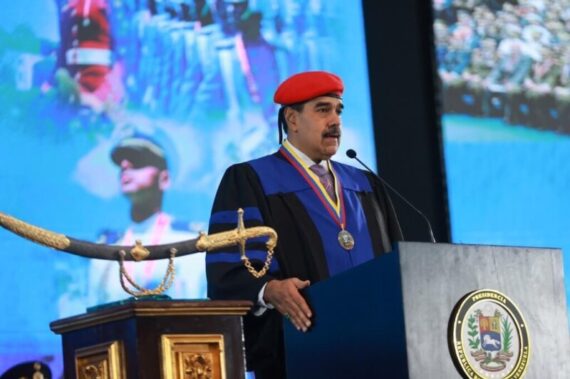
President Nicolas Maduro was awarded an honorary doctorate in National Security by the Armed Forces (FANB) on October 01, 2025 in Caracas, Venezuela. Photo by Anadolu Images.

T

he United States is preparing to launch a new phase of Venezuela-related operations in the coming days, escalating efforts to weaken President Nicolas Maduro’s grip on power amid a widening military buildup in the Caribbean, four U.S. officials told Reuters.

The officials, who spoke on condition of anonymity due to the sensitivity of the plans, said covert operations are expected to form the initial wave of action. They emphasized that the timing and contours of the operation remained fluid and that it was unclear whether President Donald Trump had issued a final order.

Still, the discussions mark the sharpest turn yet in Washington’s pressure campaign against Maduro, who has ruled the crisis-stricken country since 2013 and accuses the U.S. of seeking to overthrow him.

A senior administration official declined to detail the plan but did not rule out any option. “President Trump is prepared to use every element of American power to stop drugs from flooding into our country and to bring those responsible to justice,” the official said.

Covert action expected as first step

Two officials said covert CIA-led operations—already authorized in Venezuela—would likely form the first phase of the new effort. The CIA declined to comment.

The potential scope of U.S. options reflects the administration’s growing assertion that Maduro and key Venezuelan military figures oversee the Cartel de los Soles, which Washington accuses of trafficking cocaine into the United States. Maduro denies any involvement, calling the allegations fabricated.

The Trump administration plans on Monday to designate the cartel as a foreign terrorist organization, a move Defense Secretary Pete Hegseth said “brings a whole bunch of new options to the United States.” Trump has said the designation could justify targeting Venezuelan infrastructure and financial assets.

Military buildup raises regional concerns

The posture comes against the backdrop of a substantial U.S. military buildup near Venezuela. The Navy’s largest aircraft carrier, the Gerald R. Ford, arrived in the Caribbean on November 16 with its strike group, joining at least seven warships, a nuclear submarine and F-35 aircraft.

Officially, U.S. forces have been conducting counter-narcotics missions. Yet the scale of the deployment has alarmed regional governments and human rights monitors, who argue the assembled firepower goes far beyond what such operations require.

Since September, U.S. forces have carried out at least 21 strikes on alleged drug-smuggling vessels in the Caribbean and Pacific, killing at least 83 people. Human rights groups have condemned the attacks as extrajudicial killings, and some U.S. allies have privately expressed concern about possible violations of international law.

The FAA on Friday warned airlines of a “potentially hazardous situation” in Venezuelan airspace, prompting three international carriers to cancel flights from the country on Saturday.


Maduro digs in as Washington weighs options

Maduro has dismissed U.S. claims of drug trafficking and insists Venezuela will resist any attempt to remove him. Government-aligned media have recently broadcast segments discussing “prolonged resistance,” a guerrilla-style military strategy that would rely on dispersed units carrying out sabotage operations.

Venezuela’s armed forces, once one of Latin America’s better-equipped militaries, have deteriorated after years of economic collapse. Reports suggest some unit commanders have had to negotiate directly with farmers for food supplies due to shortages.

Still, analysts warn that any attempt by Washington to forcibly oust Maduro risks setting off a prolonged conflict. Despite low approval ratings and economic devastation, Maduro retains the loyalty of the upper military ranks and key armed civilian groups.

Diplomatic contacts continue, but uncertainty persists

Two U.S. officials acknowledged that informal channels of communication between Caracas and Washington remain active. It was unclear, however, whether those exchanges could influence the timing or scope of forthcoming U.S. operations.

Even as tensions escalate, Maduro appeared relaxed Saturday night, attending the premiere of a television series about his life at a Caracas theater. He turns 63 on Sunday.

The U.S. has offered a $50 million reward for information leading to Maduro’s arrest—double the bounty announced in August.

With forces massing offshore and covert operations reportedly already underway, the coming days may determine whether Washington pushes ahead with its most aggressive campaign yet to reshape Venezuela’s political future.

(Source: Reuters)

Politics Today is dedicated to publishing insightful analyses in order to understand the changing nature of contemporary politics. It aims to contribute to the sound and constructive discussion of international affairs.