F
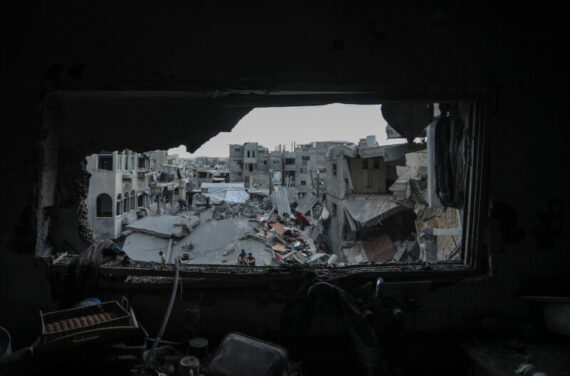
ollowing Operation Al-Aqsa Flood, the genocide carried out by the Israeli occupation army in Gaza caused destruction on an unprecedented scale. In the course of this campaign, in which all forms of life were indiscriminately targeted and destroyed, the environment suffered severe damage. The resulting devastation has not only made Gaza uninhabitable but has also undermined the longstanding discursive dominance of the Tel Aviv government and its image as an environmentally friendly state.
Furthermore, the environmental destruction in question has exposed the limitations of academic research on global environmental policies. Most importantly, the damage inflicted on Gaza’s water resources and agricultural land has demonstrated that the Zionist regime’s aggression has gone far beyond the bounds of disproportionality. Before examining these issues in detail, it is first necessary to consider the scale of the environmental destruction caused by the Zionist regime in Gaza.
The scale of environmental destruction
As a result of the genocide carried out by the occupation army, water resources have been contaminated and agricultural land has suffered extensive damage. Meanwhile, the destruction of water and sewage infrastructure has caused wastewater to seep into the sea, creating visible pollution along the coastline.
In addition, carbon monoxide emissions caused by intensive bombardment by the occupation air force, combined with the impact of massive rubble deposits, have turned the Gaza Strip into one of the areas experiencing the most severe air pollution. The Israeli occupation army has targeted water and agricultural infrastructure that directly affects human security in Gaza, where approximately 61 million tons of rubble have accumulated.
As a result, since October 7, the amount of water available per person per day in the territory has fluctuated between 4.5 and 6 liters. At the same time, diseases such as acute jaundice, bloody diarrhea, polio, cholera, and hepatitis A have become widespread because of water shortages and the consumption of salty water.
The Tel Aviv government’s targeting of agricultural land and livestock farms in Gaza has pushed food insecurity to its highest levels. As a result of the Zionist regime’s attacks, carried out under a policy of de-Palestinianization and depopulation of Gaza, approximately 90 percent of agricultural land, 80 percent of greenhouses, 90 percent of olive groves, and 85 percent of livestock farms have sustained severe damage.
These developments have not only created an environmental crisis in Gaza but have also increased the number of deaths and illnesses caused by hunger and thirst.
The limitations of academic research
A significant portion of research on global environmental policies examines whether environmental changes lead states toward cooperation or conflict. In this context, the Neo-Malthusian approach argues that environmental degradation around the world causes shortages of essential resources needed to sustain human life, particularly water and food, and emphasizes that such shortages can trigger armed conflicts and wars.
For this reason, global cooperation is necessary to prevent environmental problems, ensure food and water security, and manage resources more effectively.
However, the massacre and genocide in Gaza following Operation Al-Aqsa Flood have turned the central assumptions of the Neo-Malthusian perspective on their head. The Israeli occupation army’s genocidal policy of targeting all forms of life in Gaza has caused environmental destruction on a scale rarely seen anywhere in the world, in a territory covering just 365 square kilometers.
The devastation, resulting from a deliberate and systematic policy of destruction, has profoundly affected every key component of environmental security, including people, water, food, the economy, health, energy, and climate. Thus, contrary to Neo-Malthusian approaches suggesting that environmental degradation can cause armed conflict and war, the destruction in Gaza has demonstrated the extent to which an army can devastate the environment of an entire region.
The end of Tel Aviv’s environmentally friendly image
The global epistemological rupture caused by Operation Al-Aqsa Flood has shaken Tel Aviv’s environmentally friendly image and brought an end to the discursive dominance of its environmental narratives.
At this point, the narrative that has shaped the Zionist account of history and rests on the premise that Palestine was a land without a people has come under increasing scrutiny. This is the narrative that “Israel made the desert bloom.”
Frequently featured in history books with reference to founding Prime Minister David Ben-Gurion, these statements suggested, on the one hand, that Jews had settled in empty lands and, on the other, that Israel was an environmentally friendly state.
According to the image cultivated by the Tel Aviv government, Israel was also a leading country in the fight against environmental problems. Similarly, this perception portrayed Israel as one of the world’s foremost states in supporting nongovernmental organizations working on environmental issues, implementing green-space projects, expanding forested areas, and combating environmental problems.
The Jewish National Fund (JNF), which played an active role in the establishment of the state, had a significant impact on the consolidation of this perception and image. Indeed, the JNF’s official website showcased examples of green-space projects largely designed to erase the traces of Palestinians who had been forced to leave their homeland during the Nakba.
This longstanding Zionist narrative suffered a major blow after October 7, when the occupation army contaminated water resources, damaged agricultural land, and destroyed trees, particularly olive groves.
Recommended
A Shift in the occupation army’s strategic reflexes
Operation Al-Aqsa Flood also brought about a significant change in the strategic reflexes of the Zionist regime and the occupation army. Following October 7, the Tel Aviv government took the scale and intensity of its aggression to an entirely new level.
In this context, the Iron Wall doctrine, which had played an influential role in the establishment of the state, and the Dahiya doctrine, implemented during Israel’s 2006 war with Hezbollah, gave way during the genocide to a strategy that made no distinction between living and nonliving things. This new approach sought to destroy everything necessary to sustain life while laying waste to both the infrastructure and superstructure of the targeted region.
This new method, which frequently invokes religious texts, aims to depopulate targeted areas and make it impossible for any form of life to survive there. The environment has been among the areas most severely affected by this strategy.
Indeed, the contamination of water resources, the destruction of agricultural land, the degradation of marine ecosystems, and air pollution have meant the elimination of all the elements necessary to sustain human life.
This policy has not been confined to the Gaza Strip since October 7. Tel Aviv has demonstrated a similar approach by targeting olive groves and agricultural land in Lebanon.
Likewise, since December 8, 2024, Netanyahu and his cabinet have sought to destabilize Syria, damaging agricultural land and contaminating water resources in Quneitra in an effort to force the local population to leave the area.
In the occupied West Bank, the escalation of settler violence targeting olive groves and the growing aggression of the occupation army between July and November 2026 have provided another manifestation of the same approach.
In conclusion, as Tel Aviv has intensified its aggressive expansionist policies since October 7, it is reasonable to conclude that it will not abandon this strategy in its future campaigns of aggression.
(Originally published in Turkish by Kriter)