Democrats Sweep Congress in Midterm Rout as Trump Acknowledges Electoral Defeat
The incoming Democratic majorities are expected to investigate the administration, Trump's family and his political allies.
November 5, 2026
D
emocrats have secured control of both chambers of the U.S. Congress in a sweeping midterm victory, promising to use their newly won majorities to challenge President Donald Trump’s policies and hold his administration accountable, as Republican losses in traditionally conservative states signal a significant shift in the American political landscape.
The results set the stage for potentially two years of political confrontation between the White House and Congress, marking the first time during Trump’s presidency that Democrats will control both the House of Representatives and the Senate.
The Democratic gains were driven largely by voter frustration over rising living costs, the economic consequences of Trump’s tariffs and the unpopular war with Iran and Trump’s support for Israel. Republicans suffered major setbacks across the country, including in states that had strongly supported Trump in the 2024 presidential election.
Democrats gained at least 30 seats in the House and secured a Senate majority of at least 54-44, with races in Alaska and Mississippi still undecided. If both remaining contests go their way, their Senate majority could expand to 56-44.
The scale of the defeat prompted Trump to acknowledge that the war with Iran had contributed to his party’s losses, although he continued to defend his decision to launch the military campaign. His first public appearance after the election, however, focused largely on a tour of the construction site for a new ballroom at the White House rather than the political consequences of the Republican defeat.
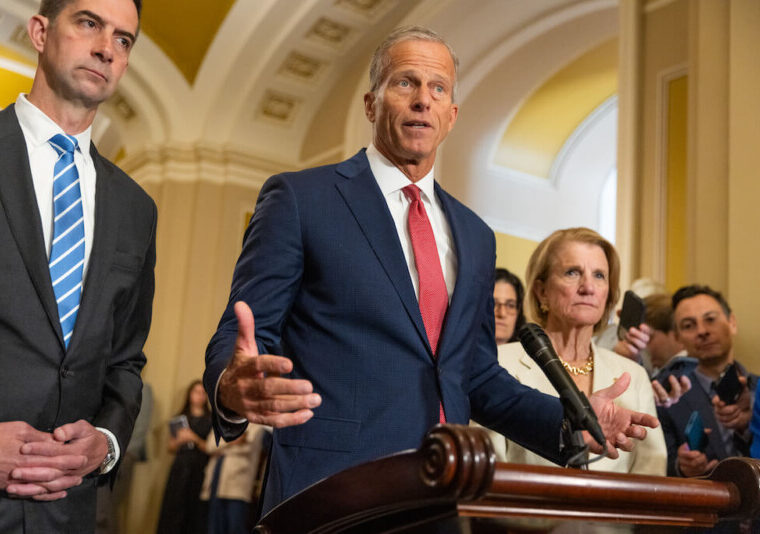
House Democratic Leader Hakeem Jeffries, who is expected to become the first Black speaker of the House, said the incoming majority would prioritize economic affordability and accountability.
Speaking to reporters on Wednesday, Jeffries declared that Democrats would no longer allow the House to operate as an extension of the Trump administration.
“We don’t work for Donald Trump. We work for the American people,” he said, adding that the days of the House of Representatives functioning as a wholly owned subsidiary of the administration were over.
New York City Mayor Zohran Mamdani, who has emerged as a prominent national figure within the Democratic Party since his election a year ago, also urged party leaders to translate their electoral victory into concrete improvements in people’s lives.
In a social media video, Mamdani called on Democrats to address the concerns of voters struggling with rising prices and demanding better schools and roads.
“It is not enough to simply win power. We must use it,” he said. “Now, it’s time for us in the Democratic Party to deliver.”
The Democratic victory was particularly significant in traditionally Republican states. Texas, which had been the largest state under Republican control, delivered one of the most dramatic setbacks for the party. Democrats won their first Senate seat there since 1988 and defeated three-term Republican Governor Greg Abbott.
Kansas also elected its first Democratic senator since the Great Depression, nearly a century ago. In South Carolina, where Trump won by almost 18 percentage points in 2024, Democratic candidates defeated his preferred Senate contender.
The results reflected a broader shift among voters who had helped return Trump to the White House just two years earlier. Dissatisfaction with the war against Iran, concerns about the cost of living, relationship with Israel and growing anger over the president’s handling of the country contributed to the Republican losses.
Democrats had centered their campaigns on affordability and corruption, criticizing Trump’s import tariffs for increasing costs and highlighting the financial gains made by members of his family since his return to the White House. Some of the administration’s tariffs had also been ruled an illegal tax by the courts.
Republicans, meanwhile, sought to portray Democrats as radical by focusing on transgender rights and other social issues. However, the election results suggested that economic concerns had taken precedence over the cultural issues emphasized by the Republican campaign.
Florida Governor Ron DeSantis, a Republican, described the outcome as close to an “extinction-level event” for his party.
The scale of the Democratic advance was reflected in voting patterns across the country. According to tallies compiled by Reuters and USA Today, Republicans lost ground in 99 percent of approximately 2,100 counties where most votes had been counted by Wednesday morning.
The election also produced several historic milestones. Abdul El-Sayed, a Democrat representing the party’s rising left wing, won Michigan’s open Senate seat, defeating Republican Mike Rogers, who had Trump’s endorsement. El-Sayed became the first Muslim elected to the US Senate.
Democrat Keisha Lance Bottoms won in Georgia, becoming the first Black woman elected governor in US history. In New Mexico, Deb Haaland became the first Native American woman to win election as a state governor.
Recommended
Trump’s response to the election offered little indication that he intended to change course. During an appearance lasting nearly an hour at the White House ballroom construction site, the president briefly addressed the results while largely focusing on the renovation project.
Defending the construction work, Trump said the White House was the ultimate symbol of America and needed to be maintained to the highest standards. He described working on the project as relaxing.
Asked about relations with the incoming Democratic-controlled Congress, Trump said he would probably get along with Democrats unless they sought to be destructive, adding that he retained the power of the presidential veto.
The president had repeatedly framed the midterm elections as a referendum on the first half of his second term, urging Republican supporters to “pretend I’m on the ballot.” That message was also amplified by Democratic leaders, who sought to make the election a direct judgment on Trump’s presidency.
The incoming Democratic majorities are expected to investigate the administration, Trump’s family and his political allies, while using their legislative power to demand concessions on major policy decisions. The Senate majority will also be able to block presidential nominees, including potential appointments to the US Supreme Court should a vacancy arise.
The victory has already raised questions about the future of the court’s conservative majority, particularly regarding its two oldest justices, Clarence Thomas and Samuel Alito. Democratic control of the Senate could complicate any effort by Trump to appoint new conservative justices.
However, Republicans will retain control of Congress until the new lawmakers take office in January. Before then, they will face a critical legislative deadline: passing a measure to fund the federal government beyond December. The remaining weeks of the current Congress could provide Republicans with an opportunity to advance conservative priorities during the so-called lame-duck period.
The Republican defeat has also triggered a leadership crisis in the House. Speaker Mike Johnson announced that he would not continue leading the Republican caucus next year, adding to the uncertainty surrounding the party’s future direction.
Trump acknowledged that the Iran war had played a role in the Republican losses but stood by his decision to launch the military campaign in February. Vice President JD Vance, who is widely viewed as a potential Republican presidential candidate in 2028, offered a more direct assessment.
In a lengthy social media post, Vance attributed the defeat to the war, questioning whether its costs had been justified given the loss of the Senate for the next six years.
The results leave Trump facing a substantially more hostile Congress during the remainder of his presidency. With Democrats promising investigations and resistance to key appointments and legislation, Washington is likely to enter a period of intensified political confrontation.
For Republicans, the election represents a major warning about the electoral consequences of economic dissatisfaction and an unpopular foreign military campaign. For Democrats, the victory creates an opportunity to challenge the administration, but also places pressure on the party to demonstrate that its promises on affordability, public services and accountability can translate into tangible results.
(Source: Reuters)

Politics Today is dedicated to publishing insightful analyses in order to understand the changing nature of contemporary politics. It aims to contribute to the sound and constructive discussion of international affairs.
You can see how this popup was set up in our step-by-step guide: https://wppopupmaker.com/guides/auto-opening-announcement-popups/

Stay informed by subscribing to
our weekly newsletter.
You can see how this popup was set up in our step-by-step guide: https://wppopupmaker.com/guides/auto-opening-announcement-popups/
You can see how this popup was set up in our step-by-step guide: https://wppopupmaker.com/guides/auto-opening-announcement-popups/
You can see how this popup was set up in our step-by-step guide: https://wppopupmaker.com/guides/auto-opening-announcement-popups/
You can see how this popup was set up in our step-by-step guide: https://wppopupmaker.com/guides/auto-opening-announcement-popups/