Where Does Turkey Stand in a US-Israel-Iran War?

April 14, 2026

Turkey is currently prioritizing preventing the Iran war from escalating further with the involvement of a Gulf state and is attempting to create a basis for negotiation between the Washington and Tehran.
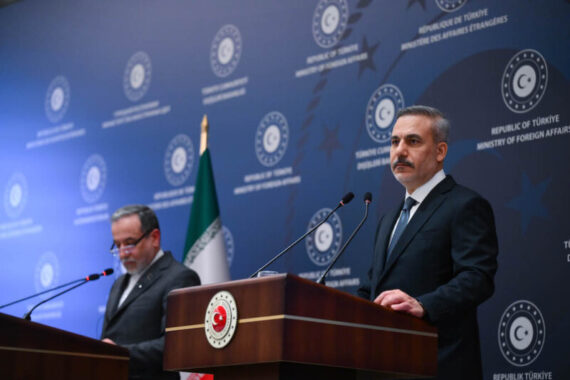
Turkish Foreign Minister Hakan Fidan (R) and Iranian Foreign Minister Abbas Araghchi (L) hold a joint press conference in Istanbul, Turkiye on January 30, 2026. Photo by Anadolu Images.

I

t was understood from the very outset—and indeed even during the period when the likelihood of war was growing—that the conflict, triggered by the US and Israel’s aggressive attacks on Iran, would have serious regional and global consequences. The geopolitical and geo-economic risks created by the conflict have not only had security-focused impacts on Middle Eastern states but have also triggered economic concerns globally by driving up energy prices. Beyond the warring parties, Iran’s Arab neighbors in the Gulf found themselves caught in the crossfire; in particular, supply issues regarding essential goods such as energy and fertilizer passing through the Strait of Hormuz have negatively impacted the global economy. The prolongation and spread of the war across the region will lead to a further deterioration of this economic situation.

As President Recep Tayyip Erdoğan put it, “this senseless war” has not only caused significant economic damage to the region but has also exposed Turkey to security risks. Foreign Minister Hakan Fidan also outlined Turkey’s stance on the matter during a television program on 28 March, stating that it was “to prevent the war from breaking out, to halt it if it does, to prevent its spread, and to keep Turkey out of it”.

Turkey, which had been actively working to prevent the war through diplomatic initiatives up until 28 February, has since faced a deeper crisis caused by the US escalating tensions as it failed to achieve its desired outcome, Israel’s attempts to deepen the crisis to destabilize the region, and Iran’s targeting of Gulf states to neutralize threats and impose costs on its adversaries.

However, despite the negative consequences of the war, no strong global initiative to halt the conflict has yet emerged. Some states, including Turkey, are continuing their efforts. Centering its approach on actual and potential security concerns, Turkey is currently prioritizing preventing the war from escalating further with the involvement of a Gulf state and is attempting to create a basis for negotiation between the US and Iran. However, the escalation of risks will shift Ankara’s stance from diplomacy to a security focus.

To understand the stance Ankara has adopted from the outset of the process and the direction in which it might evolve, it is essential to accurately identify its fundamental sensitivities and red lines regarding the current situation.


Is simply naming the crisis enough?

It is evident that, particularly since the US invasion of Iraq in 2003, the UN has remained ineffective in the face of global crises, due to both the structure of the Security Council and its application of double standards. Often content merely to name the crisis, the UN is unable to go beyond observing the crises as they naturally subside and leaving the processes to the initiative of the US. Consequently, this international organization is failing to adequately serve the primary objectives set out in the UN Charter of maintaining international peace and security. Indeed, UN Secretary-General Antonio Guterres, in a statement on 25 March, remarked, “Just a few hours after the war began in the Middle East, I warned that the clashes carried the risk of triggering a chain reaction that no one could control,” thereby demonstrating that merely naming the crisis serves little purpose.

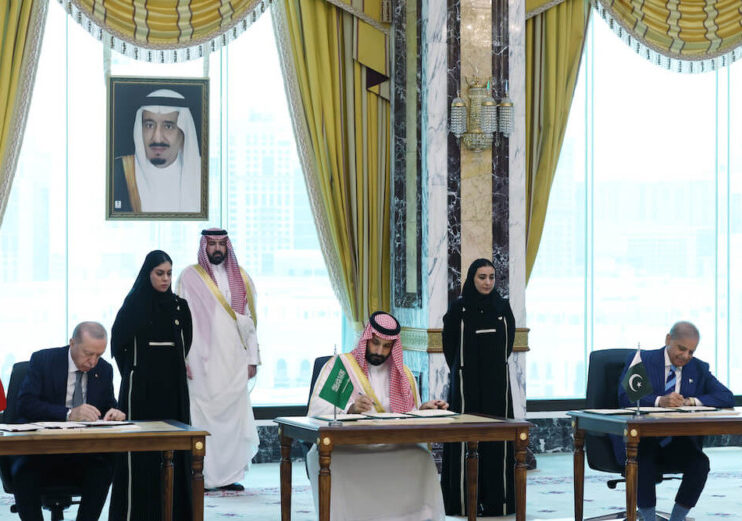
Turkey, however, is pursuing a more active policy due to being directly affected by the events. Fidan stated in a program on 28 March that this war, launched by the US and Israel in violation of international law, carries the risk of spreading further across the region. Emphasizing the regional dimension in the context of the war’s effects and potential solutions, Turkey is striving to prevent the conflict from spreading to other regional states and to bring the war to an end by establishing close contacts with countries such as Pakistan, Egypt and Saudi Arabia. To this end, Foreign Minister Fidan recently attended the Turkey-Egypt-Pakistan-Saudi Arabia Foreign Ministers’ Meeting on 29 March, where the latest developments in the Middle East were discussed.

Meanwhile, Turkey is contributing to the creation of a negotiating framework to end the war between the US and Iran. In his statement, Fidan said that the impression had been created that a certain stage had been reached in the negotiations, that a message had been conveyed via Pakistan, and that Turkey had been in contact with the US throughout the process and had kept the Iranians informed. However, for Turkey to continue on this path, the US must not launch a ground operation by bringing in one of the Gulf states – for example, the United Arab Emirates – and must not attempt to provoke an ethnic uprising whilst doing so. Otherwise, a change in Turkey’s stance will be inevitable.

What is Turkey’s red line?

The spread of the war and the US turning to a ground operation aimed at creating chaos in Iran constitute a clear red line for Turkey. Such an escalation would lead both to the prolongation of the war and to an increase in the threat against Turkey. As the US cannot risk deploying tens of thousands of troops into Iranian territory—particularly the Iranian mainland—as it did in Iraq, it will seek to establish groups to provide internal support in the event of a potential ground operation. Whilst steps are being taken to rid Turkey and the region of terrorism as part of the ‘Turkey Free of Terrorism’ process, Ankara will not stand idly by in the face of separatist elements being promoted in western Iran or any other region.

MİT President İbrahim Kalın also addressed a critical dimension of the war—one that highlights Turkey’s red line—in his speech at the International Strategic Communication Summit (STRATCOM), organised by the Presidency’s Communication Directorate on 27–28 March under the theme “Disconnection in the International System: Crises, Narratives and the Search for Order”. Noting that the war had ignited “a major conflagration” in the Middle East, Kalın emphasised that the aim was not merely to eliminate Iran’s nuclear capabilities, but that efforts were being made to lay the groundwork for an “ethnic and sectarian-based fratricidal war, a blood feud” that would last for decades.

The spread of such conflicts—experienced for years in Lebanon, Iraq and Syria—is viewed as a major threat that must be prevented at all costs from Turkey’s perspective. Recent assessments and reports indicate that Ankara has conveyed this stance to the Trump administration as well. Consequently, since the outbreak of war cannot be prevented, Turkey will continue its efforts to halt the conflict and prevent its spread should the parties continue to adopt an open stance towards it. However, should the parties continue to escalate tensions unchecked, leading the conflict to a point where it poses a direct threat to Turkey’s national security, Ankara will adopt more security-oriented policies.

(Originally published in Turkish by Kriter)

Serhan Afacan holds a BA in history and international relations. He also has a PhD in Iranian studies. His research focuses on the modern Iranian history and politics.