

Why is Europe Dependent on the US against Russia?
While Paris and London pursue a more active policy on sanctions against Russia and support for Ukraine, Berlin, which is expected to take the lead, is constantly applying the brakes.
September 17, 2025
A
lthough the failure of the Trump-Putin summit to produce a ceasefire agreement greatly unsettled European leaders, they are still striving to ‘keep Trump on their side’ or ‘draw him to their side’ because they cannot feel secure against Russia without U.S. support. The most recent example of this is the ongoing debate in Germany over whether German soldiers should be part of the peacekeeping force that is being considered for deployment to Ukraine under security guarantees in the event of a possible ceasefire.
U.S. President Donald Trump’s recent initiatives regarding the Russia-Ukraine War, including his meeting with Russian President Vladimir Putin in Alaska, have significantly stirred European politicians. Trump’s initial statements upon resuming his presidential duties and his attitude during his first meeting with Ukrainian President Volodymyr Zelensky at the White House had unsettled Europeans. Trump and some politicians under his command accused Zelensky of being responsible for the continuation of the war and stated that Ukraine could not become a NATO member and should cede some of its territories to Russia.
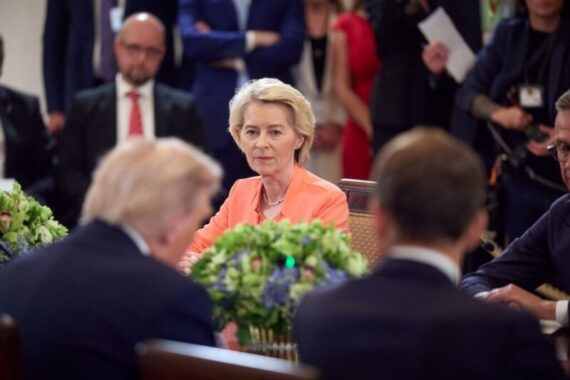
These statements were seen as unwarranted concessions and caused concern. However, European leaders have since learned the American president’s political style and are now closely monitoring him, attempting to influence him for their own interests. They were not invited to the meeting in Alaska, but through the initiative of German Chancellor Friedrich Merz, they held a teleconference with Trump prior to the Alaska meeting. In this way, they sought to ensure that Trump would exert pressure on Putin and prevent him from making statements that would upset Europe.
Following the Alaska Summit, Merz gathered numerous European leaders and took them to the White House, where they consulted with Trump on the summit’s outcomes. Although the failure to reach a ceasefire agreement at the summit greatly disturbed European leaders, they are striving to ‘keep Trump on their side’ or ‘draw him closer’ because they cannot rely on themselves against Russia without U.S. support. The most recent example of this is the ongoing debate in Germany about whether German soldiers should be part of the peacekeeping force that is being considered for deployment to Ukraine under security guarantees in the event of a possible ceasefire.
While it is unclear whether a ceasefire will happen and whether Putin would accept the deployment of European soldiers to Ukraine as part of a peacekeeping force in the event of a ceasefire, the heated debate on this issue in Germany and the rejection by a significant segment of the population of deploying German soldiers to Ukraine once again demonstrated Germany’s limits and concerns when it comes to Russia. Chancellor Merz’s refusal to deliver the Taurus missiles he had promised to Ukraine before taking office, unlike then-Chancellor Scholz, is another indication of these boundaries.
At this point, European leaders find themselves in a contradictory situation regarding the Ukraine-Russia-U.S. equation. There is a general expectation in Europe that Germany will assume a leadership role in this regard, particularly in Ukraine, Poland and the Baltic states, where this expectation is particularly high. The new coalition government’s steps to significantly increase defense spending are actually in line with this expectation. However, looking at Europe’s economically powerful countries, Germany, which has the strongest economy, appears to be pursuing more cautious policies on the Ukraine issue than France and the UK.
While Paris and London pursue a more active policy on sanctions against Russia and support for Ukraine, Berlin, which is expected to take the lead, is constantly applying the brakes. This is one of the main reasons why Europe is becoming more dependent on the U.S. and is leading to the belief that Europe cannot counterbalance Russia on its own.
In fact, when viewed in terms of important indicators of power, Europe is much stronger than Russia, beyond balancing it if it acts collectively. Looking at Gross Domestic Product (GDP) figures, the most important indicator of economic power, the total GDP of the EU and the UK is approximately 11 times that of Russia. Similarly, in terms of total defense spending, an important indicator of military power, the EU and the UK also outstrip Russia. Considering that Germany’s GDP alone is more than twice that of Russia and that four countries in Europe (Germany, the UK, France and Italy) individually have a higher annual economic output than Russia, it is clear that Russia lags far behind Europe in economic terms.
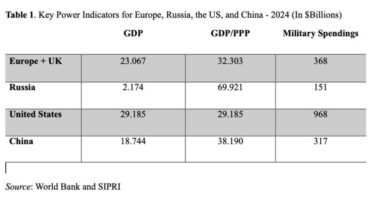
Looking at the figures in the table, it may seem difficult to explain why Europe has failed to counterbalance Russia and has sought help from the U.S. despite Trump’s pressure and humiliation. European countries, which have more than ten times the economic power of Russia and spend more than twice as much on military expenditure annually, should not actually be dependent on the U.S. But there are some realities not visible in this picture.
First and foremost, the fact that Europeans cannot speak with one voice in foreign policy and have serious differences of opinion prevents them from acting with confidence and means they are not taken seriously enough by their counterparts. Within the EU, which the UK has already left, there are Europhiles who are skeptical of cooperation with the U.S., Atlanticists who prefer the U.S. line on security policy, and even countries like Hungary that pursue policies close to both the U.S. and Russia.
Because of this fragmentation, when Brussels makes a statement on foreign policy on behalf of the EU, no one believes that all EU countries stand behind it, with a few exceptions. Ukraine and Russia are at the top of the list of foreign policy areas where the EU cannot speak with one voice. There are countries that advocate very tough sanctions against Russia and support Ukraine with all kinds of weapons, as well as countries that, despite advocating support for Ukraine, are reluctant to deliver certain weapons to this country, and countries that oppose both supporting Ukraine and imposing sanctions against Russia. This situation weakens Europe against Russia.
Another reason why Europe struggles to counterbalance Russia is that, despite appearing to spend more on military expenditure than Russia overall, it is far from establishing military superiority over Russia. European countries lack the same level of superiority over Russia in conventional weapons and ammunition production that the United States possesses, and they lag far behind Russia in terms of nuclear weapons. This situation means that if Europe were to become involved in the war in Ukraine against Russia, it would be entering a conventional war that could last a long time and be vulnerable to nuclear attack at any moment, which explains why it has so far avoided direct involvement in the war. For similar reasons, they will continue to stay away from direct involvement in the war in the future.
At this point, it should also be noted that Russia, despite the damage caused to its economy by the war, is preparing itself for a prolonged conflict by building a war economy and is in a better position in terms of weapons and ammunition production than it was at the start of the war. Furthermore, the fact that countries such as China, India and Iran have entered into economic or military relations that facilitate Moscow’s continuation of the war with Russia is another factor that has prompted Europeans to avoid confronting Russia without the United States. The fact that the United States, which has far greater military and economic power than Europe, chose diplomacy over direct confrontation and conflict with Russia during the Trump era, which could have been very damaging, also explains the cautious stance of Europeans towards Moscow.
One of the obstacles preventing European countries from emerging as effective actors against Russia is the disconnect between governments and their populations. European leaders who explain their position on the Ukraine issue as standing with Kiev against Moscow to their people as standing for freedom against despotism and for law against power politics have a serious credibility problem. This is because most of these same European leaders were complicit in the genocide carried out by Israel in Gaza during the same period, either directly or indirectly.
Recommended
Despite the fascist Netanyahu administration’s aggressive policies, which trample international law, not only in the Gaza genocide but also in the West Bank, Lebanon, Syria and Iran, they continued their support for Israel for a long time, and some, such as Germany, still maintain this support. The hypocritical policies of European countries are drawing serious reactions from European populations and leading to large protests. When it comes to Palestine, the attempts of leaders who turn their backs on freedom and justice to legitimize their policies against Russia through these concepts are not sufficiently accepted by the public, making it impossible for Europe to adopt a confident stance against Russia.
In summary, by neglecting to build a military force commensurate with its economic capacity to date, and by supporting the genocide in Gaza, Europe has squandered the last remnants of the values it has defended until now, such as the rule of law and the protection of human rights, weakening its ties with its people. Incapable of speaking with one voice in foreign policy, Europe has no choice but to seek the help of the U.S. to counterbalance Russia.
(Originally published in Turkish by Kriter)

Kemal Inat received his PhD from Siegen University with his doctoral thesis focusing on Turkish Middle Eastern Policy at the turn of the 21st Century. Currently, Inat is a Professor at the Department of International Relations at Sakarya University.
You can see how this popup was set up in our step-by-step guide: https://wppopupmaker.com/guides/auto-opening-announcement-popups/

Stay informed by subscribing to
our weekly newsletter.
You can see how this popup was set up in our step-by-step guide: https://wppopupmaker.com/guides/auto-opening-announcement-popups/
You can see how this popup was set up in our step-by-step guide: https://wppopupmaker.com/guides/auto-opening-announcement-popups/
You can see how this popup was set up in our step-by-step guide: https://wppopupmaker.com/guides/auto-opening-announcement-popups/
You can see how this popup was set up in our step-by-step guide: https://wppopupmaker.com/guides/auto-opening-announcement-popups/

