Israel's Plan to Occupy Gaza City: Will it Succeed?
Israel's plan to invade Gaza has been met with opposition from nearly all countries except the United States.
September 11, 2025
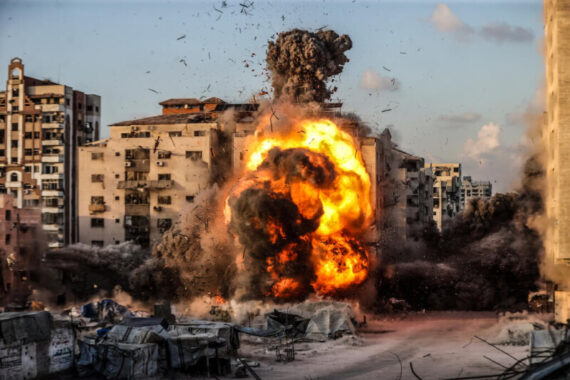
According to leaked Israeli documents, it is unrealistic to expect that Hamas, which is claimed to have been rendered ineffective by only 17 per cent so far, will be completely eliminated as a result of the new occupation plan that has been launched. In other words, even if Israel were to gain complete control over Gaza’s infrastructure through a ground operation, it would not achieve full success due to Hamas’s continued presence in the tunnels. Furthermore, this would lead to the deaths of all the hostages, which would further deepen the fault lines within Israeli society.
Israel’s attacks on Gaza, which have been ongoing since 7 October 2023, entered a new phase in August 2025. Despite the passage of 22 months and the killing of more than 63,000 Palestinians, Israel’s genocidal Prime Minister Netanyahu, unable to rescue the hostages held by Hamas, contrary to his initial rhetoric that the sole objective of these attacks was to eliminate Hamas, he announced that he would begin implementing a plan for the total occupation of Gaza.
After Hamas released footage of two Israeli hostages, Evyatar David and Rom Braslavsky, in early August, saying that Netanyahu was endangering their lives by not agreeing to a prisoner exchange deal, public outrage against Netanyahu reached fever pitch in Israeli society, raising expectations that Netanyahu would have to do something to save himself from this situation. Netanyahu, who said he was shocked by the images of the two hostages, stated, ‘I understand exactly what Hamas wants. They don’t want a deal. They want to destroy us by using these horrific videos,’ and announced that he had requested the Red Cross to deliver food and medicine to the hostages.
After seeing these videos, Netanyahu said that his ‘determination to rescue the hostages and eliminate Hamas has been renewed.’ Indeed, immediately following this statement, in an interview with the American Fox News channel, he said that they ‘aim to take control of the whole of Gaza.’ However, to say that Israel’s plan to invade Gaza stems solely from Netanyahu’s sensitivity towards rescuing the hostages does not correspond with the reality on the ground.
Indeed, just a few days later, in an interview with Israel’s I24 channel, Netanyahu stated that he was ‘committed to the Greater Israel plan’ and that this was ‘a historical and spiritual mission,’ revealing the true intent behind the occupation plan.
Following Netanyahu’s statements, the issue of the occupation of Gaza was brought before the security cabinet, and after discussions there, the occupation decision was approved despite the opposition of the chief of staff. Subsequently, Chief of Staff Eyal Zamir prepared a new occupation plan, albeit reluctantly, and presented it to the defence minister. After Defence Minister Katz’s approval, Netanyahu approved the plan on 21 August, and the occupation plan, named ‘Gideon’s Chariots 2’, was implemented on the same day.
In fact, the Israeli army already controls more than 85 per cent of Gaza with at least five of its brigades. In order to control the Gaza Strip more easily, the Israeli army opened four roads cutting across the strip on an east-west axis, thereby dividing it into five parts. During the ceasefire process that began on 19 January, Israeli army units withdrew from areas densely populated by Palestinians and positioned themselves in a manner that relatively encircled Gaza. This plan appears to involve the advance of troops stationed around Gaza into more inland areas, particularly the displacement of Palestinians living in the north, and a sweep of the Strip from north to south, advancing as far as the Rafah border.
So, the plan put forward as the plan to invade Gaza, involves reinforcing forces on the ground and then launching a ground operation with 100,000 troops, displacing approximately 1 million civilians living in Gaza City, along with Beit Lahia and Beit Hanoun in the north of the Strip, and forcing them to move to camp-like facilities to be established in the south, thereby creating so-called safe zones. This would reveal that those left behind are Hamas resistance fighters. Subsequently, intensive bombardment would be carried out to destroy the tunnels still remaining in these areas and rid the region of Hamas fighters. Following the bombardment, special forces would carry out pinpoint attacks to eliminate any remaining Hamas fighters and rescue hostages.
The Ministry of Defence, which has called up 60,000 reservists to support the occupation plan, estimated to last approximately 4-6 months, has stated that it may call up another 20,000 reservists in September, depending on the situation. Thus, the number of reservists called up is expected to reach around 130-150,000.
Although it has been announced that new food distribution centers and medical support units will be established for Palestinians who will be forced to migrate south under the plan, it is known that the Israeli army’s real aim is not to help displaced Palestinians, but rather to force them to leave Gaza. Therefore, if this occupation plan is fully implemented, it is estimated that thousands more Palestinians could lose their lives both in bombings and during the migration to the south.
Israel’s plan to invade Gaza has been met with opposition from nearly all countries except the United States, and Israel has been urged to immediately abandon this initiative, which would lead to the loss of thousands more Palestinian lives. However, there has also been intense opposition to the invasion plan from within Israel itself. This is because, under this plan, if a large-scale ground operation against Gaza is launched, it was assessed that hostages already struggling to survive under difficult conditions could lose their lives or perhaps be executed by Hamas in response to these attacks. Consequently, criticism of Netanyahu and his government has risen, primarily from hostage families, but also from a broad section of society and politicians, mostly from the opposition.
While Israeli streets have long been the scene of protests by families of hostages, the protests have intensified due to the increased risk to the hostages’ lives posed by the occupation plan. In this context, the participation of approximately 400,000 people in the protest rally held in Tel Aviv on 16 August indicates that sensitivity towards the hostages will continue to grow within Israeli society.
However, the most significant reaction to the occupation plan came from active and reserve soldiers, led by the chief of staff. Even Chief of Staff Eyal Zamir, known for his hawkish views on Gaza, opposed the occupation plan, arguing that the army was extremely tired and worn out from being at war for nearly two years and fighting on many fronts at the same time. He stated that it would be a more rational choice to negotiate a hostage exchange agreement with Hamas instead. Nevertheless, he came under pressure from cabinet members for making such statements and was asked to resign if he could not fulfill his duties.
Conversely, reflecting the long-standing discontent within the army towards Netanyahu and his cabinet, it was reported in the Israeli media that some resignations occurred after the plan was approved and that some of the reservists who had been called up did not wish to return to active duty.
Similarly, the leader of the main opposition, Yair Lapid, criticized the occupation plan, stating that ‘as if isolating Israel on the international stage were not enough, it will also lead to the deaths of many Israeli soldiers along with the hostages held by Hamas, cost Israeli taxpayers billions of dollars, and cause a political collapse.’ Reacting to Israel being ‘dragged into a pointless occupation whose goal and aftermath are unclear, and whose outcome is unpredictable,’ Lapid opposed the occupation plan, saying that this war is not Israel’s war, but rather a war to keep Netanyahu and his supporters, the far-right Ben Gvir and Smotrich, in power.
Despite objections from the army and the opposition, the government front now almost unanimously supports the Gaza occupation plan, claiming that there is no longer any possibility of negotiating with Hamas. However, last week Hamas announced that it had accepted the ceasefire plan brokered by Egypt and Qatar and stated that what happens next is up to the Israeli government. Despite this, the Netanyahu government ignored Hamas’s decision, implemented the occupation plan, and Israeli tanks waiting behind the buffer zone began to enter from the northern parts of Gaza.
Currently, 88 per cent of Gaza’s territory is controlled by the Israeli army. The Israeli army has secured this control not through a ground operation but by dropping approximately 100,000 tones of bombs, destroying more than 90 per cent of Gaza’s infrastructure. Despite this, Israel has so far failed to completely eliminate Hamas or rescue the hostages held by Hamas.
Therefore, the occupation plan that has been launched is unlikely to reverse this situation. In other words, it is unrealistic to expect that the 100,000 soldiers that are said to be sent into Gaza under this plan will rid Gaza of Hamas and rescue the hostages. Moreover, considering Israel’s losses since 7 October and the unrest within its army, it seems unlikely that it could muster 100,000 soldiers, let alone deploy them all to the Gaza front. This is because Israel’s maximalist and revisionist policies have caused it to have problems with all the countries around it.
It is known that while Israel is carrying out attacks on Lebanon, Syria and Yemen on the one hand, it is preparing for a possible second round with Iran on the other. Given that Israel, whose intention to annex the West Bank is well known, has deployed a large part of its central command here, it is clear that its current manpower will not be sufficient to fight on all fronts.
Without such a ground force, it would be impossible to control the entirety of Gaza, meaning that the decision to invade and the accepted plan have no chance of achieving 100% success.
Recommended

In addition to all this data, documents leaked from Israeli military intelligence reveal that 83 per cent of the 53,000 people killed in Israel’s attacks between 7 October 2023 and May 2025 were civilians. Under these conditions, it is unrealistic to expect that Hamas, only 17% of which has been neutralized so far, will be completely eliminated as a result of the new occupation plan. In other words, even if Israel gains control of the entire infrastructure of Gaza through its ground operation, it will not be fully successful due to Hamas’ continued presence in the tunnels. Furthermore, this would lead to the deaths of all the hostages, which would further deepen the fault lines within Israeli society.
The most tragic prediction regarding the occupation plan, as might be expected, concerns the potential losses of the Palestinian people. For in Gaza, where more than 63,000 people have been brutally murdered to date, it will be difficult to even estimate the losses that will occur if the occupation plan is deepened. At a time when the UN has declared famine in Gaza and human life is already hanging by a thread, it should not be forgotten that a full-scale occupation on top of this could lead to the greatest catastrophe of the century.
Therefore, preventing Israel’s plan to occupy Gaza must be the world’s top priority, and to achieve this, the UN General Assembly must immediately implement the ‘Uniting for Peace’ option.
(Originally published in Turkish by Kriter)

After serving 25 years in the Turkish Navy, he retired in 2014. Afterwards, he started his doctoral education on Middle East Studies at Sakarya University Middle East Institute and worked as a researcher at the Israel Studies desk of the institute. Between 2019-2021, he served as a Levant Specialist at Center for Middle Eastern Studies (ORSAM) and led the Palestine and Israel studies during this period. Currently, as an independent researcher, he conducts research on Palestine, Israel, the Middle East and Turkish Foreign Policy, writes analyses for various platforms and is a commentator on TV.
You can see how this popup was set up in our step-by-step guide: https://wppopupmaker.com/guides/auto-opening-announcement-popups/

Stay informed by subscribing to
our weekly newsletter.
You can see how this popup was set up in our step-by-step guide: https://wppopupmaker.com/guides/auto-opening-announcement-popups/
You can see how this popup was set up in our step-by-step guide: https://wppopupmaker.com/guides/auto-opening-announcement-popups/
You can see how this popup was set up in our step-by-step guide: https://wppopupmaker.com/guides/auto-opening-announcement-popups/
You can see how this popup was set up in our step-by-step guide: https://wppopupmaker.com/guides/auto-opening-announcement-popups/