Peru’s Congress Ousts President Boluarte Amid Soaring Crime
For now, Peruvians face an uncertain future — one in which hope for security and democratic renewal once again hangs in the balance.
October 10, 2025
P
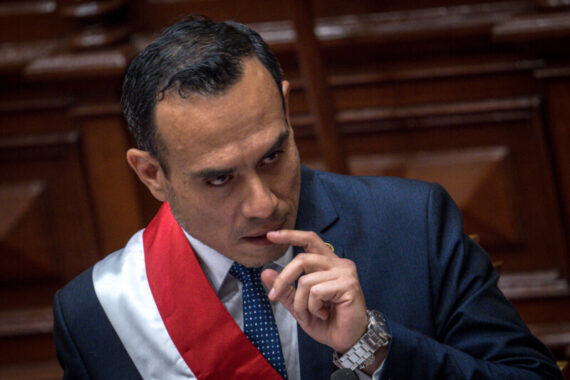
eru’s political turmoil deepened early Friday as Congress voted to remove President Dina Boluarte from office, citing her failure to curb an escalating wave of violent crime that has gripped the nation. Lawmakers swiftly installed José Jerí, the 38-year-old president of Congress, as interim leader — the country’s sixth president in less than a decade.
The dramatic vote unfolded shortly after midnight, marking the culmination of weeks of mounting frustration over the government’s inability to stem rampant violence and organized crime.
In a 130-member unicameral Congress, 124 lawmakers backed Boluarte’s removal. None opposed the motion — a rare display of unity among Peru’s often-fractured political factions.
Lawmakers had convened an emergency debate late Thursday after approving four impeachment motions against the embattled leader. They invited Boluarte to appear before them to defend her record, but when she failed to attend, the vote to oust her proceeded immediately.
The move came just hours after a shooting at a concert in Lima injured five people, further inflaming public outrage over unchecked crime across the country.
Boluarte, Peru’s first female president, had taken office in December 2022 following the ouster of leftist President Pedro Castillo, who attempted to dissolve Congress and rule by decree. As Castillo’s former vice president, Boluarte was elevated to complete his term, promising stability and reform.
But her nearly three years in office were marked by deep political division, corruption scandals, and a surge in criminal violence that has left tens of thousands of Peruvians feeling unsafe.
Within the first three months of her presidency, Peru saw more than 500 protests demanding her resignation. Analysts say her government’s credibility steadily eroded as crime worsened and economic inequality persisted.
Official figures released in August revealed the scale of the crisis: between January and mid-August 2025, at least 6,041 people were killed — the highest death toll for that period since 2017. Meanwhile, reports of extortion and organized crime have soared, with nearly 16,000 extortion complaints filed between January and July, a 28% increase compared to the previous year.
In a televised address on Wednesday, Boluarte partly blamed the deteriorating security situation on illegal immigration, claiming foreign criminal networks had taken root in Peru.
“This crime has been brewing for decades and has been strengthened by illegal immigration,” Boluarte said during a military ceremony. “Past administrations opened our borders and allowed criminals to enter without restriction.”
Her remarks drew sharp criticism from human rights groups, who accused her of scapegoating migrants while failing to present an effective national security plan.
The impeachment session — Peru’s ninth attempt to unseat Boluarte since she took office — was the only one to succeed. The overwhelming vote reflected rare bipartisan agreement that her administration had lost control of the streets.
Moments after the result was announced, lawmakers erupted in cheers and began singing the national anthem. By dawn, José Jerí, who had presided over Congress, was sworn in as interim president in a televised ceremony.
Jerí pledged to uphold Peru’s constitution and oversee a peaceful transition of power ahead of elections scheduled for April 2026.
“I will defend the sovereignty of our nation and ensure that power is handed over to the democratically elected president next year,” Jerí said, moments after receiving the presidential sash.
During a brief speech broadcast just before Jerí’s swearing-in, Boluarte defended her record, highlighting social and economic initiatives launched under her leadership.
“I have not thought of myself, but rather of Peruvians,” she said, before the live feed abruptly cut to the inauguration of her successor.
Boluarte’s ouster adds another chapter to Peru’s long-running cycle of political instability, where nearly every elected president in the past two decades has faced impeachment, resignation, or imprisonment.
Since 2016, the country has seen a rapid succession of leaders — Pedro Pablo Kuczynski, Martín Vizcarra, Manuel Merino, Francisco Sagasti, Pedro Castillo, and Dina Boluarte — none able to complete a full five-year term.
Boluarte’s downfall, however, underscores a particularly acute crisis: the convergence of political dysfunction and surging violent crime. Analysts say Peru’s Congress — which enjoys little more public trust than the presidency — is seeking to channel public anger at rising insecurity toward restoring its own legitimacy.
“This is less about reform and more about survival,” said Lima-based political analyst María del Carmen Rivas. “Peru’s political class has lost the confidence of the people. Removing Boluarte may calm the streets for a moment, but it won’t fix the deeper problems.”
In neighborhoods across Lima, Arequipa, and Trujillo, residents say daily life has become increasingly perilous. Armed robberies, contract killings, and extortion rackets have become commonplace, often linked to transnational gangs operating along Peru’s porous borders.
The concert shooting that preceded Boluarte’s impeachment appeared to crystallize public anger. The attack, during a performance by popular cumbia group Agua Marina, left five injured and dozens fleeing in panic. Authorities believe it was linked to gang extortion attempts against event organizers.
Prime Minister Eduardo Arana had defended the president just hours before the vote, urging lawmakers not to act out of political expediency.
“Parliament’s concerns are not resolved by impeachment,” Arana told legislators. “We are not clinging to our positions. From the start, we knew our first day could also be our last.”
His warning went unheeded.
Recommended
Interim President José Jerí now faces the daunting task of restoring stability and addressing Peru’s growing security crisis. With elections less than seven months away, his administration is expected to focus on crime prevention, police reform, and rebuilding public trust.
Analysts say Jerí will need to act quickly to convince Peruvians that his government represents a break from years of dysfunction.
As dawn broke over Lima, crowds gathered outside Congress — some celebrating Boluarte’s fall, others decrying another abrupt power shift in a country weary of political upheaval.
For now, Peruvians face an uncertain future — one in which hope for security and democratic renewal once again hangs in the balance.
(Source: The Associated Press)

Politics Today is dedicated to publishing insightful analyses in order to understand the changing nature of contemporary politics. It aims to contribute to the sound and constructive discussion of international affairs.
You can see how this popup was set up in our step-by-step guide: https://wppopupmaker.com/guides/auto-opening-announcement-popups/

Stay informed by subscribing to
our weekly newsletter.
You can see how this popup was set up in our step-by-step guide: https://wppopupmaker.com/guides/auto-opening-announcement-popups/
You can see how this popup was set up in our step-by-step guide: https://wppopupmaker.com/guides/auto-opening-announcement-popups/
You can see how this popup was set up in our step-by-step guide: https://wppopupmaker.com/guides/auto-opening-announcement-popups/
You can see how this popup was set up in our step-by-step guide: https://wppopupmaker.com/guides/auto-opening-announcement-popups/