Pakistan Eyes 2026 Chinese Submarine in $5 Billion Deal

November 3, 2025

Under the agreement, the first four submarines are being constructed in China, while the remaining four will be built in Pakistan, a move aimed at transferring technical know-how and expanding local shipbuilding capability.
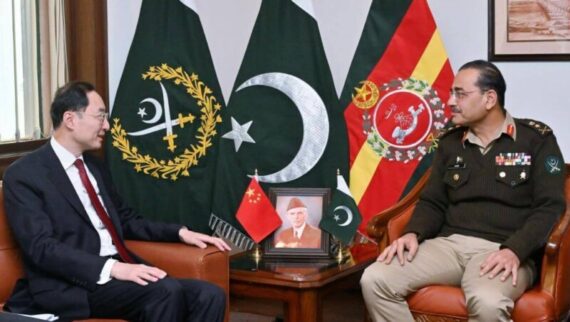
Pakistani Army Chief General Asim Munir (R) and Chinese Vice Foreign Minister Sun Veydong (L) hold a meeting for discussing measures to enhance defense cooperation between the Pakistan and China in Islamabad, Pakistan on January 22, 2024. Photo by Anadolu Images.

T

he Pakistan Navy expects its first Chinese-designed submarine to enter active service in 2026, the country’s top naval commander has said, marking a major step in a $5 billion arms deal that underscores Beijing’s growing military partnership with Islamabad and its ambitions to project power into the Indian Ocean.

Admiral Naveed Ashraf told China’s state-run Global Times that the delivery of eight Hangor-class submarines, agreed under a landmark contract with Beijing, was “progressing smoothly.” The first of the diesel-electric attack vessels is scheduled to join Pakistan’s fleet next year, while the remainder are due to be operational by 2028.

Ashraf said the new submarines would significantly enhance Pakistan’s capacity to patrol the North Arabian Sea and safeguard sea lanes stretching toward the Middle East, a region of strategic importance for both countries. “Chinese-origin platforms and equipment have been reliable, technologically advanced, and well-suited to Pakistan Navy’s operational requirements,” he said.

The admiral added that as modern warfare evolves, Pakistan was increasingly focused on “emerging technologies such as unmanned systems, artificial intelligence and advanced electronic warfare,” and would seek closer collaboration with China in these fields.

Deepening defense partnership

Under the agreement, the first four submarines are being constructed in China, while the remaining four will be built in Pakistan, a move aimed at transferring technical know-how and expanding local shipbuilding capability. Three of the vessels have already been launched into China’s Yangtze River from a shipyard in Hubei province, Chinese media reported.

The Hangor-class submarines, based on China’s Type-039A Yuan-class design, are diesel-electric powered and capable of carrying a variety of torpedoes and anti-ship missiles. They will form the backbone of Pakistan’s naval modernization drive as it seeks to counter India’s expanding maritime power.

Islamabad’s submarine program is part of a wider $5 billion arms procurement and defense cooperation package with Beijing. Over the past decade, China has become Pakistan’s dominant military supplier, accounting for more than 60% of its weapons imports between 2020 and 2024, according to data from the Stockholm International Peace Research Institute (SIPRI).

“This cooperation goes beyond hardware; it reflects a shared strategic outlook, mutual trust, and a long-standing partnership,” Ashraf said, emphasizing that the Pakistan-China defense relationship was entering a new phase of “industrial collaboration, training, and research.”


Strategic implications for the region

Analysts say the deal is likely to tilt the naval balance of power in the Indian Ocean, where India, Pakistan’s nuclear-armed rival, has steadily upgraded its fleet with Russian, French and indigenous submarines. India currently operates three nuclear-powered ballistic missile submarines and multiple classes of conventional submarines.

“Beijing’s delivery of advanced submarines to Pakistan gives China another foothold in the Indian Ocean, where it already has a base in Djibouti and growing access to ports along key maritime routes,” said Collin Koh, a naval expert at Singapore’s S. Rajaratnam School of International Studies. “For Islamabad, the partnership offers a crucial technological edge at a time of intensifying rivalry with India.”

The timing of the submarine rollout also aligns with Beijing’s broader ambitions to extend its reach westward through the China-Pakistan Economic Corridor (CPEC) — a $60 billion infrastructure network that connects China’s western Xinjiang province to Pakistan’s deep-water port at Gwadar.

Economic corridor and power projection

Stretching roughly 3,000 kilometers (1,860 miles), the CPEC is a centerpiece of President Xi Jinping’s flagship Belt and Road Initiative. It provides China with a direct trade route to the Arabian Sea, allowing its energy imports from the Middle East to bypass the narrow Straits of Malacca — a maritime chokepoint between Malaysia and Indonesia that Beijing fears could be blockaded in a conflict.

Military analysts say Pakistan’s new submarine fleet will complement this corridor by giving both countries greater control over maritime approaches to Gwadar and the Arabian Sea, while expanding China’s capacity to project influence toward the Gulf region, East Africa and beyond.

“Pakistan’s submarines effectively extend China’s defensive perimeter,” said retired Pakistani naval officer Syed Hassan Rizvi. “They enhance deterrence, ensure energy route protection, and deepen the two countries’ strategic interdependence.”

Technology transfer and training

Pakistan’s decision to assemble half of the submarines domestically at the Karachi Shipyard and Engineering Works is expected to boost its indigenous defense industry. The project involves extensive training of Pakistani engineers and naval personnel in Chinese shipyards and technical institutes.

Ashraf said Pakistan was “learning rapidly” from its Chinese counterparts and hoped to leverage the experience to pursue future joint production ventures. “In the coming decade, we expect this relationship to grow, encompassing not only shipbuilding and training, but also interoperability, research and technology sharing,” he said.

The move comes amid a broader shift in Pakistan’s defense posture, as it diversifies from Western suppliers and deepens integration with Chinese defense ecosystems. For Beijing, the submarine program reinforces its role as a major security provider to developing nations — and strengthens an alliance that both countries view as essential to counterbalancing India’s regional dominance.

(Source: Reuters)

Politics Today is dedicated to publishing insightful analyses in order to understand the changing nature of contemporary politics. It aims to contribute to the sound and constructive discussion of international affairs.