Venezuela Accuses U.S. of Using ‘Secret Weapon’ in Maduro Abduction

January 27, 2026

Experts suggest the reported failure of Venezuelan defense systems is more consistent with electronic warfare, cyber operations or high-powered microwave technology, all of which the US has used in past conflicts.
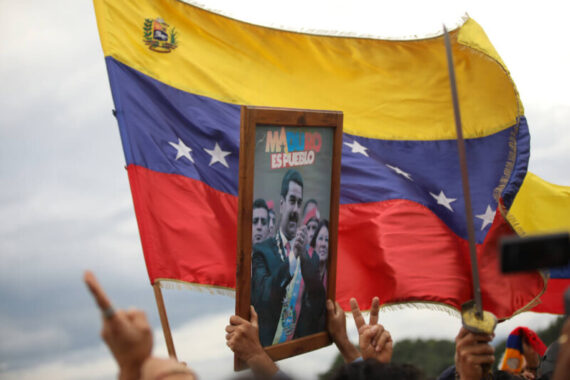
Thousands of people in Colombia's city of Cúcuta staged a demonstration around the Simon Bolivar Bridge to show support for President Gustavo Petro's stance against foreign military intervention in the region following the arrest of Venezuelan President Nicolas Maduro. Photo by Anadolu Images.

V

enezuela has accused the United States of deploying previously unused military technology during the January 3 abduction of President Nicolás Maduro, claims that gained renewed attention after US President Donald Trump referred to a mysterious weapon he called a “discombobulator”.

Venezuelan Defense Minister Vladimir Padrino López said the operation amounted to turning Venezuela into a “weapons laboratory”, alleging that advanced technologies powered by artificial intelligence were tested during the raid in Caracas. The US has not officially detailed the operation, which resulted in Maduro and his wife, Cilia Flores, being taken into US custody.

Speaking earlier this month, Padrino López said 47 Venezuelan soldiers and 32 Cuban personnel providing security to Maduro were killed during the operation. He later claimed Washington had used weapons “never before seen on the battlefield”.

“The president of the United States admitted they used weapons no one else in the world possesses,” he was quoted as saying by the Venezuelan newspaper El Universal.

Trump’s remarks fuel speculation

Trump appeared to confirm the use of unconventional technology in interviews with US media outlets. Speaking to NewsNation, he said a “sonic weapon” had been used during the raid on what he described as a heavily fortified military compound guarded by Cuban forces.

“Nobody else has it,” Trump said. “We have weapons no one knows about.”

Days later, Trump told the New York Post that US forces had used a device designed to disable defensive systems. “The discombobulator,” he said, declining to provide further details.

Speculation intensified after social media posts attributed to a Venezuelan security guard described intense sound waves, severe physical distress and bleeding during the operation. Al Jazeera and other international media outlets have been unable to independently verify these claims.

The White House has not commented on the alleged injuries.

Experts cast doubt on ‘sonic weapon’ claims

Military analysts say known US “sonic” systems, such as long-range acoustic devices (LRAD), are primarily designed for communication, crowd control and deterrence, not for disabling military hardware.

“These systems can cause discomfort or disorientation but cannot shut down air defenses or communications networks,” said Brussels-based military analyst Elijah Magnier.

Other non-lethal systems, such as the Active Denial System, affect people through directed energy but similarly do not interfere with electronics.

Experts suggest the reported failure of Venezuelan defense systems is more consistent with electronic warfare, cyber operations or high-powered microwave technology, all of which the US has used in past conflicts.

Such tools can jam radar, disrupt communications, disable electronics or cut power without visible damage.

“There is no evidence of a new weapon,” Magnier said. “The term ‘discombobulator’ appears to be political language referring to a combination of existing non-kinetic capabilities.”


No evidence of new weapon technology

While major powers routinely deploy new systems in real-world conflicts, analysts stress that there is currently no public evidence that the US used a previously unknown weapon during the Caracas operation.

“The effects described can be explained by conventional electronic warfare and standard disorientation tools,” Magnier said. “There is no need for a science-fiction explanation.”

The US government has yet to formally respond to Venezuela’s accusations.

(Source: Aljazeera)

Politics Today is dedicated to publishing insightful analyses in order to understand the changing nature of contemporary politics. It aims to contribute to the sound and constructive discussion of international affairs.