The Caracas Gambit: Power in a Multipolar World
Claims that “the U.S. invaded Venezuela to save the petrodollar” mix partial truths with exaggeration.
January 6, 2026
O
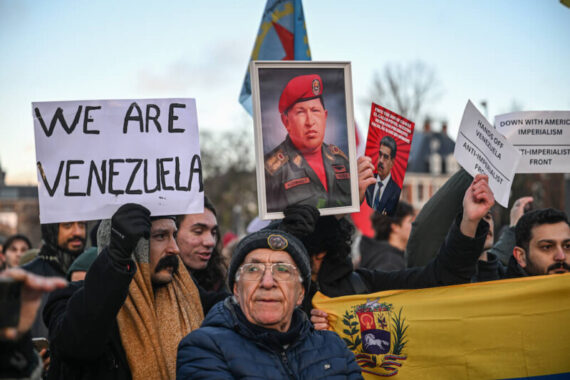
n the night of January 3, Caracas was jolted awake by a sequence of explosions so sudden and precise that, for hours, the world believed Venezuela had entered a new war. Reports indicated that more than 150 U.S. Armed Forces aircraft operated over the region, while a dozen cruise missiles struck critical sites across the capital and beyond: Oil facilities, military headquarters, air bases, Fort Tiuna, the Presidential Palace, the mausoleum of Hugo Chávez, and installations on the strategically vital island of Margarita.
Yet what followed did not resemble war. There was no cascade of air-defense fire, no counterstrike, no troop mobilization, and no descent into chaos. Within hours, the White House announced that President Nicolás Maduro and his wife had been captured and transferred to the United States. What at first appeared to be an act of American military domination, upon closer examination, look entirely different.
The most puzzling aspect was not the missiles but the silence that greeted them. Venezuela’s air-defense network, regarded as the most advanced in Latin America, failed to respond. Independent monitoring systems and eyewitnesses were reported to have confirmed that not a single defensive missile was fired. Even more telling were accounts suggesting that Venezuelan special forces had taken control of air-defense sites hours before the strike, effectively disabling them. This pointed not to a failure of technology, but to a decision from within. The implication was stark: The gates of the country’s airspace appeared to have been opened deliberately. That American missiles did not target air defenses is a key clue indicating an inside operation.
The implications deepened when reports emerged that Maduro had not been seized in a Hollywood-style raid by American commandos, but rather arrested by his own senior officers. High-ranking figures within the Venezuelan military were said to have detained Maduro and his wife and handed them over to U.S. Delta Force operatives at Caracas International Airport. The missiles, in this account, were not the spear of conquest but a curtain behind which an internal transfer of custody occurred. The spectacle of military power provided cover for a political act already decided.
This interpretation gained further weight when U.S. Senator Mike Lee was quoted in accounts as saying that the missile strikes were intended to facilitate Maduro’s extraction, not to trigger a ground invasion. Once Maduro was in custody, American military operations quickly halted. There was no attempt to dismantle the Venezuelan state, seize ministries, or install a new government; the machinery of power remained intact, merely missing its former occupant. In this context, Trump remarked, “The first attack was so successful, we probably don’t have to do a second, but we’re prepared to do a second wave…” Viewed through the lens of traditional regime change, this was an anomaly. In the emerging logic of multipolar geopolitics, it was a masterclass in containment.
Perhaps the clearest indication that this was not a traditional U.S.-driven coup lies in who emerged afterward. Instead of the pro-American opposition figure María Corina Machado, a right-wing politician who had cultivated close ties with Trump, especially after her October Nobel Prize, which she publicly dedicated to him, the U.S. president dismissed her as lacking both the backing and the “respect” required to lead Venezuela.
Power instead passed to Diosdado Cabello, widely regarded as aligned with Russia, China, and Cuba. Even American analysts acknowledge that Cabello represents continuity in Venezuela’s strategic posture against Washington. Had the United States intended to remake Venezuela in its own image, such an outcome would have been inexplicable. But if Washington’s objective was simply to remove a volatile, sanctioned, and diplomatically paralyzing leader without triggering open war, the result becomes far more intelligible.
The shadow of Beijing and Moscow quietly loomed over the unfolding drama. In the days leading up to Maduro’s arrest, Venezuelan authorities were reported to have held confidential meetings with Chinese diplomats. Just hours before his capture, Nicolás Maduro received Qiu Xiaoqi, China’s special envoy for Latin American affairs, at the Miraflores Presidential Palace. Around the same time, former President Trump met with U.S. Ambassador to China David Perdue. A week earlier, Chinese officials convened with their Russian counterparts in Moscow to discuss Venezuela. These parallel diplomatic tracks suggest that Maduro’s removal was not a unilateral American operation, but a calculated maneuver tacitly acknowledged by the major powers invested in the country.
On January 4, 2026, Dmitry Medvedev, deputy chairman of Russia’s Security Council, commented on Trump’s actions, describing them as unlawful but consistent with the defense of U.S. interests. “It must be acknowledged that, despite the obvious unlawfulness of Trump’s behavior, one cannot deny a certain consistency in his actions. He and his team defend their country’s national interests quite harshly,” Russia’s TASS news agency quoted Medvedev as saying. Medvedev added that Latin America is traditionally considered the “backyard” of the United States and suggested that Trump appeared determined to exert control over Venezuela’s oil supplies.
China’s interest in Venezuela was not merely diplomatic; it is deeply economic and strategic. Beijing holds a significant stake, primarily through an estimated $55–60 billion in loans repaid in oil, direct investments such as China Concord’s $1 billion oilfield development, and stakes by state-owned firms including CNPC and Sinopec in the Orinoco Belt. Chinese companies dominate Venezuelan crude exports, often purchasing the majority of output, while recent bilateral investment-protection agreements aim to secure and expand these ties despite sanctions and geopolitical pressures.
By then, Maduro had become a liability, not only for Washington, but for Caracas itself and for the very allies that had once shielded him. His ouster created a strategic reset without destabilizing the broader balance of power. For President Trump, the alternative, a full-scale invasion, would have been disastrous. Venezuela is not Panama. It is a large, politically mobilized nation with deep ties to China, Russia, and Cuba. An American occupation would have spiraled into a prolonged, bloody conflict with global repercussions. Extracting Maduro avoided a quagmire while achieving the central objective of removing a leader Washington considered illegitimate. For Venezuela, it averted the devastation of war. For China and Russia, it preserved influence.
The sidelining of María Corina Machado further underscored this logic. Removing Maduro alone does not overthrow the Venezuelan system. Installing a new, U.S.-aligned government would have required dismantling the state itself. That option was deliberately rejected. Instead, a surgical political removal left the structure of power largely intact.
What the U.S. needs more than oil is collateral, real assets leveraged to support a debt-based financial system under strain. Venezuela represents precisely that: Not merely oil, but one of the largest undeveloped hydrocarbon pools on Earth. Control over it means control over a massive balance-sheet resource in a world where the credibility of fiat currency is eroding.
This is why the notion that “the U.S. secured Venezuelan oil before attacking Iran because Iran might shut the Strait of Hormuz” misses the deeper risk. A disruption in Hormuz would accelerate de-dollarization, pushing energy trade onto alternative settlement systems. The real strategic threat is securing balance-sheet leverage before a global monetary reset forces energy into new pricing and settlement frameworks.
Claims that “the U.S. invaded Venezuela to save the petrodollar” mix partial truths with exaggeration. While Venezuela holds the largest proven oil reserves on the planet, roughly 300 billion barrels, it produces less than one percent of global supply due to sanctions, mismanagement, and collapsed infrastructure. Reserves alone do not translate into market power; a country that barely exports oil cannot realistically threaten the dollar.
Although Venezuela experimented with non-dollar payment methods, using yuan, euros, and barter arrangements, these measures were primarily aimed at evading sanctions, not waging monetary war. The country did not convert global oil trade away from the dollar, establish a yuan-based oil exchange, or produce sufficient export volume to influence global dollar demand. Meanwhile, nations such as Saudi Arabia, Russia, China, and Iran have long conducted energy trade in multiple currencies without provoking military intervention.
Recommended
Ultimately, the dollar’s resilience rests not on coercion or bombs but on liquidity, deep financial markets, legal infrastructure, and global trust. De-dollarization is occurring gradually as the world becomes multipolar, driven by economic forces and alternatives rather than oil wars or regime-change campaigns. Venezuela represents a strategic asset not because it can single-handedly sustain the petrodollar, but because it provides leverage over the broader balance sheet of global energy and finance, securing power before a monetary reset forces new pricing and settlement frameworks.
The real beneficiaries are neither Washington nor Caracas. They are Wall Street and the oil majors, Chevron, Exxon, and the financial houses behind them, who secure extraction rights, lock in profits, and ultimately sell Venezuelan oil back to China at a premium. This is corporate arbitrage dressed in a flag: Nations bleed, markets smile, and the financial system strengthens its balance sheet.
Whether every element of this account proves true or not, its internal logic reveals something profound about modern power. The age of unilateral regime change is over. In its place has emerged a colder, more intricate geopolitics in which leaders can be removed without states being destroyed, where missiles serve as theater and diplomacy writes the real script.
What happened in Caracas was not the triumph of American dominance, but the manifestation of a new balance, one in which even presidents are no longer overthrown by armies alone, but by the silent consensus of competing power blocs in an emergent multipolar world, where the United States, once the unchallenged global hegemon, is increasingly confined to regional influence while others quietly shape outcomes. That is why this looks less like Iraq or Libya and more like a managed geopolitical extraction.

Khalid Latif is an Independent Research Analyst based in Islamabad and a graduate of Tufts University. He can be reached at klatif@gmail.com
You can see how this popup was set up in our step-by-step guide: https://wppopupmaker.com/guides/auto-opening-announcement-popups/

Stay informed by subscribing to
our weekly newsletter.
You can see how this popup was set up in our step-by-step guide: https://wppopupmaker.com/guides/auto-opening-announcement-popups/
You can see how this popup was set up in our step-by-step guide: https://wppopupmaker.com/guides/auto-opening-announcement-popups/
You can see how this popup was set up in our step-by-step guide: https://wppopupmaker.com/guides/auto-opening-announcement-popups/
You can see how this popup was set up in our step-by-step guide: https://wppopupmaker.com/guides/auto-opening-announcement-popups/