The Strategic Framework of the Second Century in Türkiye-Ethiopia Relations
The presence of over 200 Turkish companies operating in Ethiopia and the employment they provide demonstrate the scale of economic relations.
March 26, 2026
P
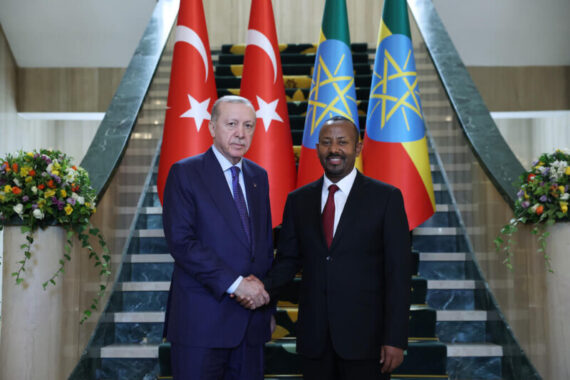
resident Recep Tayyip Erdoğan’s visit to Ethiopia is both symbolic and strategically significant, coinciding with the 100th anniversary of relations between the two countries. The opening of Türkiye’s first permanent embassy in Sub-Saharan Africa in Addis Ababa in 1926 marks a crucial milestone demonstrating the historical depth and institutional continuity of bilateral relations. However, the significance of this visit lies in the strategic direction outlined by the two leaders in their joint press conference, reflecting on the past and the direction of relations into the second century.
Following the discussions, deepening economic partnership, cooperation in defense and security, and emphasizing dialogue and stability in the face of regional crises stand out as the most important topics. When these three areas are considered together, it is seen that Türkiye-Ethiopia relations have now transcended the framework of a classic bilateral relationship and have acquired the character of a strategic partnership that can affect the geopolitical balance of the Horn of Africa.
The timing of the visit is also noteworthy in this respect. The Horn of Africa has become an area where both regional competition and global power struggles intersect. Developments across the Horn of Africa are transforming the region into an area of multi-layered geopolitical fragility. Erdoğan’s visit to Addis Ababa is significant precisely because it reaffirms Türkiye’s pursuit of stability and balance in the region amidst this climate of uncertainty.
President Erdoğan’s emphasis on expanding economic cooperation in his speech is consistent with the overall direction of Türkiye’s Africa policy. The presence of over 200 Turkish companies operating in Ethiopia and the employment they provide demonstrate the scale of economic relations. However, at this point, it is crucial that, along with increasing investment digits, these investments become production-based, technologically integrated, and connected to global supply chains.
For Ethiopia, this relationship presents a significant opportunity for economic diversification and increased production capacity. With a population approaching 130 million and being the second-largest country in Africa, Ethiopia has the potential to become a major manufacturing hub thanks to its large domestic market and young workforce. However, structural challenges such as foreign exchange shortages, access to finance problems, and bureaucratic processes remain decisive factors in ensuring the sustainability of the investment environment. The fact that the two leaders directly addressed these issues underscores the goal of establishing a more institutionalized and predictable economic cooperation in the second century of this relationship.
In this context, the transformation of economic relations into a structure that increases mutual interdependence along with trade volume and connects production networks stands out as one of the most important areas that can increase the strategic depth of relations.
The second noteworthy aspect of the visit was the messages regarding cooperation in the field of defense and security. Given the increasing security risks in the Horn of Africa, internal conflicts, border disputes, and intense competition from external actors, the strategic importance of this area becomes even more apparent.
Ethiopia is considered a central country in the region due to its population, economic weight, and geographical location. However, this central position also brings significant risks. Internal political tensions, economic pressures, and the structural disadvantages of being a landlocked country are leading the Addis Ababa administration to pursue a more active foreign policy aimed at both maintaining internal stability and increasing its regional influence.
For Türkiye, security-focused cooperation does not only mean military technical support. Ankara’s approach in the region is based on capacity building, institutional cooperation, and the goal of generating long-term stability. This framework stands out as one of the key elements that distinguishes Türkiye’s security engagement in Africa from other actors.
Although not directly stated in the leaders’ remarks, considering the regional context of the visit, Ethiopia’s pursuit of access to the sea and the resulting diplomatic tensions play a significant role in the background. The sensitivities with Eritrea and the past crises with Somalia demonstrate that this issue goes beyond mere commercial or economic matters, encompassing security and sovereignty dimensions.
Türkiye’s facilitating role in this process reveals a significant aspect of Ankara’s regional policy. Its approach of addressing Somalia’s territorial integrity concerns and Ethiopia’s economic needs within the same diplomatic framework reflects a search for a balanced solution rather than zero-sum competition. This approach points to a broader strategic perspective aimed at managing bilateral crises and preventing tensions in the Horn of Africa from impacting Red Sea security.
Given that political tensions in the Horn of Africa directly affect Red Sea security, the risks that onshore instability could pose to maritime security and global trade routes become clearer. Therefore, Türkiye’s simultaneous handling of the Horn of Africa and Red Sea issues emerges not as a preference, but as a strategic necessity.
Ethiopia is situated at the intersection of a vast geopolitical line stretching from North Africa to the Gulf, and from the Middle East to the Horn of Africa. Considering regional dynamics and the increasing engagement of extra-regional actors, Addis Ababa appears to be pursuing a multi-layered but high-risk foreign policy. In this context, the timing of President Erdoğan’s visit is noteworthy. The civil war in Sudan, sensitivities along the Ethiopia-Eritrea line, tensions with Egypt over the Nile basin, the increasing military and economic presence of extra-regional actors, and Israel’s recognition of Somaliland have transformed the Horn of Africa into an area of intense global competition.
In this multifaceted geopolitical environment, Ethiopia is pursuing a foreign policy that both seeks to capitalize on opportunities and must manage increasing risks. Deepening relations with Türkiye is important for Addis Ababa not only in the economic and defense spheres, but also in terms of expanding its diplomatic maneuvering space. For Türkiye, the relationship with Ethiopia constitutes a crucial pillar of its goal to pursue a balanced and stability-oriented policy in the Horn of Africa. Addis Ababa’s hosting of the African Union naturally adds a continental dimension to this relationship.
Recommended
The messages conveyed after the Erdoğan-Abiy Ahmed meeting reveal the fundamental approach that will guide Türkiye-Ethiopia relations in their second century. This approach reflects a strategic logic based on generating long-term stability rather than short-term tactical gains. Weakening political stability in the Horn of Africa directly impacts trade routes, port security, and regional economic projects. Similarly, security vulnerabilities in the Red Sea complicate the region’s economic integration. Therefore, Türkiye’s pursuit of diplomatic balance in regional crises while simultaneously striving to deepen economic and institutional cooperation forms a complementary strategic whole.
In conclusion, President Erdoğan’s visit to Addis Ababa should be viewed from a broader perspective than simply focusing on bilateral relations. This visit also contains important messages regarding the future of the Horn of Africa. The second century of Türkiye-Ethiopia relations, built on economic partnership, institutional cooperation, and diplomatic balance, can play a decisive role in strengthening regional stability. In this context, the most important outcome of the visit is the clarity of the direction of relations. The pursuit of a partnership that reduces tension rather than increases it, makes competition manageable rather than sharpens it, and aims for long-term stability beyond short-term gains is seen as the most fundamental outcome of this visit. Türkiye’s approach to the Horn of Africa, emphasizing balance instead of bloc formation, dialogue instead of intervention, and cooperation instead of competition, offers Addis Ababa a predictable basis for partnership.
(Originally published in Turkish by SETA Foundation)

Assistant Professor of International Relations at Mersin University and a researcher at the SETA Foundation. His research focus is the Horn of Africa.
You can see how this popup was set up in our step-by-step guide: https://wppopupmaker.com/guides/auto-opening-announcement-popups/

Stay informed by subscribing to
our weekly newsletter.
You can see how this popup was set up in our step-by-step guide: https://wppopupmaker.com/guides/auto-opening-announcement-popups/
You can see how this popup was set up in our step-by-step guide: https://wppopupmaker.com/guides/auto-opening-announcement-popups/
You can see how this popup was set up in our step-by-step guide: https://wppopupmaker.com/guides/auto-opening-announcement-popups/
You can see how this popup was set up in our step-by-step guide: https://wppopupmaker.com/guides/auto-opening-announcement-popups/