U
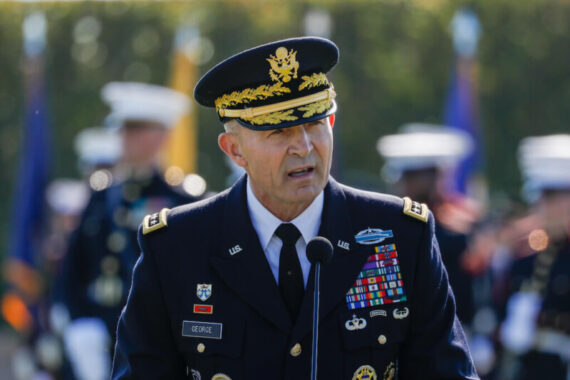
.S. Defense Secretary Pete Hegseth has dismissed Army Chief of Staff Randy George, in a rare and controversial move that underscores a sweeping reshaping of senior military leadership amid rising tensions in the Middle East, according to U.S. officials familiar with the decision.
The Pentagon confirmed late Thursday that George, the 41st Chief of Staff of the U.S. Army, would retire effective immediately, more than a year before the end of his expected four-year term. No official reason was provided for his removal, which comes at a time of heightened U.S. military activity linked to the ongoing conflict involving Iran.
The dismissal of a sitting Army chief during a period of military operations is considered highly unusual. Analysts note that such abrupt leadership changes are rare in the U.S. military, particularly during times of active deployment.
According to defense officials speaking on condition of anonymity, Hegseth has also removed other senior figures, including General David Hodne, who oversaw the Army’s Transformation and Training Command, and Major General William Green, head of the Army’s Chaplain Corps. The Pentagon has not publicly confirmed the reasons behind these decisions, adding to uncertainty within military ranks.
A sudden and tightly controlled decision-making process
General Christopher LaNeve, currently serving as vice chief of staff and a former aide to Hegseth, has been appointed as acting Army chief. Officials said senior Army leadership learned of George’s dismissal at the same time it was publicly announced, signaling a sudden and tightly controlled decision-making process.
The leadership shake-up comes as the United States continues to expand its military presence in the Middle East. While recent strikes targeting Iran have been largely carried out by naval and air forces, the Army has played a growing role in deploying air defense systems and personnel across the region.
Thousands of troops from the elite 82nd Airborne Division have begun arriving in the Middle East, raising speculation about the potential for expanded ground operations. The U.S. Army remains the largest branch of the military, with approximately 450,000 active-duty soldiers.
There had been no public indication of tensions between Hegseth and George prior to the dismissal. George, an infantry officer with combat experience in Iraq and Afghanistan, had served as Army chief since 2023 after previously holding roles as vice chief of staff and senior military adviser to former Defense Secretary Lloyd Austin.
His tenure included efforts to reform procurement processes and challenge major defense contractors, working closely with Army Secretary Dan Driscoll to accelerate weapons development and reduce costs. His removal, therefore, has raised questions about whether policy differences or internal disagreements may have played a role.
Recommended
Upheaval within the Pentagon
The latest firings are part of a broader pattern of upheaval within the Pentagon. In the past year, several high-ranking officials have been dismissed or replaced, including former Chairman of the Joint Chiefs of Staff General C.Q. Brown, as well as the chief of naval operations and the Air Force vice chief of staff.
Hegseth, a former media figure who transitioned into government, has moved quickly to assert control over the Department of Defense, pursuing a series of controversial decisions. These have included reversing internal Army investigations and planning large-scale military events tied to symbolic anniversaries.
While the Pentagon has publicly thanked George for his decades of service, the lack of transparency surrounding his removal has fueled concern among some observers about stability and continuity in military leadership during a volatile period.
Experts warn that frequent changes at the top could complicate strategic planning and coordination, particularly as the United States navigates an increasingly complex global security environment. With tensions escalating in multiple regions, including the Middle East and Eastern Europe, the role of experienced military leadership is seen as critical.
As of now, neither George nor his office has issued a public statement regarding the dismissal. The Pentagon has also declined to elaborate further on the reasons behind the decision.
The abrupt leadership change leaves unanswered questions about the direction of U.S. military strategy and the internal dynamics shaping decision-making at the highest levels of the Pentagon.
(Source: Reuters)