Israel’s Quest for Hegemony and Iran’s New Geopolitics

April 9, 2026

Iran’s operational doctrine is largely shaped by the concept of the ‘indirect approach’ and aims to exert structural pressure on the US and Israel by increasing the global economic cost of the war.
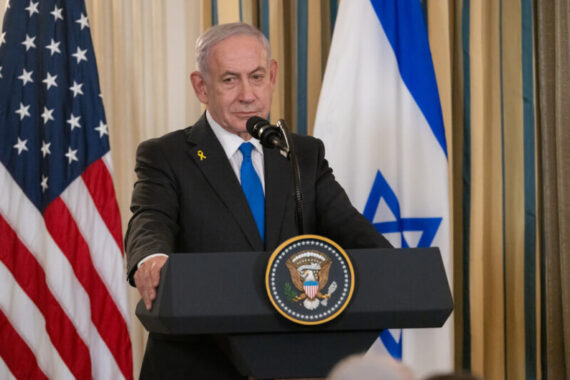
Israeli Prime Minister Benjamin Netanyahu listens a President Donald Trump gives opening remarks during a press conference in the State Dining Room of the White House in Washington, DC on September 29, 2025. Photo by Anadolu Images.

T

he war launched by the US-Israel alliance on 28 February 2026 through a direct attack on Iran has, within the current geopolitical equation, evolved from a limited conflict into a multi-layered and multi-actor regional security crisis. The military escalation between these three countries has not been confined to traditional front lines; through Iran’s asymmetric warfare strategy, it has spread across the entire region via energy fields, sea lanes and proxy forces, evolving into a global issue in terms of its consequences.

Understanding these dynamics necessitates setting aside normative approaches and the reflex to take sides, and instead viewing the situation through an objective and analytical lens from an international relations perspective. Consequently, this article will attempt to clarify the current positions of Israel and Iran in light of these projections.

What is Israel’s objective?

Israel’s regional moves, initiated following 7 October 2023 and escalating into a full-scale war with direct US involvement by 28 February 2026, represent an attempt to establish a new status quo along a broad geopolitical axis stretching from the Eastern Mediterranean to the Gulf of Basra, from the Red Sea to the Strait of Bab el-Mandeb and the Arabian Sea. This multi-dimensional strategy, in which military expansion, control of energy resources and demographic engineering tools are mobilized in concert, is aimed at becoming a ‘proxy hegemonic power’ by exploiting power vacuums in the Middle East.

At the heart of Israel’s new regional strategy lies the dismantling of Iran—which it has designated as its greatest enemy—and its network of proxy forces. In this context, Tel Aviv has succeeded in integrating American military power into its own strategy, thereby risking an open-ended and protracted regional war launched on 28 February. Washington, however, has been swept into a position serving Tel Aviv’s priorities due to the extreme vagueness of the ultimate strategic objective in this war.

The target set for Israel’s military attack on Iran, with US support, goes beyond a mere act of military weakening, focusing instead on the total elimination of Tehran’s leadership, command-and-control, deterrence and institutional survival capabilities. In this regard, the Tel Aviv-Washington alliance aims to paralyze Iran’s asymmetric force projection at its source by destroying integrated air defense systems, ballistic missile production facilities and nuclear infrastructure in critical locations such as Tehran, Isfahan, Shiraz and Kerman. Another move in the alliance’s military doctrine involves conducting systematic decapitation operations targeting the Revolutionary Guide and senior Revolutionary Guards generals, with the aim of collapsing the regime’s ‘centre of gravity’.

Israel’s quest to establish a new regional status quo

This multi-layered set of objectives represents the most aggressive manifestation of Israel’s quest to establish a new regional status quo by sidelining its greatest adversary in the regional power balance along the axis extending from the Eastern Mediterranean to the Gulf, where it has initiated a process of hegemonic consolidation. However, as a backlash to this strategy, Iran is far more eager to acquire nuclear weapons than it was in the pre-war period. This motivation could materialize in the near future.

Israel’s new strategy relies not only on military objectives but also on the control of regional energy resources and strategic territories by land and sea. Seizing the opportunity presented by the power vacuum in Syria, Israel has established a permanent forward base by occupying the Syrian side of the strategic Mount Hermon (Jebel al-Sheikh) following intensive air strikes that paralysed the military infrastructure, thereby expanding its influence in Western Syria. In the context of energy and maritime geopolitics, Israel is expanding its exclusive economic zones by securing control over disputed natural gas fields in the Eastern Mediterranean—such as Gaza Marine, Karish and Kana (where some agreements were reached with Lebanon in October 2022)—as well as energy reserves like Leviathan and Tamar.

The desire to control a corridor extending as far as the Litani River in Lebanon is based on the logic of securing access to water resources and safeguarding maritime energy objectives from land. Furthermore, projects such as the EastMed pipeline and structures like the Eastern Mediterranean Gas Forum (EMGF) have become exclusionary geopolitical mechanisms instrumentalised to exclude regional rivals such as Turkey from the energy equation and to reinforce maritime asymmetries in its favour.

Iran’s new geopolitics

Tehran’s decision to launch simultaneous attacks targeting US military bases and strategic economic infrastructure across the Gulf region has created a new geopolitical rupture in the Middle East that is virtually unprecedented. These actions have gone beyond a mere cycle of regional tensions, triggering a structural transformation in the region’s security dynamics. Given the reality that the Iranian regime will not collapse in the near future despite the severe military pressure it faces, this regional crisis will reshape security relations and geopolitical balances in the Middle East for years to come.

Iran’s operational doctrine is largely shaped by the concept of the ‘indirect approach’ and aims to exert structural pressure on the US and Israel by increasing the global economic cost of the war. Through this strategy, Tehran seeks to spread the conflict across a wide geographical area and, in particular, to raise the global economic cost of the war by effectively closing the Strait of Hormuz and increasing pressure on energy routes and trade corridors. Ultimately, this doctrine seeks to exert structural and political pressure on the US and Israel—going beyond mere military success—by depleting expensive defence systems with low-cost munitions and imposing inflationary pressure on global markets.

In this context, more than half of Iran’s ballistic missile and unmanned aerial vehicle (UAV) attacks in the region have been directed not at US or Israeli targets, but at Gulf Arab states. Although this strategy, which Iran has adopted at great cost to avoid ‘losing’, deepens its regional isolation, it has been seen to generate severe shockwaves on a global scale; particularly in global oil markets. In terms of escalation dynamics, Iran’s greatest trump card is the desalination plants that supply 90 per cent of the Gulf Arab states’ water needs. Targeting these facilities would trigger a crisis of existential proportions in the region. The US and Israel’s response to this could be to target Kharg Island, Iran’s oil export hub, and its domestic energy infrastructure. However, in the current state of the conflict, both sides are deliberately crossing escalation thresholds through calculated moves.

Paradoxical consequences

Iran’s direct attacks on military and civilian targets in Arab Gulf states such as Bahrain, Kuwait, the United Arab Emirates and Saudi Arabia necessitate a fundamental shift in the region’s security and economic doctrines. The strategy of Gulf states—which in recent years have sought to reduce their dependence on the US and diversify their defense alliances by strengthening ties with actors such as China and Russia—is losing its credibility in the face of mounting direct threats. In other words, the most critical and paradoxical geopolitical outcome of Iran’s asymmetric escalation strategy has been the collapse of the Gulf states’ quest for strategic autonomy. The Gulf Arab states have been forced to confront the reality that the economic prosperity they have built possesses a structure that is highly vulnerable to asymmetric threats.

The escalating conflict spiral that has spread across the entire region since 7 October 2023 is transforming the Gulf into a theatre of war, thereby undermining global capital’s interest and investment. This situation is forcing the Gulf capitals to seek refuge once again in the US as their primary security guarantor and, paradoxically, is further consolidating the American military presence in the region—the very presence that Tehran aims to weaken. Iran’s attacks are undermining the foundation of mutual trust in the Gulf, thereby diminishing the likelihood of constructing a potential multilateral collective security architecture. Ultimately, in the current context where energy, water resources and trade routes have ceased to be merely economic assets and have become fully militarized, the Middle East has evolved into a harsh arena of power struggle in the short and medium term, dominated by bloc formation, asymmetric infrastructure threats and Israel’s quest to become a proxy hegemon, rather than integration and diplomatic compromise.

From Israel’s perspective, however, every possible scenario on the ground is recorded as a strategic gain for the Netanyahu administration. Even if the Iranian regime continues to resist, should it emerge from the war with its capabilities eroded, Israel will have secured a strategic timeframe spanning decades in its favor by weakening its greatest enemy’s nuclear, ballistic missile and UAV infrastructure at its source. Indeed, even the possibility of the Iranian regime becoming further radicalized as an existential reflex under heavy pressure would serve as a perfect pretext for Israel to impose its aggressive war and containment doctrine against Iran on the region.

(Originally published in Turkish by Kriter)

İsmail Sarı graduated from the Department of History at Istanbul University in 2001 and received his master's degree in History and International Relations from the same university. Receiving the best doctoral dissertation award in 2016, Sari served as a post-doctoral researcher at Columbia University between 2018 and 2019 and as a visiting professor at the Missouri State University during his studies in the United States. Sarı's research focus concerns Iranian foreign policy and contemporary Iranian and US politics. Sari is currently working as a lecturer at Ankara Hacı Bayram Veli University.