UNHCR: Global Displacement Falls for First Time in a Decade

June 11, 2026

Although the decline in global displacement offers a rare positive development after years of rising refugee numbers, UNHCR officials cautioned against viewing the figures as evidence that the global refugee crisis has been resolved.
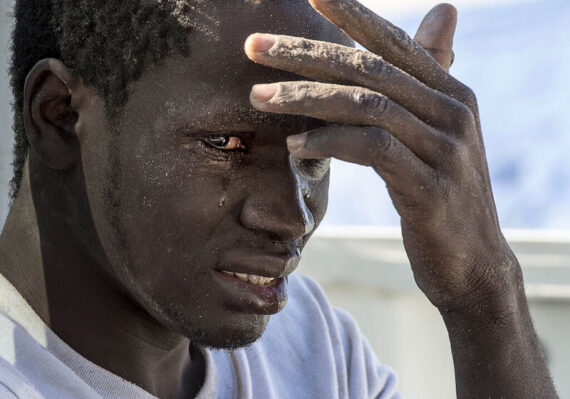
A file photo dates March 13, 2015 shows An illegal migrant reacts at the coast of Souq al Jum'aa region in Tripoli, Libya after they got captured. Total of 97 illegal migrants from Senegal, Mali, Cameroon, Nigeria and Liberia got caught by Libyan Security Forces as they were en route to Italy after their boat broken in Tripoli. Photo by Anadolu Images.

T

he number of people displaced by conflict, persecution, and violence worldwide fell in 2025 for the first time in more than a decade, according to a new report released by the United Nations refugee agency on Thursday. However, the agency warned that millions of refugees remain trapped in prolonged displacement, often spending years or even decades away from their homes with little prospect of rebuilding their lives.

The report by the United Nations High Commissioner for Refugees (UNHCR) found that 5.4 million people were newly displaced during 2025, while a significant increase in refugee and internally displaced persons returning home contributed to a decline in overall displacement figures.

Despite the improvement, the agency estimated that there were still 41.6 million refugees and people in refugee-like situations around the world by the end of the year, including approximately 6 million Palestinian refugees.

UNHCR officials described the figures as a mixed picture, highlighting both encouraging signs of return and persistent challenges facing millions who remain displaced.

“Displacement levels remain extraordinarily high despite the positive trend in returns,” the agency said, stressing that many returnees face insecurity, economic hardship, and damaged infrastructure upon returning to their countries.

Record returns drive decline

A key factor behind the decline in global displacement was a sharp increase in the number of refugees and internally displaced persons returning home.

According to the report, around 14.7 million people returned to their places of origin in 2025, representing a 50 percent increase compared with the previous year and marking the second-highest annual return figure recorded since UNHCR began tracking such data in 1965.

The majority of those returns took place in six countries: Afghanistan, Syria, Sudan, the Democratic Republic of the Congo, Ukraine, and Myanmar.

While the figures suggest growing opportunities for return in some conflict-affected countries, UNHCR cautioned that many people went back to difficult and often unstable conditions.

In several countries, returnees encountered damaged infrastructure, limited access to healthcare and education, ongoing insecurity, and weak economic prospects, raising questions about the long-term sustainability of their return.

Afghan returns surge

Afghanistan recorded one of the most dramatic shifts in refugee movements during 2025.

UNHCR reported that approximately 2.9 million Afghans returned home during the year, including 1.9 million refugees. The number was five times higher than in 2024 and significantly reduced the global Afghan refugee population from 5.8 million to 3.7 million.

The agency attributed much of the increase to stricter immigration and residency policies introduced by neighboring Iran and Pakistan, which host some of the world’s largest Afghan refugee populations.

Many Afghans reported feeling compelled to return rather than making a fully voluntary decision, according to the report.

The findings underscore the complex nature of refugee returns, where movements are not always driven by improved conditions in countries of origin but sometimes by changing policies in host states.

Syria sees major shift

The report also highlighted significant changes in Syria, long regarded as one of the world’s largest displacement crises.

Following the collapse of the government of former Syrian President Bashar al-Assad in December 2024, approximately 1.3 million Syrians returned to their homes during 2025. The figure was nearly three times higher than the previous year and contributed to a reduction in the global Syrian refugee population from 6 million to 4.9 million.

However, UNHCR warned that the challenges facing returning Syrians remain severe.

Large parts of the country continue to suffer from widespread destruction caused by years of conflict. Many communities lack basic services, employment opportunities remain scarce, and sporadic violence continues in some regions.

The agency stressed that successful return requires not only physical safety but also access to housing, education, healthcare, and economic opportunities.

New crises emerging

While displacement declined overall in 2025, the report noted that new conflicts have already begun influencing global displacement patterns in 2026.

According to UNHCR estimates, around 3.2 million people have been temporarily displaced within Iran following joint U.S.-Israeli military strikes launched at the end of February.

In neighboring Lebanon, approximately one million people have been forced from their homes since the outbreak of war in March amid Israeli military operations and evacuation orders.

The developments highlight how rapidly new conflicts can generate large-scale humanitarian emergencies even as older crises begin to stabilize.

Humanitarian agencies have expressed concern that funding shortages could hamper efforts to assist newly displaced populations while continuing support for long-term refugee communities.

A central focus of the report is UNHCR’s effort to address what it describes as “protracted displacement”, situations in which refugees remain displaced for years without durable solutions.

According to the agency, about 70 percent of the world’s refugees have lived in exile for five years or longer. Many reside in countries such as Lebanon, Jordan, Turkey, and Iran, where refugee communities have become a long-term reality.

To address the problem, UNHCR has launched an initiative aimed at halving the number of refugees and others in long-term displacement requiring humanitarian assistance by 2035.

The strategy emphasizes expanding access to education, employment, and economic opportunities, particularly in low- and middle-income countries that host the majority of the world’s refugees.

UNHCR High Commissioner Barham Salih said refugee protection must remain a priority, but stressed that humanitarian aid alone cannot solve the problem.

“Asylum and protection are life-saving and not up for debate, but we cannot accept a future in which millions of refugees remain trapped for years or decades without realistic prospects of rebuilding their lives,” he said.

The initiative also seeks to promote voluntary and sustainable returns where conditions permit while supporting refugees’ ability to become economically self-sufficient in host countries.


Cautious optimism

Although the decline in global displacement offers a rare positive development after years of rising refugee numbers, UNHCR officials cautioned against viewing the figures as evidence that the global refugee crisis has been resolved.

Conflicts continue to drive displacement across multiple regions, and millions remain unable to return home safely.

The report concludes that while increased returns in countries such as Afghanistan and Syria contributed to a reduction in refugee numbers, lasting solutions will require sustained international support, political stability, and long-term investment in recovery and reconstruction.

For the world’s displaced populations, the agency said, the challenge is no longer simply finding safety but securing a future beyond years of uncertainty and dependence on humanitarian assistance.

(Source: Reuters)

Politics Today is dedicated to publishing insightful analyses in order to understand the changing nature of contemporary politics. It aims to contribute to the sound and constructive discussion of international affairs.