Nine Dead as Thousands of Migrants Cross into Spain's Ceuta Enclave from Morocco
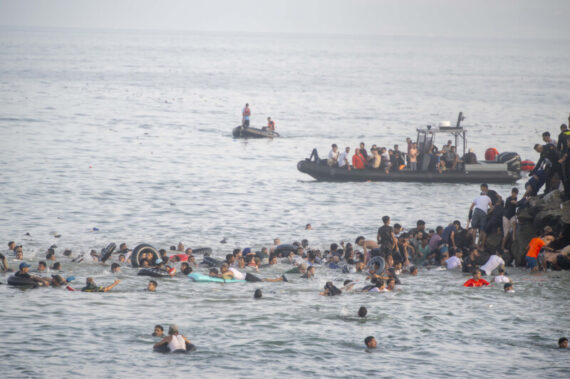
Authorities in Ceuta said 1,500 to 2,000 migrants had entered the enclave over the past 10 days, with hundreds more arriving on Thursday.
July 31, 2026
A
t least nine people have died after thousands of migrants crossed from Morocco into the Spanish enclave of Ceuta in one of the largest surges in recent years, prompting local authorities to declare a humanitarian emergency and request military assistance.
Authorities in Ceuta said between 1,500 and 2,000 migrants had entered the enclave over the past 10 days, with hundreds more arriving on Thursday alone. Regional President Juan Jesús Vivas described the situation as an “absolute humanitarian and social emergency” and urged Spain’s central government to deploy troops to help restore control at the border.
Spain’s Interior Ministry rejected calls to declare a national emergency, saying such measures do not apply to migration crises, but announced that 60 soldiers would be deployed to reinforce border security.
Video footage showed groups of migrants entering the territory by sea, many using inflatable flotation devices to swim around border barriers from the Moroccan coast. Others crossed by land after scaling border fences, according to Spanish media reports.
Some migrants were heard shouting “Viva España!” as they entered the enclave.
Zakaria Zarroqui, a migrant rights activist, told Reuters the latest influx resembled the mass crossing in May 2021, when about 10,000 Moroccan and sub-Saharan migrants entered Ceuta within days.
“The situation remains out of control as we speak,” Zarroqui said, adding that people continued gathering in the Moroccan border town of Fnideq in an attempt to reach the Spanish territory.
Recommended
Ceuta, together with the nearby Spanish enclave of Melilla, forms the European Union’s only land border with Africa and has long been a focal point for migrants seeking to reach Europe.
The surge follows a recent ruling by Spain’s Supreme Court that migrants intercepted at sea while attempting to reach Ceuta or Melilla cannot automatically be returned to Morocco.
“It has been a slow trickle since the Supreme Court’s ruling, but today has been an explosion,” a spokesperson for Spain’s Guardia Civil told Reuters.
Spain’s Interior Ministry said it was working closely with Moroccan authorities to respond to the increase in irregular crossings, accusing human smuggling networks of exploiting the court ruling to encourage migrants to attempt the journey.
Interior Minister Fernando Grande-Marlaska is expected to visit Ceuta on Friday to assess the situation and coordinate the government’s response.
(Source: Aljazeera English)

Politics Today is dedicated to publishing insightful analyses in order to understand the changing nature of contemporary politics. It aims to contribute to the sound and constructive discussion of international affairs.
You can see how this popup was set up in our step-by-step guide: https://wppopupmaker.com/guides/auto-opening-announcement-popups/

Stay informed by subscribing to
our weekly newsletter.
You can see how this popup was set up in our step-by-step guide: https://wppopupmaker.com/guides/auto-opening-announcement-popups/
You can see how this popup was set up in our step-by-step guide: https://wppopupmaker.com/guides/auto-opening-announcement-popups/
You can see how this popup was set up in our step-by-step guide: https://wppopupmaker.com/guides/auto-opening-announcement-popups/
You can see how this popup was set up in our step-by-step guide: https://wppopupmaker.com/guides/auto-opening-announcement-popups/