Israel’s Expanding ‘Yellow Lines’ Reshape Gaza and Southern Lebanon

October 14, 2026

Israeli military-controlled zones continue to expand across Gaza and southern Lebanon, displacing civilians, restricting access to homes and farmland, and raising concerns over prolonged occupation.
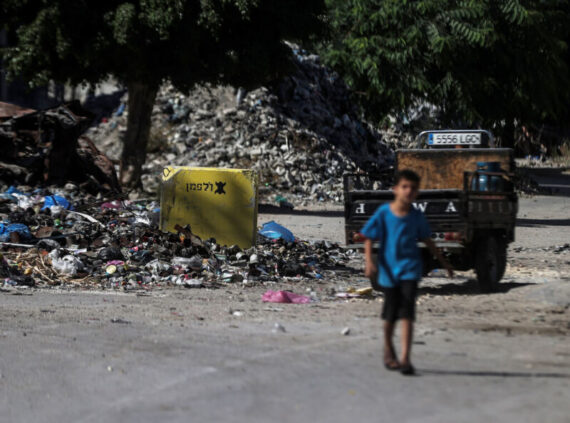
A view of a yellow block as the Israeli forces placed new yellow concrete blocks at the Sanfura junction continuing to expand the area known as the 'Yellow Line' despite the ceasefire in western Gaza City, Gaza, Palestine, on July 27, 2026. Photo by Anadolu Images.

I

srael’s expanding military-controlled zones in Gaza and southern Lebanon are reshaping both territories despite US-brokered ceasefire agreements, as shifting boundaries, widespread demolitions and restrictions on civilian movement leave hundreds of thousands of displaced families uncertain about whether they will ever return home.

The so-called “Yellow Line”, used by Israel to demarcate areas under its military control, has emerged as a defining feature of the post-ceasefire landscape in both territories, according to separate Al Jazeera reports published on October 12 and 14.

In Gaza, Israeli control and access restrictions now cover approximately 65 percent of the territory, confining 2.1 million Palestinians to the remaining 35 percent. In southern Lebanon, Israeli troops continue to occupy a zone extending up to 10 kilometers into Lebanese territory, where entire villages have been demolished and residents remain unable to return.

Although the circumstances and agreements governing the two territories differ, analysts cited by Al Jazeera say the expanding military boundaries reflect a similar pattern of territorial control, population displacement and destruction of civilian infrastructure.

Gaza’s shrinking territory

A year after the US-brokered Gaza ceasefire, Israel has expanded its military-controlled territory beyond the original Yellow Line established under US President Donald Trump’s 20-point plan to end the war.

The agreement initially required Israeli forces to withdraw to the demarcation within 24 hours, with further withdrawals expected in subsequent phases.

Instead, Israeli troops have repeatedly moved the yellow concrete blocks marking the boundary farther west, bringing additional Palestinian neighbourhoods and agricultural areas under military control.

On Sunday, Israeli forces reportedly relocated the blocks dozens of metres west in Shujayea, southeastern Gaza City, forcing more Palestinian families to flee.

“It’s not simply about where the ‘Yellow Line’ is today but where it can move next,” Al Jazeera correspondent Ibrahim al-Khalili reported from Gaza City.

The original ceasefire arrangement left Israel controlling approximately 53 percent of Gaza, restricting Palestinians to 172 square kilometres of the 365-square-kilometre territory.

Research organisation Forensic Architecture estimated that Israeli control had expanded to 58 percent by December. In March, the Israeli military introduced an additional restricted area, described as the “orange line”, requiring humanitarian organisations to coordinate movements with the army.

According to the UN Office for the Coordination of Humanitarian Affairs (OCHA), military control and access restrictions now cover 65 percent of Gaza.

The remaining population is concentrated within approximately 128 square kilometres, increasing population density to nearly 16,000 people per square kilometre, almost three times its prewar level.

Each resident has an average of just 61 square metres of land, compared with approximately 160 square metres before the war.

The humanitarian consequences are compounded by extensive destruction. The UN Satellite Centre estimates that 82 percent of Gaza’s structures have been damaged or destroyed, while the Food and Agriculture Organization says only 3 percent of its cropland remains both undamaged and accessible.

More than 950,000 Palestinians are living in displacement sites vulnerable to flooding, predominantly in tents and makeshift shelters.

Approaching the Yellow Line also poses significant dangers. Nearly 1,500 Palestinians have been killed across Gaza since the ceasefire was announced, according to figures cited by Al Jazeera.


Southern Lebanon faces a similar pattern

A comparable military demarcation has emerged in southern Lebanon, where Israeli forces continue occupying substantial territory despite a framework agreement signed with Lebanon in June.

The agreement, reached through US-brokered negotiations, was intended to facilitate a phased Israeli withdrawal and establish pilot zones where Lebanese Armed Forces personnel would replace Israeli troops and disarm Hezbollah forces.

However, Israel continues to occupy territory extending up to 10 kilometres north of the border, while demolitions of homes and infrastructure have continued behind the Yellow Line.

Israeli Defence Minister Israel Katz has previously indicated that Israeli forces would not withdraw from Lebanon, raising concerns about an extended occupation.

The latest Israeli military campaign followed Hezbollah rocket fire on March 2, which the group described as retaliation for repeated Israeli violations of the November 2024 ceasefire and the assassination of Iranian Supreme Leader Ayatollah Ali Khamenei.

Israel subsequently intensified its military operations and reinvaded southern Lebanon, displacing more than 1.2 million people.

According to Al Jazeera, approximately 50 frontline villages, including Khiam and Bint Jbeil, have suffered extensive destruction.

Mohamad Bazzi, a New York-based political analyst originally from southern Lebanon, said the destruction reflected an effort to make entire communities uninhabitable.

“Israel’s primary goals were to empty, depopulate, and make those dozens of frontline villages and towns uninhabitable,” he told Al Jazeera, describing the approach as an application of the Gaza model to Lebanon.

Ahmad Baydoun, a Lebanese architect and open-source researcher based in the Netherlands, said the Yellow Line had effectively become a fixed military boundary despite the ceasefire.

He argued that continued demolitions suggested the ceasefire was being applied differently to Israeli-occupied territory than to the rest of Lebanon.

Displacement risks becoming permanent

Beyond the Yellow Line, discussions in Israel about establishing an additional “Grey Line” have intensified concerns about the future of southern Lebanon.

According to reports cited by Al Jazeera, the proposed boundary could extend approximately four kilometres into Lebanese territory, creating an uninhabited buffer zone where civilians would be prohibited from rebuilding their homes.

Restrictions also affect residents who remain in villages under Israeli control.

Baydoun said access to agricultural land increasingly depends on checkpoints and military coordination, describing the emerging system as the “West Bankification of those who remained”.

The consequences extend beyond immediate military operations.

Even if Israeli forces eventually withdraw, widespread destruction of housing, roads, agricultural land and essential infrastructure could prevent displaced communities from returning for years.

Ali, a displaced resident of Khiam currently renting accommodation in Hasbaiyya, said his hometown had become uninhabitable.

“Khiam is destroyed, there’s nothing, it’s uninhabitable for the next 10, 15, 20 years,” he told Al Jazeera.

Across Gaza and southern Lebanon, the expanding Yellow Lines have therefore become more than military demarcations. They increasingly determine where civilians can live, whether they can access their land and how much territory remains available for reconstruction.

With withdrawals stalled and destruction continuing, both territories face growing uncertainty over whether temporary ceasefire arrangements are evolving into prolonged systems of territorial control and displacement.

(Source: Aljazeera English)

Politics Today is dedicated to publishing insightful analyses in order to understand the changing nature of contemporary politics. It aims to contribute to the sound and constructive discussion of international affairs.