Muslim Families in India Face Detention and Deportation After Removal From Voter Rolls

November 16, 2026

A Reuters investigation found that several Muslim families in the eastern state of West Bengal in India had faced immigration-related action despite possessing Indian identity documents.
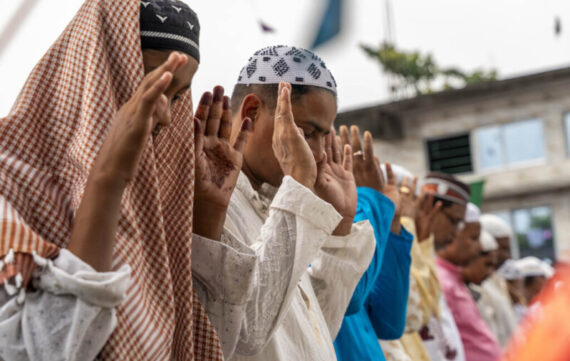
Indian Muslims perform the Eid al-Adha (Feast of Sacrifice) morning prayer at an Eidgah in Barpeta, India, on May 28, 2026. Photo by Anadolu Images.

A

sweeping revision of India’s electoral rolls has left millions of people facing uncertainty over their citizenship, with some Muslim residents reporting detention, deportation and questioning by authorities after their names were removed from voter lists.

A Reuters investigation published Monday found that several Muslim families in the eastern state of West Bengal had faced immigration-related action despite possessing Indian identity documents and having relatives whose names remained on the electoral rolls.

Among those affected is Sahida Fakir, a 38-year-old woman who says Indian authorities forced her across the border into Bangladesh after detaining her in Mumbai in July. More than three months later, she remains in a Bangladeshi village, separated from her husband and two children.

Fakir told Reuters that plainclothes officers seized her phone, which contained copies of her identity documents, before transferring her to border authorities and sending her into Bangladesh.

“Someone grabbed my hand from behind and ordered me to get into the vehicle,” she said, describing her detention.

She is among 10 families interviewed by Reuters whose relatives were detained, deported or questioned about their citizenship after being removed from India’s revised voter rolls.

The cases have raised concerns about the relationship between electoral registration and immigration enforcement, particularly because removal from a voter list does not in itself establish that an individual is a foreign national.

The controversy has intensified debate over the treatment of India’s Muslim minority under Prime Minister Narendra Modi’s Hindu nationalist Bharatiya Janata Party (BJP), which has governed the country since 2014. Rights groups have accused the government of pursuing policies that disproportionately affect Muslims, allegations the BJP rejects.

Voter roll revision raises citizenship concerns

The revision removed approximately 130 million names from electoral rolls nationwide, making it the largest deletion of voters in India’s history.

West Bengal became a major focus of the exercise, with approximately nine million names removed ahead of state elections earlier this year. According to the Kolkata-based Sabar Institute, Muslims accounted for around 70 percent of the 2.7 million names deleted following a more detailed review, despite representing approximately 27 percent of the state’s population.

The BJP subsequently won the state election and took control of West Bengal for the first time.

Sabir Ahamed, founder of the Sabar Institute, said voter deletions had played a significant role in determining the election outcome, alongside dissatisfaction with the previous state government.

The revision has also sparked protests and accusations that the BJP was attempting to reshape the electorate in its favor. The party has denied targeting legitimate Indian citizens.

The connection between voter registration and the government’s campaign against suspected illegal immigration has become particularly contentious following comments by Home Minister Amit Shah.

Speaking at a rally in Haryana on November 5, Shah explicitly linked the removal of names from electoral rolls to the identification and expulsion of alleged undocumented migrants.

“It is the BJP’s resolve that we will detect infiltrators, remove them from the electoral rolls, and after that, we will pick them out one by one and expel them from the country,” he said.

West Bengal has been a major focus of immigration enforcement, particularly involving Bengali-speaking Muslims.

The issue is politically and historically sensitive because the 1947 partition of British India divided Bengal between India and Pakistan, while the 1971 war that led to Bangladesh’s independence triggered another major movement of people across the border. Families and communities have since maintained connections on both sides of the frontier.

India’s Home Ministry, the Prime Minister’s Office and the Election Commission did not respond to Reuters’ requests for comment.

Deportations and detentions face legal challenges

Fakir’s case has become one of the most prominent examples of the legal uncertainty facing people removed from the electoral rolls.

According to court documents, Mumbai police said she had been transferred to the Border Security Force and subsequently deported to Bangladesh through designated authorities. She was among 149 people deported during the operation after being identified by Indian officials as Bangladeshi nationals.

Fakir disputes the authorities’ account, insisting that her family has lived in India for generations.

Records reviewed by Reuters show that her parents and grandparents were registered voters in West Bengal from India’s first national election in 1952. Their names also appeared on electoral rolls from 2002-03, a reference period used in the latest revision to determine eligibility for continued registration without additional documentation.

Fakir herself had appeared on the state’s electoral rolls since at least 2008, according to her voter identification card reviewed by Reuters.

Her family filed a petition before India’s Supreme Court in August, arguing that removal from the electoral rolls could not be used as proof of foreign citizenship and that deportation based on an untested government assertion was unlawful.

However, Mumbai’s Foreigners Regional Registration Office told the Calcutta High Court that Fakir had presented a Bangladeshi birth certificate during an inquiry and failed to provide credible documentary evidence establishing her Indian citizenship.

Fakir rejected that account, saying officials had confiscated her phone and prevented her from presenting copies of documents stored on the device. Indian law does not require citizens to carry identification documents at all times.

Another case before the Calcutta High Court involves Nasiruddin Sheikh, a utensil seller who said he was detained alongside 22 other people while working in the central Indian state of Chhattisgarh.

Sheikh said 19 detainees were released after 14 days when authorities confirmed their names appeared on the revised electoral rolls. He and three others whose names remained absent were held for 32 days.

“A policeman told me, ‘Your name is not in the voter list. You are a Bangladeshi,’” Sheikh told Reuters.

He described the detention facility as resembling a prison, with a large hall containing beds for more than 60 people. Detainees underwent medical examinations and biometric registration before being confined.

Police and government lawyers have told the Calcutta High Court that West Bengal does not operate permanent detention camps.

Nevertheless, Reuters reporters visiting a holding center for suspected foreign migrants in Murshidabad observed clothes hanging inside the compound and people looking through its windows. An ambulance and a covered police bus were also present within the guarded facility.

Human rights activist Kirity Roy said the growing number of legal challenges had overwhelmed the system, leaving affected families waiting for decisions.

He said millions of cases concerning electoral roll deletions were awaiting consideration by special tribunals, raising concerns about delays and access to justice.

The controversy has placed India’s voter registration process at the center of a wider dispute over citizenship, migration and minority rights. As legal challenges continue, the cases of Fakir, Sheikh and other affected residents highlight the consequences of linking electoral eligibility with efforts to identify and deport suspected undocumented migrants.

(Source: Reuters)

Politics Today is dedicated to publishing insightful analyses in order to understand the changing nature of contemporary politics. It aims to contribute to the sound and constructive discussion of international affairs.