Hezbollah’s “Resistance”: The Disarmament Process Through the Lens of Lebanon and the Regional Equation

November 12, 2026

Although Hezbollah avoids directly linking the question of its weapons to Iran, developments on the ground and the group’s determination to preserve its arsenal intersect with Tehran’s regional strategy.
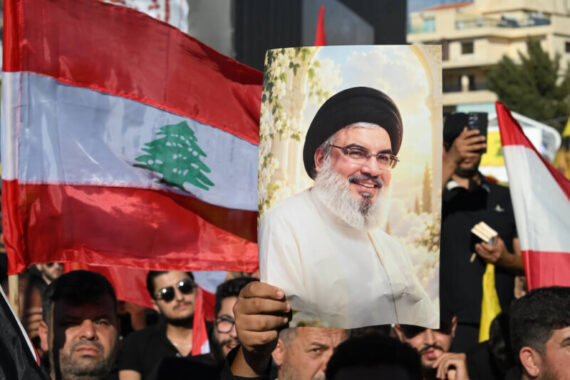
People commemorate the former Hezbollah Secretary-General Hassan Nasrallah, who was killed in an Israeli attack, with a ceremony on the second anniversary of his death, in Dahieh district of Beirut, Lebanon on September 27, 2026. Photo by Anadolu Images.

O

n October 20, 2026, the negotiating process entered a new phase as Lebanese and Israeli officials met for the eighth time in the United States. Although the June Tripartite Framework Agreement had raised expectations that diplomatic initiatives between the two countries could produce tangible results, developments on the ground had already called the agreement’s viability into question from the outset. As a result, negotiations initially aimed at securing a ceasefire and launching a peace process between Lebanon and Israel evolved into something different at the latest meeting in October. Rather than focusing primarily on peace or normalization, the parties moved toward a negotiating framework centered on their respective security parameters.

This shift, driven largely by Israel’s own security doctrine and its military objectives and plans in Lebanon, has not diminished Lebanon’s demands for an end to Israeli operations in southern Lebanon and the withdrawal of Israeli forces from Lebanese territory. However, Israel’s insistence on using Hezbollah as a justification for maintaining its occupation on the ground has effectively brought efforts to establish a withdrawal timetable to a standstill.

One of the key questions at this stage is how Lebanon can move beyond the existing plan and pursue the disarmament of Hezbollah. The group’s uncompromising position on its weapons, combined with the Beirut government’s extremely limited room for maneuver in the face of that stance, has prevented any tangible progress so far. Meanwhile, the possibility of a renewed US-Iran war and the prospect of Hezbollah becoming involved in the conflict are making it even more difficult for Lebanon to remain outside the dynamics of a regional war. Lebanon is therefore caught between domestic political balances and the question of Hezbollah’s disarmament on the one hand, and external pressure and the possibility of a new regional conflict on the other. Under these circumstances, the central question is not so much how far Beirut can maintain its current political course, but whether it can develop an alternative strategy capable of extricating the country from this multidimensional predicament.

The resistance front in Lebanon

One of the most notable developments in the process of disarming Hezbollah has been the group’s growing use of the rhetoric of “resistance” not only in reference to its struggle against Israel, but also against the Lebanese government. Although Hezbollah continues to defend its weapons as a necessity in the face of Israeli occupation, it has increasingly directed its rhetoric toward the Lebanese front. By warning that any pressure aimed at disarming the group could lead to a political crisis or civil war, Hezbollah has made its opposition to the process unmistakably clear. This has also contributed to a growing emphasis on the dangers of internal discord and civil conflict.

Such rhetoric was frequently used during Hassan Nasrallah’s leadership. Although it took on a softer tone under Naim Qassem, it hardened again following the agreement with Israel, partly in response to public reaction. It has since become one of the main instruments through which Hezbollah exerts pressure on the Lebanese government.

In this context, reactions from the Shiite political camp to the Lebanon-Israel agreement emerged shortly after it was announced in Washington, with the Lebanese government directly targeted and social dynamics brought into play. Parliament Speaker Nabih Berri’s negative stance toward the agreement was reflected in his statement: “My people in Lebanon, all of Lebanon. This is sedition.” Hezbollah Secretary-General Naim Qassem, meanwhile, described the agreement as “humiliation, shame, and a surrender of sovereignty.” By placing the political crisis with the Lebanese government at the center of the debate, these statements transformed the issue into one affecting the country’s internal political balance and social cohesion.

Another factor deepening tensions between Hezbollah and the Lebanese government is that some criticism directed at Hezbollah has overlapped with Israel’s security rhetoric. Foreign Minister Youssef Rajji’s statement that Hezbollah’s weapons legitimize the Israeli occupation was a particularly notable development, as it framed the group’s armed presence as a factor providing justification for the continuation of the occupation.

In a similar vein, US Ambassador to Lebanon Michel Issa, commenting on Israeli attacks, said that a distinction must be made between the party launching an attack and the party responding to it. “We cannot simply say that Israel is attacking without remembering who started it,” he said. His remarks reopened debate over how responsibility for the Israeli occupation should be addressed. His further statement that “If you do not attack, Israel will not respond. But if you attack, Israel will respond forcefully” also risked provoking stronger reactions from Hezbollah and political circles close to the group.

This situation, in which criticism of Hezbollah’s armed presence has become intertwined with Israel’s occupation and military policies, has encouraged the group to portray itself not merely as the military representative of resistance to Israel, but also as the country’s foremost political representative in the defense of national sovereignty.

Another dimension of Hezbollah’s resistance to the Lebanese government is the country’s political fragmentation. Although there is a degree of consensus within Lebanese politics on the need to surrender weapons, differences have emerged over the methods to be used and the extent of pressure that should be applied.

In this regard, Gebran Bassil, leader of the Free Patriotic Movement, and Druze leader Walid Jumblatt favor negotiations and political compromise in the disarmament process. By contrast, Samir Geagea, leader of the Lebanese Forces, argues that dialogue with Hezbollah is a waste of time and insists that political leaders should use pressure to achieve results.

Consequently, the atmosphere of agreement around the goal of disarmament has not translated into a unified political position on how to achieve it. The agreement with Israel has proved insufficient to establish the conditions for peace, while divisions within Lebanese domestic politics have made it easier for Hezbollah to maintain its uncompromising stance.


The Türkiye-Iran equation and the question of weapons

It is clear that one of the most critical aspects of the Lebanon-Israel talks for both sides is the effort to remove Iran from the equation. The launch of direct negotiations was seen by Israel as a way to separate the Lebanon issue from the US-Iran ceasefire process, and by Lebanon as part of an effort to end Iran’s influence in the country.

However, uncertainty over whether Hezbollah would take action in a potentially renewed US-Iran war, as well as Iran’s own approach, is bringing the process between Tel Aviv and Beirut to a standstill. Hezbollah’s statements that it would make its own independent decision in the event of a war involving Iran have kept alive the possibility that the group could join the conflict. Iran’s position is another important dimension of this uncertainty.

Whether Hezbollah remains outside the war will depend not only on the group’s own preferences, but also on how the conflict unfolds and the extent to which Israel seeks to advance its objectives in Lebanon. Although Hezbollah avoids directly linking the question of its weapons to Iran, developments on the ground and the group’s determination to preserve its arsenal intersect with Tehran’s regional strategy. For this reason, the future of the Lebanon-Israel negotiations depends not only on bilateral relations between the parties, but also on the trajectory of tensions between Iran and the United States and Israel’s objectives in Lebanon.

Another issue emerging in discussions about Hezbollah’s disarmament concerns assessments of Türkiye’s potential role as a mediator. Türkiye’s role came into focus even before the weapons issue itself, following remarks by US President Donald Trump during the June G7 summit that Syrian President Ahmed al-Sharaa could take action against Hezbollah. These remarks raised the possibility of Syria becoming involved in developments in Lebanon.

Indeed, shortly after Trump’s statements, reports emerged alleging that Türkiye had brought the parties together to prevent a possible conflict between Syria and Hezbollah. It was claimed that Syrian officials and Hezbollah representatives had met in Türkiye through the efforts of Turkish security and intelligence agencies.

The fact that Turkish and Syrian authorities have denied reports on the matter makes it necessary to examine the nature of these mediation claims. Even if Türkiye did play a role in establishing contact between the parties, such an initiative would most likely have been aimed primarily at preventing instability along the Lebanon-Syria border and stopping regional conflicts from spreading to new fronts.

Claims that Türkiye had intervened to facilitate the transfer of Hezbollah’s weapons to Iran are not supported by official evidence. There is no verified information indicating that such claims, frequently raised by Israeli officials, reflect Türkiye’s official policy. Although Türkiye favors Hezbollah’s disarmament, Ankara’s position on the group’s armed presence and its direct involvement in a diplomatic process to achieve that objective are two distinct matters.

In the current circumstances, the process of disarming Hezbollah is unfolding alongside the Lebanese state’s efforts, Israel’s occupation, and shifts in regional power dynamics. Israel’s determination to maintain its occupation in Lebanon, Iran’s efforts to preserve its regional influence, and Hezbollah’s turn toward domestic crises to maintain its current position are among the main factors limiting the Lebanese government’s room for maneuver.

Türkiye’s potential role as a mediator in the disarmament process remains under discussion. Ultimately, the future of the process appears to depend on how the tension between Lebanon’s pursuit of sovereignty and the strategic priorities of regional actors develops.

(Originally published in Turkish by Kriter)

Tuba Yıldız is Assistant Professor at the Faculty of Theology, Istanbul University. Her studies concentrate on sectarian policies in the Arab regions of the Ottoman Empire and the relationship between religion and politics. Her areas of research also cover contemporary politics in Lebanon, more specifically sectarianism in Lebanon's recent political history.