China's Energy and Investment Scales and the Iran-Israel War
Although Iran weighs heavily on the energy and investment scales, Israel is also an actor that cannot be completely ignored by China.
August 8, 2025

A
s the global system becomes increasingly fragmented with each passing day, the impact this has on the strategies of international actors undoubtedly highlights the need for more careful calculations. The clashes between Iran and Israel throughout June, while exposing the fragile geopolitical balances in the Middle East, also reveal the diplomatic maneuvers and rhetoric employed by international actors, which may shed light on their longer-term strategic orientations. In this context, the strategic calmness and cautious stance of the People’s Republic of China on the Iran-Israel 12-day war, whose every step is closely monitored from the first moments of heightened tension until the United States’ direct involvement, stands out as a case worthy of examination.
In recent years, in the face of regional conflicts, political deadlocks, and global injustices emerging in various parts of the world, it has become apparent that the international community’s attention is increasingly turning not only to Western capitals but also to China, which is rising as a quiet yet influential power at the eastern end of Asia, with growing interest and expectations. For many actors in the Global South, it is a well-known reality that China is no longer merely an economic partner but also a symbol of political autonomy, a developmental state model, and a point of resistance against Western-centric interventionism.
In the face of these expectations, China, which is content with offering prescriptions to the international community for the resolution of conflicts and refrains from being an interventionist actor, has begun to experience tension between maintaining its own foreign policy characteristics and failing to meet the expectations of the international community. China’s approach, which is based on the concepts of sovereignty, territorial integrity, and peaceful dialogue, has led to a dilemma between “ineffective neutrality” and the identity of a “responsible global actor,” especially in situations where conflicts have caused serious fractures in the global public conscience.
In the Iran-Israel conflict, the latest example of all these conflicting dynamics intertwining, China has taken a firm stance on maintaining its current position, on the other hand, its view that stability in the region is vital for energy security and how it would respond if its strategic interests were directly threatened, as well as the international community’s insistence that China become a more proactive actor, raise important questions about the impact these factors will have on Beijing’s foreign policy behavior.
Energy is a constant and permanent necessity for a dragon that drives the wheels of the world. In particular, an energy supply that is based on cheap resources and provided without interruption is an indispensable element for the sustainability of China’s production capacity. This reality has made energy security one of the main factors shaping China’s approach to regional conflicts. Indeed, in the words of President Xi Jinping, China is “an actor that must hold its own energy bowl in its hands.”
In this context, the fact that approximately 45 percent of the oil China imports passes through the Strait of Hormuz makes instability in this region a direct national security issue for the country. When we add to this the fact that China is the buyer of 90% of Iran’s oil exports, maintaining the status quo in Tehran is of vital importance not only for the continuity of energy supply but also for Beijing’s ability to continue its strategic pragmatism.
In this context, it is possible to say that Iran is not only an economic supplier in China’s energy equation, but also a geopolitical partner. Iran, which is under international sanctions, supplies oil to China at much lower prices and in higher quantities than world markets, and these shipments are often carried out by “shadow fleets” with their transponders turned off.
Although the Comprehensive Cooperation Plan signed in 2021, covering a 25-year period, establishes the institutional framework for the strategic partnership between the two countries and strengthens the legal infrastructure for the long-term and discounted sale of Iranian oil to China, China remains a valuable customer for Iran in a context where it is only permitted to sell a small portion of its production.
At this point, the mutualistic energy relationship between Beijing and Tehran is based not only on economic rationality but also on geopolitical concerns. Iran occupies a central position in the West Asia leg of China’s Belt and Road Initiative, which it has touted as the project of the century. The logistics routes developed by China through the Central and Southern corridors also include land and rail routes that pass-through Iran. Therefore, maintaining the status quo in Tehran is a strategic necessity for Beijing, not only in terms of energy supply but also in terms of logistical continuity and regional influence capacity.
Looking at the other side of the coin, contrary to what one might think, Israel-China relations, while not as critical as those with Iran, do have multifaceted areas of economic cooperation. In particular, the position China has gained in critical infrastructure sectors such as infrastructure projects, port operations, and telecommunications as a result of Chinese companies’ investments in Israel’s technology and innovation ecosystem has shifted the relationship between the two countries to a different strategic axis.
In fact, China’s interest in global port projects has also manifested itself in Israel, and in this regard, Tel Aviv has become an important partner for China in terms of access to strategic sea routes in the Eastern Mediterranean. Therefore, in the Iran-China-Israel triangle, which is advancing along the axis of energy and strategic investments, it is important to note that although Iran weighs heavily on the scales, Israel is also an actor that cannot be completely ignored by China.
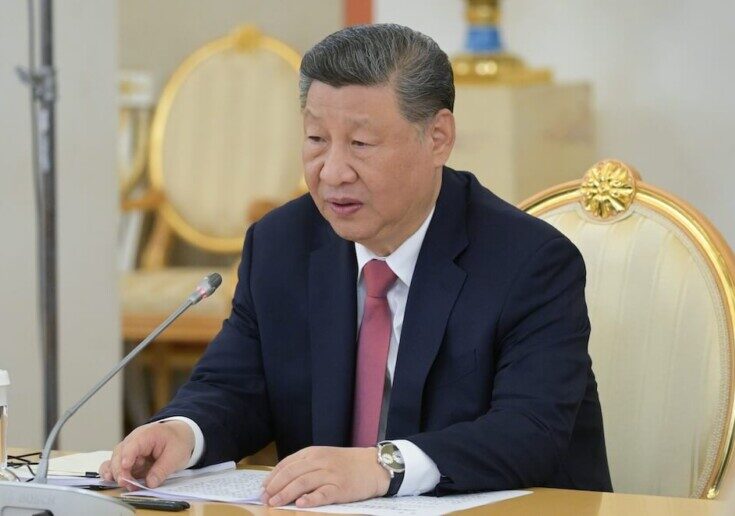
In light of all this information, expectations that the conflicts between Iran and Israel would push China to adopt a more aggressive and interventionist foreign policy stance were left unanswered by Beijing, and the process was cautiously pursued through diplomatic measures. In this regard, Chinese President Xi Jinping proposed a four-point solution, while Foreign Minister Wang Yi condemned Israel’s actions as contrary to international law and established contact with both sides in order to continue mediation efforts.
A similar stance was reiterated at a UN Security Council session convened at the request of Russia, China, and Pakistan. China’s Permanent Representative emphasized the need to resolve disputes through peaceful means, declare an immediate ceasefire, and ensure the safety of civilians, thereby concretizing Beijing’s long-term foreign policy character based on the principles of “peaceful dialogue,” “respect for sovereignty and territorial integrity,” and “maintaining balance.” This stance is one of the clearest indicators of China’s attempt to balance its claim to take responsibility in global crises with its strategic caution.
Recommended
In light of all these developments, one reality stands out: the Iran-Israel tension has once again brought to the fore the fundamental dilemmas that have long existed in China’s foreign policy. A non-interventionist neutrality, an emphasis on peaceful dialogue, and foreign policy reflexes based on sovereignty sensitivities continue to shape Beijing’s approach to global crises. However, growing expectations, energy security priorities, and the demands of the global public opinion suggest that China will eventually be compelled to assume greater responsibility.
In this context, as China approaches the position of an actor whose next steps are eagerly awaited in an environment where crises in the global system are on the rise, it is moving toward a process in which it will be forced to update its position as a “silent power” with a more active balancing policy, while maintaining its strategic caution in the face of these conflicts. The Iran-Israel conflict is not only an example of this transformation process, but also it provides important clues as to what role Beijing will choose to play in the global power architecture.
(Published originally by Kriter Magazine)

Diren Doğan is a lecturer at Alanya Alaaddin Keykubat Üniversitesi and a visiting fellow at the National Chengchi University in Taiwan.
You can see how this popup was set up in our step-by-step guide: https://wppopupmaker.com/guides/auto-opening-announcement-popups/

Stay informed by subscribing to
our weekly newsletter.
You can see how this popup was set up in our step-by-step guide: https://wppopupmaker.com/guides/auto-opening-announcement-popups/
You can see how this popup was set up in our step-by-step guide: https://wppopupmaker.com/guides/auto-opening-announcement-popups/
You can see how this popup was set up in our step-by-step guide: https://wppopupmaker.com/guides/auto-opening-announcement-popups/
You can see how this popup was set up in our step-by-step guide: https://wppopupmaker.com/guides/auto-opening-announcement-popups/