Deterrence Tested in Eastern Europe: Russian UAV Attacks on NATO Airspace

October 31, 2025

The recent violations of Polish and Romanian airspace by Russian drones, as well as the incursion of MiG-31 fighter jets into Estonian airspace, have tested NATO's resilience and readiness.
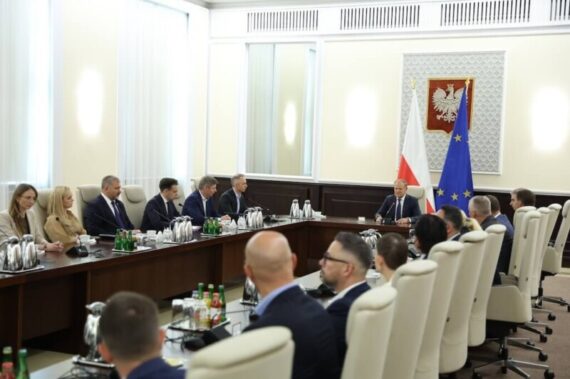
Polish Prime Minister Donald Tusk delivers a speech as he confirms that Polish forces shot down Russian drones, which violate the country's airspace, in Warsaw, Poland on September 10, 2025. T Photo by Anadolu Images.

I

n recent weeks, serious tensions have emerged in the Eastern European security landscape. On September 9-10, 2025, 19 Russian unmanned aerial vehicles (UAVs) entered Polish airspace via Belarus. At least three UAVs were shot down by Polish and NATO forces. NATO-affiliated Dutch F-35s, Polish F-16s, Italian AWACS aircraft, and German Patriot systems responded to the violation. Moscow claimed the UAVs were targeting Ukraine and that the incursion into NATO airspace was unintentional. However, in the West, these violations were perceived as a deliberate “provocation.” Polish Prime Minister Donald Tusk described the incident as a real threat to civilians and invoked Article 4 of the NATO Treaty, which initiated a consultation process among the alliance’s 32 members.

Article 4 of NATO activates the collective consultation mechanism when a member state perceives a threat to its security, though this does not automatically entail direct military intervention. Article 5, on the other hand, defines collective defense and requires all members to respond if one member is attacked. However, Article 5 does not automatically come into effect. It has only been invoked once historically, following the September 11 attacks on the United States. In this latest incident, Poland did not invoke Article 5, instead requesting allied solidarity under Article 4. NATO Secretary General Mark Rutte emphasized that this was not an isolated incident and stressed the importance of maintaining deterrence on the eastern flank.

The nature of the incident has sparked debate about whether it was a “provocation” or a “probing” operation. It has been assessed that the UAVs were flying along planned routes, and Moscow’s aim was to test NATO’s reactions, integration, and operational procedures. The performance of the QRA (Quick Reaction Alert) system, AWACS, and Patriot systems was observed, and critical operational intelligence was obtained prior to the Zapad 2025 exercise, which took place from September 12-16. This demonstrates that Russia gathered information on the military and political responses by testing NATO’s defense reflexes.

Western reactions and strategic concerns

Along with Poland, Western capitals have assessed the incident as a provocation. However, the U.S. administration’s indecisive and contradictory stance has disappointed Europeans and raised questions about NATO’s effectiveness as a deterrent. This situation could encourage Moscow to continue similar violations. Europe’s political fragmentation makes it easier for Russia to make strategic calculations. Notably, Germany, Italy, and France’s cautious stance against the risk of escalation contrasts with the demand for tough measures by eastern flank countries such as Poland, Estonia, and Lithuania, highlighting coordination problems within NATO.

Militarily, NATO’s air defense systems have responded swiftly. Polish F-16s, Dutch F-35s, German Patriot systems, and ISR (intelligence, surveillance, and reconnaissance) networks have been rapidly deployed, demonstrating technical capacity. However, cost-effectiveness is a serious weakness. Using $100,000 AIM-9 Sidewinder missiles to shoot down $10,000 Gerber UAVs is not a sustainable defense solution. This situation shows that NATO’s expensive air defense systems are inadequate against low-cost, asymmetric threats, and there is an urgent need for inexpensive, rapidly produced UAV countermeasure solutions.

Poland’s measures and economic impacts

Poland has emerged as a key player in global security, providing over $4 billion in military aid to Ukraine and playing a central role in transit routes through Western Europe. The country is home to over one million Ukrainian refugees and hosts 10,000 U.S. troops, a missile defense base, and a permanent garrison. These developments have increased Poland’s military and diplomatic influence, ensuring its central role in NATO’s deterrence and defense strategy on the eastern flank.

To enhance border security and reduce potential risks, Poland closed its temporary border crossings with Belarus, reopening them on September 25. The decision to close the border was made due to the Zapad 2025 exercise and the incursion of 21 Russian UAVs into Polish airspace, which caused serious disruptions to trade flows. The annual €25 billion trade between China and Europe has been affected by the temporary border closures, raising concerns about potential economic losses. Prime Minister Tusk stated that security considerations take precedence over economic concerns and that he reserves the right to close the border crossings again in the event of future threats.

Political differences and debates within NATO

The recent violations of Polish and Romanian airspace by Russian drones, as well as the incursion of MiG-31 fighter jets into Estonian airspace, have tested NATO’s resilience and readiness. Despite the growing Russian threat, there are still political differences over deterrence in Europe. Germany, Italy, and the US are cautious about the risk of escalation, while Baltic and Eastern European countries are demanding tougher measures.

Swedish Defense Minister Pål Jonson emphasized that NATO members must act jointly and consistently against threats. He stated that they would respond to airspace violations with force if necessary. Policy debates within NATO have intensified, with the question of “at what threshold should a response be given” coming to the fore. Moscow has noted that NATO can respond militarily, yet it is hesitant in political and financial terms. This reinforces the perception that similar provocations could be repeated.

This situation tests NATO’s military capacity, political will, and coordination ability. Considering both military and political outcomes, this crisis demonstrates the inevitability of restructuring the European security architecture. A more robust defense strategy is needed to deter hybrid threats and low-cost asymmetric attacks.

This has reopened discussions on NATO’s defense concept along its eastern flank. Gaps in low-altitude air defense have been observed in Poland and the Baltic States, underscoring the necessity for NATO to adopt a layered, continuous, and rapid-reaction-focused defense posture.

European security and NATO’s future

Ultimately, Russian UAV violations should not be viewed as merely airspace violations. Rather, they should be assessed as a test of the West’s military, political, and economic reflexes. While NATO has demonstrated its military response capacity with existing systems, the cost-ineffectiveness and unpreparedness against low-cost UAV threats have become apparent. This situation necessitates reviewing defense strategies in Europe and developing more agile, layered, and cost-effective systems against hybrid threats.

The contribution of strategic partners, particularly Poland, the Baltic States, and Türkiye, is essential to strengthening NATO’s defense and deterrence capabilities. Poland’s border security and support capacity for Ukraine serve as a deterrent and a logistical hub for the West. Türkiye’s experience with radar, air defense, electronic warfare, and C4ISR, developed within the Iron Dome architecture, can fill gaps in NATO’s eastern flank. Additionally, Türkiye’s rapid reaction and local command authority can shorten reflex times against threats.

Unless NATO becomes more agile and resilient in deterring low-cost technological threats and provocations, similar incidents will be inevitable. The direction of the coming years in terms of security balances, defense spending, and allied solidarity in Eastern Europe will be determined by the lessons Poland and NATO draw from this latest experience.

In summary, the UAV incidents of September 9-10 have been recorded as a critical case testing NATO’s deterrence and defense strategies on its eastern flank. Decisive factors in restructuring NATO’s resilience include Poland’s military and diplomatic capacity, NATO’s rapid response capability, cost-effectiveness, and level of preparedness against hybrid threats. In this context, Poland, NATO, and other European countries must establish a new security architecture that includes layered air defense, cost-effective UAV defense systems, and strategic cooperation. This will ensure regional security and enable Europe to develop long-term, sustainable deterrence capabilities against Moscow.

(Orignally published in Turkish by Kriter)

Cansu Kunt graduated with a bachelor’s degree from the Department of Political Science and Public Administration at Hacettepe University in 2017. She completed her master’s degree in the Security Studies program at the Institute for International Relations and Strategic Research at Ankara Yıldırım Beyazıt University, graduating in 2024.
Cansu Kunt worked as a Foreign Policy Research Assistant at the SETA Foundation. She is a native-level speaker of German, has advanced proficiency in English, and intermediate proficiency in French.