G20 and Connectivity: What Role Can the G20 Play as a New World Emerges?
The G20 can play an important role here by becoming a platform where competing connectivity projects interact, are discussed, and sometimes take on new forms.
December 18, 2025
T
here is a growing tendency to view the G20 as a “neoliberal system club” that is a relic of the heyday of globalization and is now largely ineffective. The platform has been paralyzed by great power rivalry and has strayed far from the sense of urgency and purpose it had during the 2008 global financial crisis. It has also lost its ability to produce inclusive norms on strategic issues. While this observation is valid, it overlooks the profound transformation that could occur within the G20.
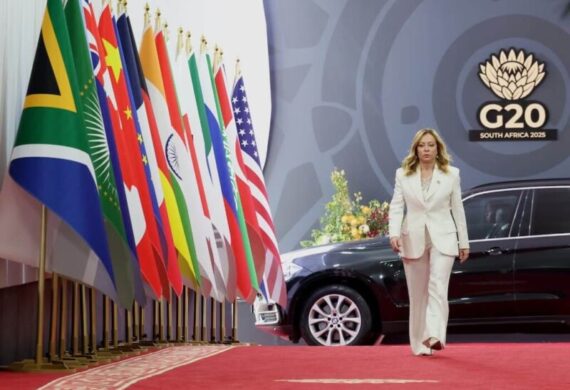
Although the G20 no longer serves a powerful function as an “executive committee” bound by neoliberal rules in a globalized world economy, it could become a new platform for global power interaction and connectivity. This potential is particularly important for medium-sized powers, especially since the leaders of the U.S., China, and Russia didn’t attend this year.
The G20’s structure is inadequate in terms of representation, institutional design, and norm-setting capacity. Nevertheless, it can still serve a purpose in a fragmented world. Its value now lies not in grand narratives or compromises but in the interdependent interaction at digital, physical, and financial levels. Indeed, the G20 remains one of the few platforms where major and medium-sized powers—or the global center and periphery—can engage with each other.
The G20’s legitimacy is based on its numerical weight and function. Its members represent approximately 85 percent of the global GDP, 75 percent of global trade, and two-thirds of the world’s population. Between 2008 and 2010, this economic weight produced coordinated fiscal expansion, financial sector reform, and a commitment to fighting protectionism to overcome the global crisis. At its core was the belief that the current neoliberal system was indispensable.
However, today, this belief has largely eroded. Developments such as US–China strategic competition, Russia’s invasion of Ukraine and the resulting sanctions, the weaponization of energy and food supplies, and the politicization of supply chains have altered the G20’s role. Rather than being a mechanism that supports a common globalization project, the platform has now become an arena where visions of global order and connectivity compete. Although members remain highly dependent on each other for production, raw materials, capital, data, and technology, there is an increasing divergence of opinion on how to manage this dependency and who should benefit from it.
This is precisely why the concept of “conncectivity” is analytically significant. In order to understand the new era, one must comprehend the dynamics that shape interdependence and, consequently, competition. Topics such as submarine cables, 5G networks, digital payment systems, cloud services, energy lines, ports, rail corridors, development banks, and climate funds are the most important areas of connectivity—and consequently, geopolitical competition. The G20 can play an important role here by becoming a platform where competing connectivity projects interact, are discussed, and sometimes take on new forms. Three main topics have become the cornerstones of G20 connectivity competition: digitalization and data, infrastructure and superstructure, and finance and the economy.
The most stark and critical form of competition is seen in the digital sphere. On one side are Western states — largely clustered around the G7 — which advocate for cross-border data flows, private-sector innovation, and multi-stakeholder internet governance. On the other side is an approach that prioritizes cyber sovereignty, localization of data, and strong state control over digital infrastructure. Both camps are present within the G20. Additionally, there are “tide countries” positioned between the two poles.
Consequently, discussions on the digital economy, artificial intelligence, cross-border data transfers, digital public infrastructure, the taxation of digital entities, and legal and commercial regulations have recently taken center stage in G20 discussions. Although these discussions are often expressed in technocratic language, the issues are political. This is because control of data, benefits from digital value and production chains, and the de facto global regulatory model will directly affect geopolitical competition.
The G20 could serve as a forum where red lines are clarified and a minimum level of compatibility is negotiated. Trust-based data flows, digital security, and inclusive digitalization could produce commitments and minimal consensus, albeit vague. Otherwise, a world of mutually incompatible, and even fragmented, technology companies and states could emerge, including in digital terms.
A similar situation applies to infrastructure and superstructure, particularly large-scale connectivity projects. China’s Belt and Road Initiative, Western-backed ” infrastructure” programs, regional initiatives such as the Development Road, and economic corridors linking Asia, the Middle East, Africa, and Europe have become the norm in a new era of development competition. These connectivity projects are also of strategic importance as geopolitical instruments that influence trade, secure access to resources, and consolidate political influence.
The G20’s role is limited here, yet important, particularly as it facilitates discussion of technical norms, such as debt sustainability, transparency, environmental and social safeguards, local content, and procurement rules. The G20 enables agreement on these norms in principle. The G20’s set of principles provides a framework for borrowing countries and competing creditors to determine which practices are considered “legitimate.” These principles can then serve as a reference point in negotiations on specific projects.
For medium-sized peripheral states, this represents a significant opportunity. Indeed, such principles and frameworks can be an important tool for demanding better conditions, greater sustainability, and fairer risk-sharing from larger economies. In this sense, the G20 serves as a stage where emerging powers discuss these “standards” and embrace their regional connectivity agendas selectively. Furthermore, this situation provides medium-sized states seeking to preserve their strategic autonomy with the opportunity to develop their own projects or choose between existing ones.
The least visible, yet perhaps most important, structural dimension of connectivity is financial. The dollar-centric US system, which includes global payment networks, banking, and reserve currencies, still forms the backbone of international finance. However, recent crises have revealed the political nature of this infrastructure. Sanctions, asset freezes, and restrictions on access to payment channels demonstrate that financial infrastructure can be a coercive, politicized tool of the state rather than a “neutral” channel.
This situation has sparked debates within the G20. The first centers on reforming financial institutions, such as the IMF and World Bank, which have become instruments of neoliberal hegemony. The second concerns diversification and the quest for financial sovereignty. Regional financial regulations, trade in national currencies, alternative payment systems, and central bank digital currencies are particularly prominent. While these initiatives may not eliminate the dollar’s dominance in the short term, they signal a gradual shift towards a more diverse financial connectivity regime.
The G20 is not establishing a new financial order. However, as the sole platform where leading economic powers-the U.S. and China—can meet with market debtors and alternative financiers, the G20 can play a critical role in managing certain risks. Therefore, in an era of overly politicized finance, the G20 can indirectly help resolve potential disputes.
Recommended
Although the concept of connectivity suggests that the G20 may still be relevant, debates over representation reveal its limitations. While the platform is more inclusive than the G7, it still has a closed structure that excludes most of the world’s states. For a long time, there was no permanent seat representing the entire African continent. Furthermore, small states and economies remain confined to indirect representation. This creates a legitimacy gap, particularly in areas such as climate, food security, and debt crises, which affect these states the most.
Nevertheless, the G20 has become an important stage for “middle powers” and global alternative coalitions. Countries from the global periphery can leverage their presidencies and agenda-setting opportunities to advance their priorities. Thus, the platform offers both constraints and opportunities. The constraint stems from the structural underrepresentation of smaller, poorer states. The opportunity lies in the fact that it is one of the few areas where large and middle powers can negotiate critical issues directly, without the need for intermediary institutions in the global center-periphery competition.
The world that gave rise to the G20 no longer exists. The idea that globalization is inevitable and desirable is no longer the platform’s common ground. Now, the G20 operates in an era of heightened strategic competition, contentious interdependence, and growing demands for justice from peripheral countries around the world. Given this environment, it is unreasonable to expect the G20 to produce comprehensive or transformative “grand agreements” annually. Therefore, it is reasonable to conclude that the G20 is no longer significant in the traditional sense. However, there is also different potential here.
In the new world order, which is still in its early stages, and in the new era of geopolitical competition, global connectivity is important. In this context, the G20 can play a limited yet meaningful role in a world of incompatible competing orders and blocs with integrated infrastructures, weaponized mutual dependence, and unmanaged fragmentation. The G20 can establish a foundation for negotiation among actors and blocs, achieving a minimum level of harmony, albeit fragmented, during the transition from the old to the new order. Therefore, despite its flaws, the G20 can promote healthy connectivity as a platform. In other words, although it has lost its traditional meaning and function as a product of U.S.-centered liberal hegemony, the G20 can assume a new, albeit limited, critical role in constructing the new international order by adapting to the requirements of connectivity politics.
(Originally published in Turkish by Kriter)

Baki Laleoğlu: Editorial Director at National Intelligence Academy-Türkiye. His research interests include comparative politics, populism, xenophobia, and Turkish politics.
You can see how this popup was set up in our step-by-step guide: https://wppopupmaker.com/guides/auto-opening-announcement-popups/

Stay informed by subscribing to
our weekly newsletter.
You can see how this popup was set up in our step-by-step guide: https://wppopupmaker.com/guides/auto-opening-announcement-popups/
You can see how this popup was set up in our step-by-step guide: https://wppopupmaker.com/guides/auto-opening-announcement-popups/
You can see how this popup was set up in our step-by-step guide: https://wppopupmaker.com/guides/auto-opening-announcement-popups/
You can see how this popup was set up in our step-by-step guide: https://wppopupmaker.com/guides/auto-opening-announcement-popups/