Lancet Study Estimates 75,000 Deaths in Gaza in the First 16 Months of Genocide

February 20, 2026

A Lancet study suggests 75,200 violent deaths in the first 16 months of the Israeli genocide, whereas 49,090 violent deaths over the same period were reported by the Gaza Ministry of Health.
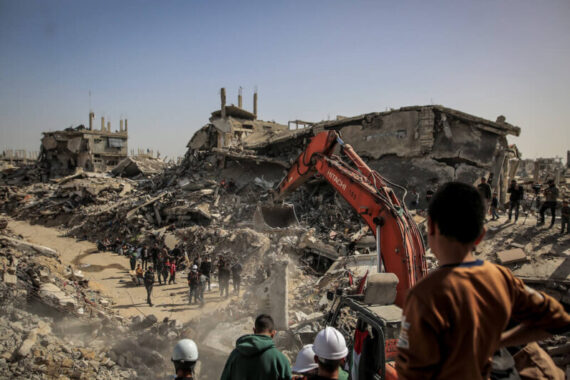
Civil defense teams, in coordination with officials from the International Committee of the Red Cross (ICRC), use heavy machinery to search the rubble of a destroyed building to recover the bodies of members of the Abu Nasr family following Israeli attacks in Beit Lahia, northern Gaza, on February 15, 2026. Photo by Anadolu Images.

A

ccording to the Lancet, a respected academic journal, the Gaza Mortality Survey interviewed 2,000 households across 200 sampling locations between December 30, 2024, and January 5, 2025. Researchers documented the status of 9,729 individuals who were members of those households on October 6, 2023, the day before hostilities escalated.

Using stratified cluster sampling and statistical weighting — adjusting for age, gender, governorate of origin and household size — the study produced the following estimates for the first 15 months of the conflict: 75,200 violent deaths (95% confidence interval: 63,600–86,800), Equivalent to 3.4% of Gaza’s pre-war population, 42,200 women, children and older people killed violently, comprising 56.2% of violent deaths and 16,300 non-violent deaths, including 8,540 excess deaths above projected baseline mortality.

By comparison, Gaza’s Ministry of Health reported approximately 49,090 violent deaths over the same period. The Lancet study concludes that the ministry’s figure was about 34.7% below its central estimate.

However, the demographic breakdown — particularly the proportion of women, children and elderly among the dead — closely mirrors MoH reporting. The researchers say this convergence is significant, finding no evidence that official figures were inflated. Instead, they suggest the ministry likely undercounted violent deaths amid the extreme operational pressures of the conflict.


Violent vs. non-violent mortality

The study distinguishes between deaths caused directly by military action and non-violent deaths linked indirectly to the war, such as those resulting from untreated disease, disrupted medical care or other conflict-related conditions.

Researchers estimate 8,540 excess non-violent deaths up to early January 2025. While substantial, that figure is lower than some earlier projections suggesting indirect deaths might outnumber direct fatalities several times over.

The findings indicate that violent deaths were the primary driver of mortality during the period examined. The estimated crude death rate from violence was 33.1 per 1,000 population per year — a level the authors describe as exceptionally high by contemporary conflict standards.

The results broadly align with a 2025 capture-recapture analysis published in The Lancet, which suggested Gaza’s official figures undercounted deaths by roughly 40%. The consistency of findings across different methodologies strengthens confidence in the overall scale of mortality, the authors say.

The survey also estimated that 12,200 people were missing, predominantly men aged 18–64. For their primary calculations, the researchers conservatively treated missing individuals as alive, noting that final mortality totals could shift depending on future clarification of their status.

Methodological challenges in active conflict

With a 97.2% household response rate and detailed supervisory procedures, the Gaza Mortality Survey demonstrates that rigorous mortality surveillance is possible even in an active war zone, the authors argue. They emphasize that their figures are estimates rather than definitive counts and carry statistical margins of uncertainty.

Nonetheless, the evidence suggests that by early January 2025, between three and four percent of Gaza’s population — estimated at roughly 2.2 million before the war — had been killed violently.

Since the survey concluded, humanitarian conditions in Gaza have deteriorated further. Famine was declared in parts of the territory in August 2025, and health infrastructure remains severely compromised.

The long-term health consequences of the conflict — including chronic disease, trauma and disrupted medical care — are likely to extend well beyond the period covered by the study, the authors warn, underscoring the enduring human cost of the war.

(Source: The Lancet)

Politics Today is dedicated to publishing insightful analyses in order to understand the changing nature of contemporary politics. It aims to contribute to the sound and constructive discussion of international affairs.