Libya’s Revolution Is Being Buried by Those Who Profited from Its Failure
The central political question therefore risks ceasing to be “How do we build a prosperous Libyan state?”
September 23, 2026
F
ifteen years after Libyans rose against personalized rule, the country risks replacing one family-centred dictatorship not with democracy, but with competing dynasties, armed patronage networks and a political class that has discovered that “transition” can last forever.
Libyans have not necessarily abandoned their aspiration for democracy. Something more insidious is happening: They are being taught that democracy does not matter.
Fifteen years after the overthrow of Muammar Qaddafi, Libya remains trapped in what is still politely called a “transition.” Governments described as temporary become permanent, elections are promised and postponed, and institutions whose democratic mandates have long expired continue to exercise power. Armed groups become state actors, family members become commanders and power brokers, and public money sustains a system whose principal achievement is its own survival.
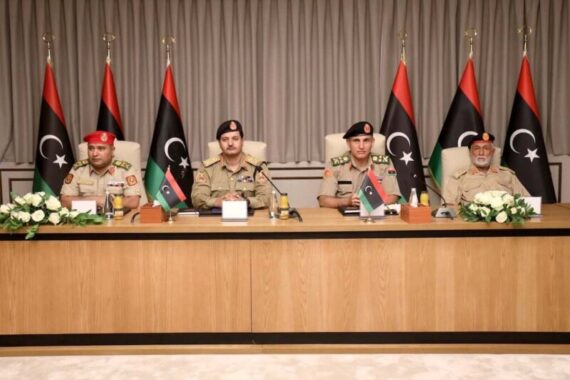
The absurdity is illustrated by the Government of National Unity headed by Abdul Hamid Dbeibah. Created as an interim authority to take Libya to presidential and parliamentary elections in December 2021, it remains in power in Tripoli in 2026 although those elections never happened. In the east, meanwhile, another political-security establishment has consolidated itself around Khalifa Haftar, his family and the forces under their control. Governments change names, roadmaps are rewritten, and election dates recede into the future, but those exercising power remain. Libya has turned the provisional government into a permanent political system: everybody is temporary, but nobody leaves.
Perhaps that is no accident. Genuine elections contain something profoundly threatening to Libya’s political class: the possibility of losing. Elections mean that those controlling ministries, budgets, armed formations, contracts and patronage networks today might wake up tomorrow without them. Why should beneficiaries of the existing order enthusiastically construct the mechanism capable of removing them?
Dbeibah and Haftar are not allies, and eastern and western power centres continue to compete. Yet beneath their rivalry lies a convergence of interests. The western establishment needs money, armed protection and control of Tripoli; the eastern establishment needs access to national revenues and international legitimacy. Militias need salaries and influence, business networks need contracts, politicians need offices, and families surrounding powerful men need access to wealth. Foreign governments want oil, migration control, counterterrorism cooperation and sufficient stability to protect their interests. No formal coalition is necessary. Everyone merely has to conclude that continuation of the existing system is preferable to allowing Libyan voters to overturn it.
The bitterest irony concerns nepotism. Libyans rose in 2011 against a political order in which the state had become inseparable from Qaddafi, his sons and the networks surrounding them. Yet power in eastern Libya has become increasingly concentrated not merely around Khalifa Haftar but around the Haftar family. His son Saddam Haftar has risen to become deputy commander of the eastern forces and increasingly represents that establishment internationally. Instead of building institutions capable of surviving Khalifa Haftar, eastern Libya risks building a succession mechanism capable of perpetuating his family. Western Libya has developed a different but similarly troubling phenomenon through the growing political and commercial influence of networks associated with the Dbeibah family.
Libya thus risks completing a grotesque historical circle. It overthrew one family-centred authoritarian state only to produce multiple family-centred political, commercial and military fiefdoms. This is not a restoration of Qaddafi’s Jamahiriya. In one respect it could prove worse: Qaddafi presided over one personalised state; Libya now risks acquiring several personalized centres of power competing over the resources of the same country.
None of this can be understood without oil. Libya possesses immense petroleum wealth shared among a population of only several million people. That should provide the foundations for one of Africa’s most prosperous states. Instead, it helps finance political dysfunction. A government dependent upon taxation must, however imperfectly, worry about the citizens from whom it collects revenue. Libya receives enormous income from selling hydrocarbons abroad. Control the institutions through which that money flows and you gain influence over budgets, salaries, subsidies, contracts, appointments and patronage.
The central political question therefore risks ceasing to be “How do we build a prosperous Libyan state?” and becoming “Who gets access to the money generated by the Libyan state?” Oil makes capturing the government extraordinarily profitable. When political survival can be financed through distributing oil rents, accountability to citizens becomes less urgent. Libya’s greatest economic blessing becomes its political curse.
The international community also deserves uncomfortable scrutiny. Western governments proclaim their commitment to elections, while the United Nations continues producing roadmaps towards elected and unified institutions. The language remains impeccable. But governments reveal their priorities through behaviour rather than communiqués.
Europe wants Libya to restrain migration across the Mediterranean. Washington wants counterterrorism cooperation, regional stability and limits on Russian influence. Italy wants energy and migration cooperation. Turkey, Egypt, France, Russia and the Gulf states pursue their own strategic and commercial interests. Oil must continue flowing, migration must be contained, jihadists controlled, and geopolitical competitors kept in check.
And if the men capable of delivering these things happen to be authoritarian, dynastic or embedded in systems of patronage? Increasingly, the practical answer appears to be: We can work with them.
Haftar has understood this particularly well. The more he presents himself not merely as a Libyan military strongman but as a regional security broker—cooperating against terrorism, becoming useful in the Sahel, controlling territory and offering stability—the more the question in foreign capitals changes. Instead of asking, “By what democratic authority does this man exercise power?”, policymakers begin asking, “Can this man deliver what we need?”
That is often how democratic principles die in international diplomacy: not through one dramatic betrayal, but through a thousand pragmatic accommodations. Democracy moves quietly from objective, to aspiration, to talking point.
Yet it would be wrong to conclude that Libyans themselves have rejected democracy. When municipal elections have been permitted, Libyans have demonstrated a willingness to participate, while consultations have repeatedly produced demands for elections, unified institutions and accountable government. The tragedy may therefore not be that Libyans no longer want democracy, but that they increasingly believe nobody will allow democracy to change anything.
That is more dangerous, because frustration eventually becomes exhaustion. After enough failed roadmaps, postponed elections, rival governments, parliaments, militias, foreign interventions and political conferences, ordinary citizens stop asking constitutional questions. They ask whether the electricity will stay on, whether salaries will be paid, whether their children can find work and whether they can return home safely at night. When politics reaches that point, authoritarianism no longer requires enthusiasm. It requires fatigue.
Then comes one of the oldest bargains in politics: give us obedience and we will give you stability. After fifteen years of turmoil, such a proposition inevitably becomes more attractive. Some Libyans remember a country that, whatever the brutality and absurdities of Qaddafi’s rule, possessed a single government, a recognizable state and a degree of everyday predictability. That does not mean they want Qaddafi back. It means that when democracy becomes associated with disorder, corruption and political impotence, authoritarianism can acquire the appearance of competence simply by comparison.
That may ultimately prove the greatest failure of post-2011 Libya: not merely that democracy failed to arrive, but that those who captured the transition could succeed in discrediting democracy without ever seriously trying it.
Libyans demanded dignity, accountability, political participation and an end to arbitrary, personalized government in 2011. What risks emerging instead is a system of family networks, armed patronage, oil rents, corruption, foreign sponsorship, unelected institutions and indefinitely postponed elections.
Recommended
The danger is no longer necessarily another Qaddafi reunifying Libya under a single dictatorship. It may be something subtler and harder to uproot: an oligarchic settlement in which eastern and western elites learn to coexist, divide access to the state’s enormous revenues, distribute patronage through their respective networks and periodically renegotiate the balance among themselves.
Foreign governments might accept such an arrangement because the oil flows. Europe might accept it because migration is contained. Washington might accept it because terrorism is controlled, and geopolitical rivals are kept at bay. Libyan elites might accept it because everyone sufficiently powerful receives a share.
There would be only one conspicuous absentee from this grand bargain: the Libyan citizen.
That is why it is premature to say Libyans have bid farewell to democracy. They have not necessarily abandoned it. Democracy is being taken away from them through attrition. The ballot box is forever promised for tomorrow while political power and national wealth are divided today.
The most dangerous moment will come when Libyans finally stop demanding elections—not because dictatorship defeated democracy in an open contest, but because years of manipulation persuaded them that voting could never change anything.
At that point, the architects of Libya’s permanent transition will have achieved their greatest victory. They will not have needed to abolish democracy. They will merely have persuaded Libyans to stop believing in it.
Abdullah Al-Ma'azi was born in Tripoli, Libya to a well-known Tripolitanian family that dates back at least 500 years. He studied politics at the University of York and has written extensively on Libya and the politics of the Arab world. His work has appeared in Arabic in As-Safir and Al-Akhbar, and in English in The Tripoli Post and Middle East Eye. His articles on Libya have attracted substantial readership and debate, reflecting his longstanding engagement with the country’s political development.
You can see how this popup was set up in our step-by-step guide: https://wppopupmaker.com/guides/auto-opening-announcement-popups/

Stay informed by subscribing to
our weekly newsletter.
You can see how this popup was set up in our step-by-step guide: https://wppopupmaker.com/guides/auto-opening-announcement-popups/
You can see how this popup was set up in our step-by-step guide: https://wppopupmaker.com/guides/auto-opening-announcement-popups/
You can see how this popup was set up in our step-by-step guide: https://wppopupmaker.com/guides/auto-opening-announcement-popups/
You can see how this popup was set up in our step-by-step guide: https://wppopupmaker.com/guides/auto-opening-announcement-popups/