One Libya, Two Destinations: Fidan’s Visit and the New Equation in the Eastern Mediterranean

August 31, 2026

Turkish Foreign Minister Fidan’s move to Egypt following his visit to Libya completes the missing link. The topics to be discussed lay out the blueprint for the strategy in the region. Gaza, Syria, Libya, Sudan and the Eastern Mediterranean, as well as hydrocarbons and the electricity grid.
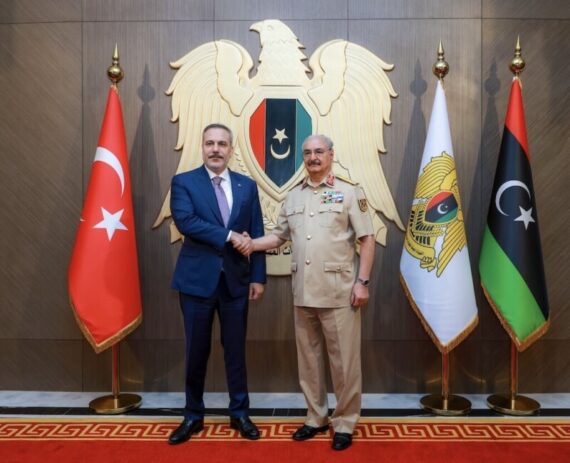
Turkish Foreign Minister Hakan Fidan met with Libyan National Army General Commander Khalifa Haftar during his visit to Benghazi. Photo by Anadolu Images.

T

urkish Foreign Minister Hakan Fidan’s visit, covering Tripoli and Benghazi between August 11 and 12, has been one of the most visible indicators of the shift in Türkiye’s Libya policy that has become apparent in recent years. Immediately prior to the visit, a 4.5-million-litre petrol tank at the Zawiya Refinery, 50 kilometres west of Tripoli, was set alight by a drone attack, prompting the National Oil Corporation to declare a state of emergency at the highest level. Foreign Minister Fidan’s reference to an approach that “makes no distinction between western, eastern and southern Libya” is the clearest expression of Ankara’s new approach, which, whilst defending Libya’s territorial integrity, does not limit its engagement on the ground to a single political and geographical center.

Exercises unite the army but not politics

One of the notable changes in the Libya dossier in 2026 was Washington’s return as a more visible actor. Indeed, the initiative led by Massad Boulos, US President Donald Trump’s adviser on Arab and African affairs, materialized in Sirte on July 14. Khalid Haftar, son of Khalifa Haftar and Chief of Staff of the Libyan National Army (LNA), and Selahaddin Nemrush, Chief of Staff of the Government of National Unity (GNU), met under the supervision of the United Nations (UN) Support Mission and issued a declaration on a ‘single national army’. They also agreed to organize joint exercises to tackle smuggling and migration along the Chad-Niger border.

Details that have emerged suggest that a power-sharing formula is being discussed, under which Abdulhamid Dbeibeh would remain as Prime Minister and a senior executive position would be opened up for the Hafter faction. Furthermore, plans to encourage the return of American energy companies to Libya and to carry out joint military activities under the leadership of AFRICOM indicate that Washington is seeking to advance the political, economic and security dimensions of its Libya policy simultaneously. The adoption in April 2026 of the first unified budget since 2013 has been one of the most tangible outcomes of this process to date.

Washington approaches Libya’s political crisis partly with a cost-benefit analysis. The Central Bank cannot finance two parallel governments indefinitely; therefore, scarcity forces the parties to unite. This is an approach that treats the economy as the driving force, whilst regarding legitimacy as a technical detail to be resolved later. The unification of military institutions under a single structure, the conduct of joint exercises and even reaching agreement on a joint budget are genuine achievements. However, none of this address the question of which political authority the armed groups will be subject to. Indeed, the outright rejection of the plan by the armed groups in Misrata, the militia clashes in Tripoli and the objections rising from the south demonstrate that the architecture on paper has yet to find its counterpart on the ground.


Ankara’s own terms

Another weakness of the Boulos initiative lies in the tension between timing and legitimacy. The 36-month transition timetable and the stated election date of February 17 position the ballot box as a promise rather than a concrete objective. The fact that the unified budget signed in April has still not been implemented shows that the agreement on paper has had only limited impact on the ground. Political steps taken without establishing an implementation mechanism do not, on their own, alter the balance of power on the ground. Furthermore, power-sharing carries the risk of fueling corruption and further reinforcing existing power networks by easing current constraints on public spending. In short, the formula of political compromise in exchange for oil revenue is sufficient to keep the two capitals at the negotiating table in the short term. However, as the size of the rent to be shared increases, so does the disruptive capacity of armed actors left out of the process. The events in Zawiya can also be interpreted within this framework.

Türkiye is positioning itself within this plan on its own terms. Ankara’s advantage lies in maintaining its strong military and political presence in western Libya whilst progressively deepening its relations with actors in the east. Foreign Minister Fidan’s meetings in Tripoli with Dibeybe, Menfi and Takala, as well as Acting Defence Minister Zubi, Interior Minister Trabelsi, Chief of the General Staff Nemrush and Head of Military Intelligence Mahmud Hamza; and in Benghazi with Marshal Hafter, Saddam Hafter and Agile Salih, demonstrates that Türkiye is analyzing the situation in Libya at the level of its security apparatus.

Moreover, some of the figures on this list, including Agile Salih, are known to be actors who maintain a distance from the American initiative. Consequently, Ankara’s network of contacts encompasses actors who approach the American initiative to varying degrees. Ankara’s military and political access emerges as a key factor in making the US plan feasible on the ground. This position allows it to continue its engagement with Ankara through American initiative, whilst enabling it to defend its own priorities more forcefully at the negotiating table.

Sons and nephews: The consolidation of loyalty and a fragile arena

The most critical dynamic observed in Libya today is the advancement of succession engineering rather than institutionalization. In the east, Saddam Hafter’s military and political clout, Khalid Hafter’s position within the General Staff, and Bilkasım Hafter’s management of the reconstruction budget through the Development and Reconstruction Fund; whilst in the west, Ibrahim Dibeybe’s central role in the dossier as the Prime Minister’s national security adviser, represent the two ends of the same spectrum. In both camps, power is consolidated through families and networks of loyalty rather than through institutions. In this context, Ankara has established relations with actors likely to influence the future of Libyan politics.

The fact that political and military balances in Libya are never static makes this approach rational from a foreign policy perspective. Washington’s return to the negotiating table is also reshaping the calculations. The key capability stemming from Ankara’s decade-long experience lies not in alliances formed with specific actors, but in the flexibility to recalibrate its position as actors change. Conversely, when Türkiye’s core interests are at stake, the same flexibility cannot apply. The inclusion of the Turkish Armed Forces’ Libya Task Force Command in Tripoli in the visit program serves as a deliberate reminder of the deterrent power underpinning diplomacy.

Vulnerability, however, is concentrated in the west. The Zawiya refinery has for years been a nexus of fuel subsidies, smuggling and rivalry between armed groups. The increasing isolation of Mohammed Bahrun—a key regional actor who once aligned closely with the Dbeibeh faction—is turning Zawiya into one of the new flashpoints of tension between the government and local armed groups. Regardless of who carried out the attack, the current situation indicates that one of the key dimensions of the struggle in western Libya centers on the distribution of rents and resources. Foreign Minister Fidan’s inclusion of Omar Mukhtar’s memorial tomb in his Benghazi itinerary can be interpreted as a symbolic message showing that Türkiye’s engagement in the east is not limited solely to existing political and military actors. Ankara is establishing a foundation in the east that is grounded not only in military and political relations but also in Libya’s historical memory.

The Cairo circle: The Mecca Pact, maritime jurisdiction zones and the equation extending to the Red Sea

The framework that gives Fidan’s visit to Libya its true significance, however, is regional. The joint defense agreement signed in Mecca on August 7 by President Erdoğan, Crown Prince Mohammed bin Salman and Prime Minister Shahbaz Sharif established a collective security architecture that treats an attack on one party as an attack on all parties, whilst remaining open to the participation of other regional countries. This move, which brings together Türkiye’s military weight within NATO, Saudi Arabia’s financial capacity and Pakistan’s security capabilities within the same framework, has made the divisions between the various partnership networks already taking shape in the region more apparent.

The addition of India’s growing interest to the cooperation between Greece, the Greek Cypriot Administration of Southern Cyprus and Israel indicate the emergence of overlapping partnerships that balance Türkiye’s regional influence, rather than a single opposing bloc. The competitive arena for this axis could extend from the Eastern Mediterranean to the Red Sea and East Africa.

At this juncture, the Türkiye–Libya agreement on maritime zones, signed in 2019, is becoming one of the key elements in the balance of power in the Eastern Mediterranean, in addition to its legal status. The political sustainability of the agreement depends not only on the continuity of the government in Tripoli but also on Benghazi’s stance towards this text. For this reason, the relationship maintained with the Haftar family is also significant in terms of safeguarding Türkiye’s legal rights and gains regarding maritime zones in the Eastern Mediterranean. The relations Ankara has developed with Benghazi present an important opportunity for the maritime zones agreement to gain acceptance in eastern Libya as well.

Egypt might join the Mecca Agreement

Cairo was the missing link in this equation. Foreign Minister Fidan’s visit to Egypt following his trip to Libya completes this missing link. The topics to be discussed outline the strategy for the region. Alongside Gaza, Syria, Libya, Sudan and the Eastern Mediterranean, the details of this strategy include hydrocarbon and electricity grid integration, the defense industry, and the trade volume, which is targeted to increase from 8 billion dollars to 15 billion dollars. Foreign Minister Fidan’s indication that Egypt might join the Mecca Joint Defense Agreement, however, elevates this visit beyond a mere technical consultation. The fact that Türkiye and Egypt are now able to speak with one voice on Libya could weaken one of the key elements of the rival patronage equation that has long fueled the east-west divide in Libya.

It is no coincidence that the Sudan dossier is also being discussed at the same table. Egypt is the key country in the corridor linking the Eastern Mediterranean to the Red Sea and East Africa. The quest for stability in Libya and the containment of the conflict in Sudan are two ends of the same geopolitical axis. The defense framework signed in Mecca on August 7, the meetings in Tripoli and Benghazi held between August 11 and 12, the reception of Mahmoud Abbas in Ankara on August 12, and the visit to Cairo on August 13 all constitute an intense diplomatic flurry crammed into a single week. It would be an oversimplification to view this sequence of events as entirely unrelated developments.

Turkish foreign policy today views the Eastern Mediterranean, North Africa and the Red Sea basin as an increasingly interconnected security zone. Ankara’s emphasis on a ‘single Libya’ is, in fact, the diplomatic expression of its view that the Eastern Mediterranean constitutes a holistic, rather than fragmented, strategic equation. Within this equation, Libya serves as a strategic terrain where it is critical not only to secure gains but also to safeguard them over the long term.

(Originally published in Turkish by SETA Foundation)

Assistant Professor of International Relations at Mersin University and a researcher at the SETA Foundation. His research focus is the Horn of Africa.