Lula Urges Leaders to ‘Defeat’ Climate Crisis Deniers at COP30
Lula warned that global efforts to address the climate emergency were being sabotaged by a “new wave of obscurantism.”
November 11, 2025
B
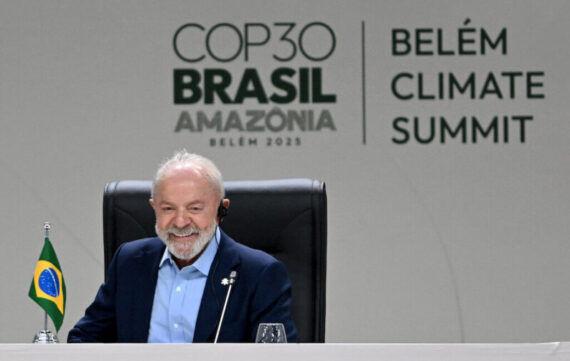
razilian President Luiz Inácio Lula da Silva opened the 30th United Nations Climate Change Conference (COP30) on Monday in the Amazonian city of Belém with a fiery call to action, urging world leaders to “defeat” climate crisis deniers and prioritize investment in the planet over military spending.
In his keynote address at the first plenary session, Lula warned that global efforts to address the climate emergency were being sabotaged by a “new wave of obscurantism” — movements and leaders who reject science, spread misinformation, and undermine multilateral cooperation.
“In the age of misinformation, obscurantists reject not only scientific evidence but also the advances of multilateralism,” Lula declared. “They control algorithms, sow hatred, and spread fear. They attack institutions, science, and universities. It is time to inflict a new defeat on the deniers.”
His remarks marked one of the strongest public condemnations yet by a sitting world leader of climate change denial and digital disinformation. They also set the tone for what promises to be a tense conference, with many major world powers — including the United States, China, and India — notably absent from the opening session.
The COP30 summit is being held in Belém, deep in the Amazon basin, for the first time in the history of UN climate talks. The location is symbolic: the Amazon rainforest, often described as the “lungs of the planet,” plays a crucial role in absorbing carbon dioxide but is under severe threat from deforestation, mining, and agricultural expansion.
Lula, who has made environmental protection a central plank of his presidency, framed the Amazon as a frontline in the global battle against climate collapse. He described holding the summit there as both a “celebration of hope” and a “call to conscience.”
“Belém stands in the heart of the forest that sustains our planet,” he said. “But half its population lacks basic sanitation, a stark reminder that climate justice and social justice are inseparable.”
Since returning to office in 2023, Lula’s administration has reversed many of the environmental deregulations enacted under his predecessor, Jair Bolsonaro, and dramatically reduced deforestation rates. Still, environmentalists say global coordination remains insufficient to meet the Paris Agreement goals.
In one of the speech’s most pointed moments, Lula condemned the rising global defense budgets — particularly in the United States and Europe — calling them a moral failure in the face of the escalating climate crisis.
“If the men who wage war were at COP30,” he said, “they would realize it is much cheaper to spend $1.3 trillion a year to end the climate problem than $2.7 trillion to wage war, as they did last year.”
He accused world powers of “arming themselves against imaginary enemies” while ignoring the real threat posed by climate change.
“Every missile built is a wind turbine that was never installed,” he said to applause. “Every tank produced is a school that was never built, a river that was never cleaned, a forest that was never protected.”
Lula’s comments echoed the long-standing demands of developing nations for wealthier countries to contribute more to global climate finance. The 2015 Paris Agreement called for at least $100 billion per year in aid from industrialized nations to support developing countries in reducing emissions and adapting to climate impacts — a goal that has repeatedly been missed.
Lula urged negotiators at COP30 to recommit to the Paris Agreement’s target of limiting global temperature rise to 1.5°C above pre-industrial levels. Scientists warn that the planet is already on track to exceed that threshold within the next decade unless emissions are drastically reduced.
“The clock is ticking louder than ever,” Lula warned. “We cannot negotiate with physics or plead with the atmosphere. Every delay, every broken promise, pushes us closer to irreversible damage.”
He also called for a fairer system of global environmental governance, arguing that current models often penalize poorer nations while allowing major polluters to continue emitting.
“Developing nations should not be forced to choose between growth and survival,” he said. “We need a new financial architecture that rewards conservation, not destruction.”
Recommended
The absence of top leaders from the U.S., China, and India — which together account for more than half of global greenhouse gas emissions — loomed large over the proceedings. Their delegations sent lower-level representatives, citing domestic priorities.
Still, the event drew hundreds of delegates, climate activists, and indigenous leaders, many of whom praised Lula’s leadership in putting the Amazon and the Global South back at the center of the climate conversation.
Marina Silva, Brazil’s environment minister, said Lula’s speech “reaffirmed Brazil’s role as a bridge-builder between developed and developing nations.”
“From Belém, the message to the world is clear,” she said. “The time for excuses is over. The time for action is now.”
As the conference enters its second week, delegates are expected to debate new mechanisms for financing climate adaptation, the phase-out of fossil fuels, and strategies to strengthen indigenous stewardship of forests.
For Lula, the battle lines are clear — not just between nations, but between truth and denial.
“Defeating climate deniers,” he concluded, “is not just about politics. It is about defending life itself.”
(Source: Anadolu Agency)

Politics Today is dedicated to publishing insightful analyses in order to understand the changing nature of contemporary politics. It aims to contribute to the sound and constructive discussion of international affairs.
You can see how this popup was set up in our step-by-step guide: https://wppopupmaker.com/guides/auto-opening-announcement-popups/

Stay informed by subscribing to
our weekly newsletter.
You can see how this popup was set up in our step-by-step guide: https://wppopupmaker.com/guides/auto-opening-announcement-popups/
You can see how this popup was set up in our step-by-step guide: https://wppopupmaker.com/guides/auto-opening-announcement-popups/
You can see how this popup was set up in our step-by-step guide: https://wppopupmaker.com/guides/auto-opening-announcement-popups/
You can see how this popup was set up in our step-by-step guide: https://wppopupmaker.com/guides/auto-opening-announcement-popups/