Pacific Summit Backs Concerns Over China Missile Test Despite Nauru Dissent

September 4, 2026

The dispute over China’s missile test reflects the growing strategic importance of the Pacific, where military activity by major powers is increasingly drawing the attention of island nations.
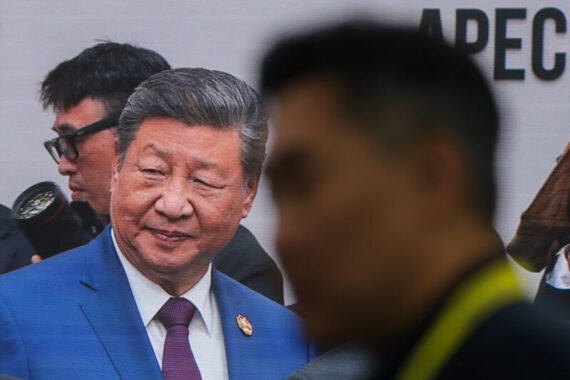
Chinese President Xi Jinping (L) is seen greeting with world leaders on a broadcast screen, as they meet during the APEC Economic Leaders' Week, in Gyeongju, South Korea, on November 1, 2025. Photo by Anadolu Images.

P

acific Island leaders have expressed concern over China’s recent intercontinental ballistic missile test in the Pacific, calling for greater transparency and advance notification of future missile launches, despite a formal dissent from Nauru.

The issue emerged as a major point of discussion at the annual Pacific Islands Forum, where leaders from the region debated security concerns while also facing pressure from Beijing over Taiwan’s participation in the summit.

Palau’s President Surangel Whipps Jr., who hosted the meeting, said China’s July missile test had passed over several Pacific island nations without sufficient warning. The launch was China’s first known ICBM test in the Pacific since September 2024.

At the conclusion of the summit, Whipps said Pacific leaders had called on all countries conducting ICBM tests to provide greater transparency and reassurance. He said they supported advance notification of missile tests at least 24 hours before launch, in line with international practice.

However, Whipps noted that Nauru had formally dissented from the position adopted by the majority of Pacific states.

Australian Energy Minister Chris Bowen, who attended the summit alongside Prime Minister Anthony Albanese, defended the decision to issue the statement despite the lack of unanimity. He said it was reasonable for most Pacific countries to express their concerns while allowing one or two states to hold a different position.

“Unanimity is not necessary” to express strong views on behalf of the majority of Pacific island states, Bowen said, according to ABC Radio.

The disagreement highlights the competing diplomatic positions within the Pacific, where governments maintain different relationships with China, Taiwan, Australia and other major powers.


Palau pushes back as China challenges Taiwan’s presence

Palau had pressed the 18-member Pacific Islands Forum to formally condemn China’s missile test, making the issue a prominent feature of the summit. The island nation is one of only three Pacific states that maintain official diplomatic relations with Taiwan.

Beijing responded sharply to Palau’s efforts, accusing the summit host of creating unnecessary “hype” around the missile test and warning that attempts to influence other Pacific nations were “malicious” and would fail.

China’s objections were not limited to the missile issue. The summit was also strained by Beijing’s opposition to Taiwan’s participation in the meeting.

China maintains that Taiwan is part of its territory and argues that the self-governed island does not qualify to attend the regional gathering. Taiwan rejects Beijing’s sovereignty claims and maintains its own democratic government.

Taiwan’s Foreign Minister Lin Chia-lung condemned what he described as China’s “wolf warrior” diplomacy at the summit. Lin also alleged that Chinese officials had engaged in espionage during the event, adding another layer of tension to an already contentious meeting.

Bowen similarly criticized Beijing’s approach, saying such diplomacy could undermine unity among Pacific countries. He described the Chinese approach as unpopular among Pacific governments and argued that it risked damaging regional cohesion.

The summit was further complicated by the absence of five Pacific leaders, who were represented instead by lower-ranking ministers. Despite the divisions, the meeting provided an opportunity for Pacific governments to collectively raise concerns about security developments in their region.

Dispute over China’s missile test

The dispute over China’s missile test reflects the growing strategic importance of the Pacific, where military activity by major powers is increasingly drawing the attention of island nations. For countries located along potential missile flight paths, the demand for advance notification is framed as a matter of safety, transparency and regional reassurance.

The Pacific Islands Forum’s statement does not amount to a unanimous condemnation of China, given Nauru’s dissent, but it demonstrates that a significant majority of Pacific governments are prepared to publicly raise concerns about Beijing’s military activities.

The summit also underscored the region’s complicated diplomatic landscape. While China has expanded its economic and political engagement with Pacific island states, countries such as Palau continue to maintain formal relations with Taiwan. Nauru, meanwhile, restored diplomatic relations with China in 2024 after previously recognizing Taiwan.

The next Pacific Islands Forum summit is scheduled to be hosted by New Zealand in 2027, when regional leaders are expected to confront many of the same questions surrounding security, strategic competition and the Pacific’s increasingly contested diplomatic environment.

(Source: Reuters)

Politics Today is dedicated to publishing insightful analyses in order to understand the changing nature of contemporary politics. It aims to contribute to the sound and constructive discussion of international affairs.