India’s Gen Alpha Takes to the Streets, Demanding Better Schools
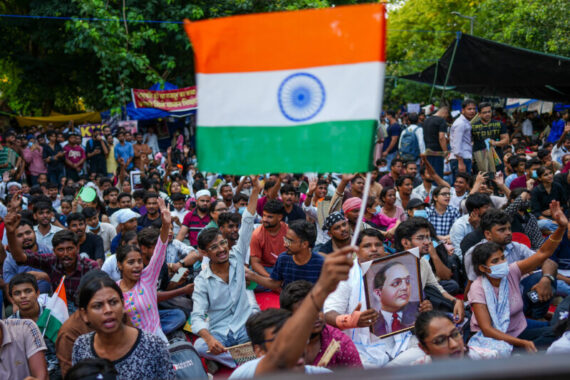
The school protests have gained support from members of the Gen Z movement that emerged earlier this year in India.
September 4, 2026
A
new wave of student protests is spreading across India as schoolchildren increasingly take to the streets to demand safer buildings, qualified teachers, clean drinking water, electricity, adequate classroom facilities and better food.
The protests, reported across at least 10 states since late July, have been driven largely by students at government-run schools, many of which serve children from economically and socially marginalised communities. The demonstrations are emerging only weeks after a nationwide youth movement led largely by Gen Z challenged Prime Minister Narendra Modi’s government over examination failures, unemployment and problems within the education system.
The latest protests have been described as the beginning of a Gen Alpha movement, with children as young as six challenging teachers and government officials over conditions in their schools.
At a government primary school in Samuhi Bhatpurwa village in Uttar Pradesh, 122 students refused to attend classes on August 22 until authorities promised to replace their deteriorating school building.
The school had been left partly in ruins after a wall collapsed in 2023, severely injuring a girl. The children said they had repeatedly asked authorities for a new building because they feared the structure could collapse again.
Their protest eventually drew the attention of a senior education department official, Block Education Officer Deepak Awasthi, who promised that a new building would be constructed. The students then agreed to return home.
Eight-year-old Priya, one of the protesters, said fear over the condition of the building was making it difficult for students to concentrate on their studies. “The fear does not let us concentrate on our studies,” she told Al Jazeera.
The protests reflect wider concerns about the quality of India’s public education system, despite official data showing improvements in access, declining dropout rates and a national teacher-pupil ratio of about one teacher for every 24 students.
The grievances vary from state to state, but many protesters are demanding basic facilities that are already recognized as rights under Indian law.
At Sarvodaya Inter College in Uttar Pradesh, students protested on July 28 over the absence of drinking water and electricity and a shortage of benches. Class 12 student Manoj said students struggled to study during hot and humid weather because there were no fans and many pupils were forced to sit on the floor.
Students at Vaidyanath Vidyalaya in Maharashtra later demonstrated against a shortage of teachers. Other protests have focused on poor school buildings and the quality of meals provided under India’s midday meal program.
In Bihar’s Simuara village, about 50 students walked four kilometers to meet a senior government official and complain about the food being served at their school. They said the school lacked piped water to properly clean ingredients and that rice, lentils and vegetables were often of poor quality, with some vegetables allegedly nearly rotten.
Education rights activist Nagasimha Rao said children were demanding basic provisions including teachers, benches, school buildings, drinking water, electricity and toilets. He argued that inadequate infrastructure and staffing had been a longstanding problem in government schools.
India has one of the world’s largest education systems, with about 247 million students attending roughly 1.5 million schools. Around 70 percent are operated by federal, state or local governments. Yet government data shows that more than 100,000 schools have only one teacher for all grades, affecting about 2.9 million children. The country also has thousands of schools officially classified as having no enrolled students.
The Right to Education Act, introduced in 2009, established education as a fundamental right for children aged six to 14 and set standards covering school buildings, water, sanitation and safety. It also specifies a teacher-student ratio of at least one teacher for every 30 students.
Recommended
The school protests have also gained support from members of the Gen Z movement that emerged earlier this year.
Beginning in June, thousands of young protesters gathered at New Delhi’s Jantar Mantar to demand accountability over high-profile examination paper leaks. Their concerns later expanded to unemployment and underemployment, helping turn the demonstrations into a broader challenge to the government.
The movement was organised in part by the satirical Cockroach Janata Party, or CJP, which was formed in May to express anger over unemployment and systemic problems in education. After security forces cracked down on protesters, the movement gained wider public support, and Education Minister Dharmendra Pradhan resigned.
The CJP subsequently turned its attention to India’s schools. On August 15, it launched a grassroots campaign called “School Thik Karo,” or “Fix the Schools”, supporting schoolchildren protesting poor facilities and teacher shortages.
Ratna Singh, the group’s legal affairs head, said the organisation had met children and parents from rural areas during its earlier demonstrations and heard repeated complaints about school infrastructure, teachers and roads leading to schools.
The campaign has faced resistance. CJP members visiting schools in different parts of the country have reported incidents of violence and intimidation. One member, Gaurav Bharti, alleged that police and local groups were threatening activists after he highlighted poor conditions at a rural school in Uttar Pradesh.
The growing movement could eventually have political consequences. More than 30 percent of India’s population is under 18, meaning many of the children protesting today will be eligible to vote by the 2029 national elections. Activists say the education system could therefore become an increasingly important political issue.
Educationist Swarna Rajagopalan has called for systemic reforms, including equal infrastructure, better recruitment and support for teachers, and stronger measures to encourage families to keep children in school.
For students and activists, however, the immediate demand is simpler: authorities must listen.
Sujata Gowda, a postgraduate mathematics student at Bangalore University, said the protests were the result of frustration that had been building for years.
“Students across the country,” she said, “felt abandoned by the system.”
Unless authorities address the concerns raised by students, she warned, more protests could follow across India.
(Source: Aljazeera English)

Politics Today is dedicated to publishing insightful analyses in order to understand the changing nature of contemporary politics. It aims to contribute to the sound and constructive discussion of international affairs.
You can see how this popup was set up in our step-by-step guide: https://wppopupmaker.com/guides/auto-opening-announcement-popups/

Stay informed by subscribing to
our weekly newsletter.
You can see how this popup was set up in our step-by-step guide: https://wppopupmaker.com/guides/auto-opening-announcement-popups/
You can see how this popup was set up in our step-by-step guide: https://wppopupmaker.com/guides/auto-opening-announcement-popups/
You can see how this popup was set up in our step-by-step guide: https://wppopupmaker.com/guides/auto-opening-announcement-popups/
You can see how this popup was set up in our step-by-step guide: https://wppopupmaker.com/guides/auto-opening-announcement-popups/