Taiwan Tests Doomsday Invasion Scenario as China Pressure Intensifies

July 3, 2026

The military exercise reflected President Lai Ching-te's broader strategy to prepare Taiwan's civilian institutions for conflict, drawing lessons from the wars in Ukraine and the Middle East.
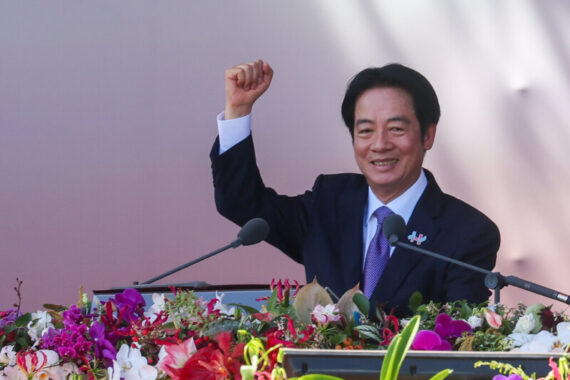
Taiwan President Lai Ching-te (William Lai) delivers a national day address, during the National Day Ceremony of the Republic of China (Taiwan), outside the Presidential Office in Taipei, Taiwan, on October 10, 2025. Photo by Anadolu Images.

T

aiwan has conducted its most comprehensive civil defense and wartime preparedness exercise to date, simulating a cascading national emergency that began with a Chinese blockade and earthquake before escalating into cyberattacks, sabotage, civil unrest and a full-scale military invasion. The drills, observed exclusively by Reuters, underscore Taipei’s growing efforts to strengthen national resilience as military pressure from China continues to intensify.

Held over two days in central Taiwan’s Nantou County, the exercise brought together more than 370 government officials, military officers and emergency responders. Organizers described the scenario as a realistic test of the island’s ability to maintain essential government functions during a complex, multi-dimensional crisis.

The exercise reflected President Lai Ching-te’s broader strategy to prepare Taiwan’s civilian institutions for conflict, drawing lessons from the wars in Ukraine and the Middle East, where attacks on civilian infrastructure, information warfare and prolonged disruptions have become defining features of modern warfare.

Officials participating in the drill confronted a rapidly deteriorating scenario beginning with a Chinese naval blockade coinciding with a magnitude 6.8 earthquake that killed dozens of people and damaged critical infrastructure. According to the exercise, Beijing exploited the natural disaster to launch cyberattacks, spread disinformation, hijack television broadcasts and sabotage key facilities before initiating a full-scale military assault.

Rare access to the closed-door exercise

Reuters, which was granted rare access to the closed-door exercise, reported that officials were required to coordinate responses across multiple agencies while simultaneously maintaining emergency services, public order and communications under wartime conditions.

“Our adversary is right on our doorstep, just across the Taiwan Strait. That is very close,” Chi Lien-cheng, Taiwan’s minister without portfolio overseeing the exercise, told Reuters.

“If you don’t defend your own country, who else will defend you?” he added, while acknowledging that Taiwan still faced significant shortcomings in resources and preparedness.

The drills represent a shift from Taiwan’s previous emergency exercises, which had often been criticized as overly scripted and symbolic. This year’s program was designed to expose weaknesses and force officials to make decisions under increasingly realistic battlefield conditions.

The first day focused on a lengthy tabletop simulation, while the second featured field exercises that included counter-drone operations, emergency food distribution and coordination between civilian authorities and military reserve forces.

One scenario involved a Chinese drone strike on the county’s emergency response headquarters, forcing officials to activate a backup command center after 75 personnel were declared missing.

Emergency responders also rehearsed protecting power stations, maintaining healthcare services and restoring communications while coping with widespread infrastructure failures.

Civil-military coordination takes center stage

A key objective of the exercise was strengthening cooperation between Taiwan’s civilian institutions and its armed forces.

Military reserve units coordinated directly with local governments, while officials monitored unfolding events through advanced tactical mapping systems and interactive digital platforms that tracked emergency resources in real time.

Lin Fei-fan, deputy secretary-general of Taiwan’s National Security Council, said demonstrating societal resilience was intended to strengthen deterrence against Beijing.

“The message to our adversary is clear: when they know Taiwan’s society is prepared, they will have to think very carefully about whether to launch such a costly war against Taiwan — one that may not succeed,” he said.

Taiwanese officials have increasingly argued that modern conflicts require not only military readiness but also the ability of civilian governments, businesses and communities to continue functioning during sustained attacks.

Lessons from Ukraine have featured prominently in Taiwan’s planning, particularly regarding the importance of decentralized command structures, resilient communications networks and maintaining essential public services.

This year’s drills included moving hospital operations underground, testing backup government facilities and inviting professional cybersecurity experts to attack official networks in simulated cyber warfare.

Participants also faced extensive information warfare scenarios.

In one simulation, local television broadcasts were replaced with Chinese propaganda while false information spread rapidly through social media and printed leaflets. Officials were required to identify disinformation, hold emergency press briefings and reassure the public.

Community leaders also took part in the training

Lee I-yuan, a 75-year-old borough chief who participated in the exercise, said the simulations highlighted the growing importance of combating false information during crises.

“If the other side attacks, they will definitely use AI to spread false information,” he said.

The drills assigned Nantou County, Taiwan’s only landlocked county, a strategic wartime role as a logistical rear base where civilians fleeing frontline regions could seek shelter while government agencies relocated critical operations inland.

Local officials were questioned extensively about emergency preparedness, including the availability of food supplies, infant formula, reserve manpower and medical resources.

Some participants struggled to answer detailed questions as commanders deliberately increased pressure throughout the exercise.

“We can’t actually put them through a real war, so we can only use scenarios to help them understand that war is extremely cruel — all situations will be severe and urgent,” one official involved in the exercise told Reuters.

China, which considers democratically governed Taiwan part of its territory, has never ruled out using force to achieve reunification.

While the resilience exercise concluded, Taiwan’s defense ministry reported that China had simultaneously conducted another combat readiness patrol around the island involving warships and at least 22 military aircraft, including nuclear-capable H-6 bombers.

Beijing accused President Lai of escalating tensions across the Taiwan Strait.

Chinese Foreign Ministry and Taiwan Affairs Office officials said Lai’s policies were increasing the risk of conflict, describing him as a “creator of crises” in cross-strait relations.

Taiwan rejects China’s sovereignty claims, insisting that only the island’s 23 million people can determine their future.

As military activity around Taiwan continues to increase, Taipei hopes its expanding civil defense program will strengthen national resilience while reinforcing its message that any attempt to seize the island by force would face not only military resistance but also a prepared and functioning civilian society.

(Source: Reuters)

Politics Today is dedicated to publishing insightful analyses in order to understand the changing nature of contemporary politics. It aims to contribute to the sound and constructive discussion of international affairs.