Pickup Trucks and Drones: Who Is Financing the War in the Sahel?
Some of the actors shaping the war in Mali today emerged from networks inherited from the old fronts of post-Cold War Saharan geopolitics.
May 13, 2026
W
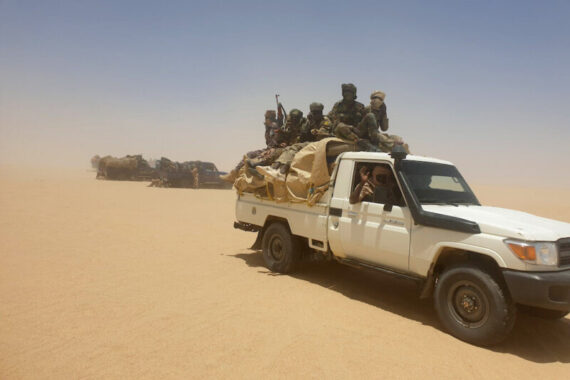
hen we hear news of a conflict in the Middle East or across the Sahel, one of the first images that comes to mind is the pickup truck with a heavy machine gun mounted on its bed. Racing along desert roads, sometimes accompanying the convoy of a state army, sometimes forming part of a militia raid, these vehicles have become one of the most familiar images of modern warfare.
The footage that emerged from Mali on the morning of April 25, 2026, revived that memory once again. Coordinated attacks carried out by al-Qaeda-linked JNIM and the FLA forces advocating Azawad independence brought these desert cavalrymen back into the global spotlight.
Yet, of course, no “victory” won in this region comes merely through off-road vehicles fitted with PK machine guns. So before asking who is financing and directing the war in the Sahel today, it is worth looking at who first turned these vehicles into some of the most iconic war machines of irregular warfare, and under what circumstances.
At the heart of the crisis unfolding in the Sahara in the second half of the 1980s lay the Aouzou Strip, located along the Chad–Libya border. This desert territory, covering roughly 114,000 square kilometers, carried the burden of vague, arbitrarily drawn borders inherited from the colonial era. Libya, under Muammar Gaddafi, regarded the area as a matter of historical right, while Chad saw this claim as a direct threat to its national sovereignty.
When the war began, the military balance on paper heavily favored Libya. The Libyan army resembled a Soviet-equipped steel fist. Gaddafi’s regime controlled the Aouzou Strip with roughly 8,000 troops, T-55 tanks, armored personnel carriers, artillery units, and Mi-24 helicopters, famously known as “flying tanks.” Facing them were the Chadian National Armed Forces, who knew the terrain far better but had only limited technological capabilities.
By 1987, however, the intelligence, weapons, and air support provided by France under Opération Épervier quickly shifted the course of the war in Chad’s favor. France was the most critical actor behind the Chadian government, seeking both to protect Western bloc interests and to break Libya’s influence south of the Sahara. These were, after all, the years when Cold War rivalry increasingly turned local conflicts into proxy wars.
The Battle of Fada on January 2, 1987, marked the turning point in this shift. The French Air Force had suppressed Libyan air operations and largely neutralized Gaddafi’s air superiority. Alongside this, hundreds of Toyota pickups supplied by France, together with MILAN anti-tank missiles capable of destroying a tank from roughly two kilometers away, were among the main factors that turned the battlefield equation against Libya. Indeed, Khalifa Haftar, one of the most influential figures in Libyan politics today, was among those captured by Chadian forces during that period.
By September 1987, Chadian units carried out a daring raid, infiltrating roughly 100 kilometers into Libyan territory and striking the Maaten al-Sarra Air Base. Numerous aircraft, ammunition stocks, and military assets belonging to the Libyan air force were destroyed before they could even take off. Conducted under French command, this raid became one of the most critical moves in undermining Libya’s air superiority in the region and forcing Gaddafi toward the diplomatic table.
The Chad–Libya War of 1986–87 is now remembered as the “Toyota War.” These low-cost pickup trucks, brought into the country with French support and fitted with heavy machine guns and anti-tank missiles, had been transformed into mobile war machines capable of destroying million-dollar T-55 tanks from hundreds of meters away. While Libya’s heavy Soviet tanks sank into the sand and turned into static targets, the lightweight Toyotas, with their wide tires, seemed almost to float across the desert surface. According to an account that even found its way into military reports, Chadian soldiers would cross Libyan minefields at speeds exceeding 100 kilometers per hour. They moved so fast that even if a wheel triggered the fuse of an anti-tank mine, by the time the explosion occurred the pickup had already left the blast radius.
The real strength of these vehicles, known in modern military literature as “technicals,” lay not in their armor but in their speed and simplicity. When a tank broke down, it required a team of specialist engineers, heavy maintenance infrastructure, and a complex supply chain for spare parts. When a Toyota broke down, basic technical knowledge, limited equipment, and a bit of ingenuity were often enough.
Of course, these vehicles were not what won the war on their own. Without France’s suppression of Libya’s air superiority, the MILAN anti-tank missiles it supplied, the flow of intelligence, and the political-military guarantee provided by Paris, such an outcome would not have been possible. For this reason, the Toyota War is remembered not merely as a story of light vehicles defeating heavy tanks, but as a striking example of how asymmetric warfare, when combined with external support, can change the outcome of a conflict.
The Toyota Hilux and similar vehicles, which have entered popular culture as the archetypal “terror pickup,” have become a constant feature of conflict zones stretching from the Middle East to the Sahel due to their durability, low cost, and ease of weaponization. Having first emerged in the deserts of Chad in the 1980s, where speed, simplicity, and geography gave them an edge against heavy tanks, these vehicles are now back on the battlefield in Mali.
So, are the pickups and drones now pushing southward in Mali truly being commanded by the rebel alliance alone?
On the morning of April 25, 2026, Mali was shaken by one of the most extensive waves of attacks it had seen in recent years. From the outskirts of Bamako to the country’s central and northern regions, numerous military sites were targeted in the early hours of the day.
The heaviest blow fell on Kati, regarded as the heart of regime security. Defense Minister Sadio Camara was killed in a suicide attack on his residence at around 5:20 a.m. Another devastating outcome of the attack wave for the Malian government was the recapture of Kidal, seen as the symbolic capital of the Azawad independence idea, by armed groups.
The statements that followed soon after altered not only perceptions of the attacks’ scale, but also their political meaning. The operations were jointly claimed by al-Qaeda-linked JNIM and the FLA, the Tuareg-dominated Azawad independence movement.
What made this partnership so striking was the ideological distance between the two groups. On one side stood JNIM, a jihadi-Salafi organization and one of the most effective extensions of the global jihad network in the Sahel. On the other stood the FLA, a Tuareg-led movement rooted in an ethnic, historical, and regional claim to independence in northern Mali. Yet on the ground, ideological boundaries were bending in the shadow of shared enemies. Both groups had converged on the same front against the Bamako government, the AES alliance, and the Russia-linked axis.
This rapprochement also rested on a deeper historical foundation. Within the leadership ranks of both groups were figures who had previously fought in Libya on Gaddafi’s side. In other words, some of the actors shaping the war in Mali today emerged from networks inherited from the old fronts of post-Cold War Saharan geopolitics. This time, however, they are embedded in much broader alliances and far more complex proxy relationships.
The contact between the Azawad movement and jihadi-Salafi groups also carries the legacy of a profound historical disappointment. The declaration of Azawad’s independence on April 6, 2012, marked a high point for Tuareg nationalism. Yet that victory was short-lived. The secular-nationalist Azawad movement soon found itself under the military and ideological pressure of jihadi-Salafi groups such as Ansar Dine, AQIM, and MUJAO, which would later come together under the JNIM umbrella.
The most important threshold of that period came in May 2012, when an attempt was made to establish a unified Islamic state between the then-independence-oriented Azawad movement, the MNLA, and Ansar Dine. The initiative provoked backlash both internationally and within the MNLA itself, because there was a structural incompatibility between the MNLA’s secular-nationalist line and Ansar Dine’s sharia-based ideology. Although Ansar Dine’s leader, Iyad Ag Ghaly, had been one of the leading figures of previous Tuareg rebellions, by then he had shifted toward the jihadi-Salafi camp. Shared ethnic and regional roots, therefore, were not enough at the time to overcome ideological divergence.
In 2024, this fragile relationship was tested once again. The strategic Wagadou Forest, near the Mauritanian border, was a vital sanctuary and transit corridor for both sides. On April 5, a JNIM ambush on an Azawad convoy escalated tensions. Even so, through the initiative of Alghabass Ag Intalla, one of the most prominent Tuareg figures, the parties negotiated a new non-aggression arrangement.
This arrangement covered intelligence sharing, mutual passage rights, and deconfliction against the Malian army and Wagner forces, but it excluded joint military operations.
The simultaneous and coordinated attacks launched in the final days of April 2026, however, carried this relationship into a new phase. Contact between JNIM and the FLA was no longer limited to intelligence sharing or tactical deconfliction.
Recommended
In the 1987 Toyota War, the decisive factor behind Chad’s upper hand against Libya was not merely the speed and durability of the Toyotas, but the intelligence, air support, and strategic thinking provided by France. Paris had positioned itself behind Chad in line with its own interests and the regional agendas of its allies, seeking to limit Gaddafi’s influence south of the Sahara.
Today, however, the question of who stands behind the rebels against Mali’s open alliance with Russia remains one of the most critical uncertainties in the Sahel equation. Indeed, “independent” sources on this issue remain limited.
According to Mali, the FLA and JNIM are positioned within a broader destabilization coalition that benefits from the intersecting interests of France, Ukraine, Algeria, and Mauritania. In this perspective, France seeks to weaken the anti-Western alliance taking shape along the Mali–Niger–Burkina Faso axis; Ukraine aims to open an indirect front against Russia in the Sahel; and Algeria wants to preserve its historical influence over northern Mali. Mauritania, meanwhile, is also alleged to be providing these groups with indirect room for maneuver due to regional balances.
Russian sources, by contrast, interpret the picture through a more military-technical lens. According to them, FLA and JNIM elements received training from Ukrainian military intelligence in the use of drones and FPV kamikaze systems, reconnaissance and surveillance, target acquisition, and precision-strike techniques. The group’s technological leap throughout 2025 is also read as an extension of the war against Russia being carried into the Sahel.
Yet amid all these claims, the most tangible indication remains the following statement made by Ukrainian Military Intelligence spokesperson Andriy Yusov after the Tinzaouaten ambush in July 2024, in which Wagner and the Malian army suffered heavy losses:
“The rebels received the necessary information, and not only information, which enabled them to carry out a successful military operation against Russian war criminals. We will certainly not go into the details for now. There will be more to come.”
(Originally published in Turkish by Middle East Africa)

Muhammed Yasir Bodur is a Research Assistant at the Sakarya University Center for African Studies and a doctoral candidate at Istanbul Medeniyet University. His academic work focuses on Senegal and Mali within the field of international relations, while also engaging with African migration and critical border studies from a sociological perspective.
You can see how this popup was set up in our step-by-step guide: https://wppopupmaker.com/guides/auto-opening-announcement-popups/

Stay informed by subscribing to
our weekly newsletter.
You can see how this popup was set up in our step-by-step guide: https://wppopupmaker.com/guides/auto-opening-announcement-popups/
You can see how this popup was set up in our step-by-step guide: https://wppopupmaker.com/guides/auto-opening-announcement-popups/
You can see how this popup was set up in our step-by-step guide: https://wppopupmaker.com/guides/auto-opening-announcement-popups/
You can see how this popup was set up in our step-by-step guide: https://wppopupmaker.com/guides/auto-opening-announcement-popups/