Russia, China Raise Voices against US-Israeli Attacks on Iran
Beijing has consistently advocated a diplomatic solution to tensions over Iran’s nuclear program, positioning itself as a mediator in regional disputes.
March 4, 2026
R
ussia and China have sharply criticized the United States and Israel over their military strikes on Iran, urging an immediate halt to hostilities and warning that the conflict risks accelerating nuclear proliferation across the Middle East.
The diplomatic pushback comes days after joint US-Israeli airstrikes targeted sites inside Iran, prompting retaliation from Tehran and widening regional instability.
Chinese Foreign Minister Wang Yi told his Israeli counterpart Gideon Saar on Tuesday that the attacks interrupted negotiations between Washington and Tehran that had “made significant progress,” including discussions addressing Israel’s security concerns.
According to China’s Foreign Ministry, Wang said Beijing “opposes any military strikes launched by Israel and the US against Iran” and called for an immediate cessation of operations to prevent escalation.
“Force cannot truly solve problems; instead, it will bring new problems and serious long-term consequences,” Wang said during the phone call.
China also requested that Israel take “concrete measures” to ensure the safety of Chinese personnel and institutions in Iran. The call followed additional diplomatic outreach by Wang to the foreign ministers of Iran, Oman and France in an apparent effort to stabilize the rapidly deteriorating situation.
Beijing has consistently advocated a diplomatic solution to tensions over Iran’s nuclear program, positioning itself as a mediator in regional disputes.
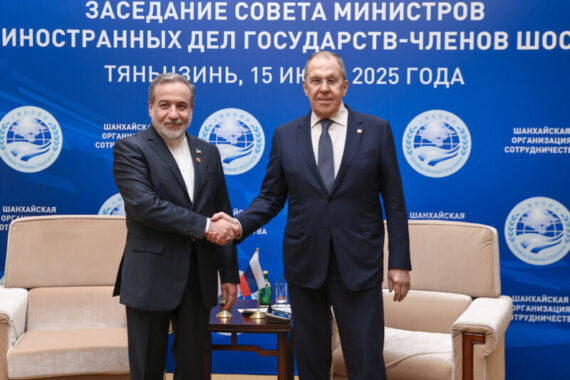
Russian Foreign Minister Sergey Lavrov also criticized the U.S. and Israel, warning that their actions could produce the opposite of their stated objective — preventing Iran from obtaining nuclear weapons.
Speaking at a news conference, Lavrov said the “logical consequence” of the attacks could be that forces inside Iran might push to acquire a nuclear bomb.
“Because the US doesn’t attack those who have nuclear bombs,” Lavrov remarked, suggesting that military pressure could incentivize deterrence through nuclear capability.
Lavrov further warned that other Arab states might now reconsider their own strategic positions, potentially triggering a broader nuclear arms race in the region.
Israel is widely regarded as the Middle East’s only nuclear-armed state, though it neither confirms nor denies possessing such weapons.
Recommended
Lavrov said Russia had seen no evidence that Tehran was developing nuclear weapons and reiterated Moscow’s readiness to assist in finding a diplomatic solution. He spoke on Tuesday with Iran’s foreign minister, Abbas Araghchi, and condemned what he described as “unprovoked military aggression” by the U.S. and Israel.
Earlier, Russia’s Foreign Ministry accused Washington and Tel Aviv of carrying out a “premeditated and unprovoked act of armed aggression” against a sovereign UN member state, warning that the campaign could lead to humanitarian, economic and even radiological consequences.
The ministry said the U.S. and Israel were pushing the region toward “an unpredictable chain reaction and spiraling violence,” placing full responsibility for the fallout on them.
Russia’s criticism comes as Moscow itself continues to face international condemnation for its ongoing war in Ukraine, now entering its fifth year.
China and Russia have both strengthened political and economic ties with Iran in recent years, often opposing US-led sanctions and military pressure on Tehran.
As the conflict between Israel, the United States and Iran intensifies, diplomatic divisions among major global powers appear to be widening, complicating efforts to contain what analysts warn could become a broader regional confrontation.
(Source: Aljazeera English)

Politics Today is dedicated to publishing insightful analyses in order to understand the changing nature of contemporary politics. It aims to contribute to the sound and constructive discussion of international affairs.
You can see how this popup was set up in our step-by-step guide: https://wppopupmaker.com/guides/auto-opening-announcement-popups/

Stay informed by subscribing to
our weekly newsletter.
You can see how this popup was set up in our step-by-step guide: https://wppopupmaker.com/guides/auto-opening-announcement-popups/
You can see how this popup was set up in our step-by-step guide: https://wppopupmaker.com/guides/auto-opening-announcement-popups/
You can see how this popup was set up in our step-by-step guide: https://wppopupmaker.com/guides/auto-opening-announcement-popups/
You can see how this popup was set up in our step-by-step guide: https://wppopupmaker.com/guides/auto-opening-announcement-popups/