Syrian Government Announces Ceasefire and Integration of SDF

January 19, 2026

Turkish President Recep Tayyip Erdoğan held a phone call with President al-Sharaa on Sunday, stressing that the complete removal of terrorism from Syrian territory is vital for Syria and the wider region.
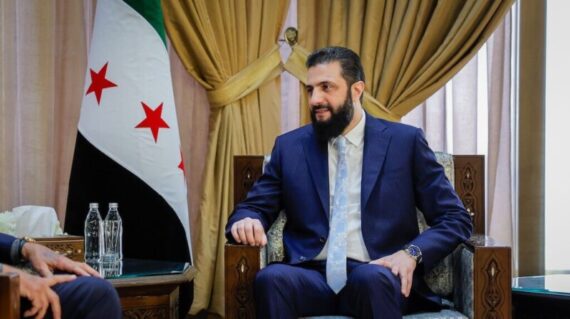
Syrian President Ahmed Sharaa meets with US Special Envoy for Syria Thomas Barrack at the People’s Palace in Damascus, Syria on January 18, 2026. Photo by Anadolu Images.

S

yrian President Ahmad al-Sharaa announced on Sunday a comprehensive ceasefire and a far-reaching integration agreement between the Syrian government and the Syrian Democratic Forces (SDF), marking a major shift in the balance of power in the country’s northeast after years of fragmentation and conflict.

According to details published by the state-run Syrian Arab News Agency (SANA), the agreement provides for an immediate and full ceasefire across all fronts and contact lines between Syrian government forces and the SDF. The deal is to take effect alongside the withdrawal of all SDF-affiliated military formations to areas east of the Euphrates River, a move described as a preparatory step for redeployment and reintegration.

Under the agreement, the provinces of Deir ez-Zor and Raqqa will be handed over fully and immediately to the Syrian government, both militarily and administratively. This includes the transfer of all civilian institutions, public facilities, and local administrative bodies to state control. Employees currently working in civil institutions in the two provinces will be retained within relevant Syrian state ministries, and the government pledged not to take punitive measures against SDF personnel or members of the existing civil administration.

The integration of all civilian institutions in Hasakah

The deal also stipulates the integration of all civilian institutions in Hasakah province into Syrian state administrative structures, further extending Damascus’ authority over territories that had remained outside direct government control for much of the past decade.

A key element of the agreement concerns strategic economic assets. The Syrian government will assume control of all border crossings as well as oil and gas fields in the northeast. According to SANA, Syrian forces will secure these sites to ensure that revenues are returned to the state, a development expected to have significant economic implications for a country struggling under years of war and sanctions.

Developments on the ground appeared to move in parallel with the political announcement. In eastern Deir ez-Zor, Syrian tribal forces took control of major oil and natural gas facilities previously held by the YPG/SDF, Anadolu Agency reported. Tribal groups operating east of the Euphrates, reinforced by fighters arriving from the western side of the river, seized the Al-Omar oil field and the Koniko natural gas field, two of Syria’s most important energy sites.

Withdrawal of U.S. forces

Local sources said the advances followed the withdrawal of U.S. forces from the area, which had previously used several of the oil and gas facilities as military bases. The U.S. pullout created a security vacuum that accelerated the collapse of SDF control in large parts of the region.

As tribal forces advanced, they also took control of several towns and villages east of the Euphrates, including Shehil, Al-Hawayij, Ziban, Tayyane, Abu Hamam, Hatla, Garanij, Baghouz, Susah and Shafeh. SANA broadcast images showing SDF withdrawals from key locations such as the Al-Halabiya Roundabout, described as a major transportation hub linking the eastern, western and northern countryside of Deir ez-Zor.

The Syrian army and internal security forces expanded their presence in other strategic areas. SANA reported that government forces took control of al-Tabqah Prison west of Raqqa province, while the army’s Operations Command announced full control of the al-Tabqah military airport. Internal security units were also deployed to villages in the western Deir ez-Zor countryside to consolidate control and restore order.

Regional reactions

Regional reactions to the developments were swift. Turkish President Recep Tayyip Erdoğan held a phone call with President al-Sharaa on Sunday, stressing that the complete removal of terrorism from Syrian territory is vital for Syria and the wider region. According to a statement by Türkiye’s Communications Director Burhanettin Duran, Erdoğan reaffirmed that Türkiye’s support to Syria, particularly in counterterrorism efforts, would continue to increase.

During the call, the two leaders discussed bilateral relations and recent developments in Syria. Erdoğan emphasized that Türkiye attaches great importance to Syria’s territorial integrity, unity, stability and security—principles Ankara has repeatedly highlighted in its policy toward the Syrian conflict.

The agreement between Damascus and the SDF represents one of the most significant political and military shifts in northeastern Syria in recent years. The region, long shaped by U.S. military presence, SDF administration and complex tribal dynamics, is now witnessing a rapid reassertion of Syrian state authority.

While questions remain about the long-term implementation of the deal and the future role of former SDF militants within state structures, the combination of political agreements, tribal mobilization and regional backing signals a decisive moment in Syria’s protracted conflict, potentially closing one of its most enduring territorial and governance divides.

(Source: Anadolu News)

Politics Today is dedicated to publishing insightful analyses in order to understand the changing nature of contemporary politics. It aims to contribute to the sound and constructive discussion of international affairs.