The Israel Factor in Türkiye-US Relations and the Decisive Role of the NATO Summit

August 6, 2026

Türkiye’s excellent hosting of the NATO Summit and the efforts by the Israeli delegation throughout the summit to shift the agenda and overshadow the summit were equally striking.
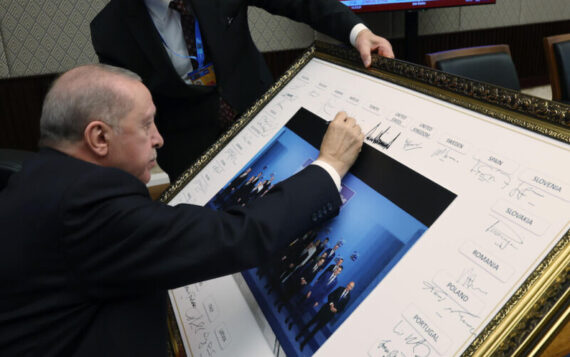
Turkish President Recep Tayyip Erdogan signs the commemorative board bearing the signatures of leaders attending the 36th NATO Summit of Heads of State and Government at the Presidential Complex in Ankara, Turkiye, on July 8, 2026. Photo by Anadolu Images.

T

he 36th NATO Summit, held in Ankara on July 7-8, 2026, saw US President Trump state that he had attended the summit solely out of respect for President Erdoğan; the ‘NATO 3.0’ agenda was realized; and, contrary to some experts’ expectations, there was no rift within the alliance. Türkiye’s excellent hosting, which continues to make the country the talk of the town, the efforts by the Israeli delegation throughout the summit to shift the agenda and overshadow the summit were equally striking.

The main factor driving Israel to make such desperate moves was Trump’s pre-summit remarks, in which he suggested that Türkiye might be supplied with F-110 jet engines and the fifth-generation F-35 fighter jets—which had been withheld since 2019—and that the CAATSA sanctions, in place since 2020, might be lifted. On the other hand, Türkiye’s hosting of the summit during such a critical period, President Erdoğan’s meetings on the sidelines of the summit with over 40 heads of state and government on the sidelines of the summit, and, of course, the organization of a defense industry exhibition showcasing Türkiye’s national and domestically produced defence industry products – a first in NATO history – have driven Israel to distraction.

The most significant reason driving Israel to such a state of exasperation and pushing it to make irrational moves is the sense of insecurity that has arisen both within Israel and in the American public sphere due to the stalemate in the war against Iran and the fact that, contrary to promises, an absolute victory has not yet been achieved. Conversely, the fact that Türkiye is viewed as one of the factors hindering Israel’s success due to its role in the war against Iran, coupled with the fact that relations between Türkiye and the US have come to take precedence over those between Israel and the US, is seen as a cause setting off alarm bells and leading Israel to pull out all the stops simultaneously.

It would therefore be useful to highlight the ‘Israel factor’ in Turkish-American relations by examining the rivalry between Türkiye and Israel, mediated through the US and Trump, and the methods Israel employed to persuade the Trump administration to withdraw its support for Türkiye.

Israel’s divergent stance as Turkish-US relations improve

Despite the improvement in Turkish-US relations during Trump’s first term—following the strained relations of Obama’s second term, which is regarded as a crisis period—full normalization could not be achieved due to the dominance of the Zionist lobby over Trump. Indeed, despite all claims of an improvement in bilateral relations, the Pastor Brunson crisis, the Halkbank crisis, threats of economic attacks and the imposition of CAATSA sanctions on Türkiye following its exclusion from the F-35 program all took place during the Trump era. Following the Biden era, which was marked by very frosty Turkish-American relations, Trump’s second presidential term was of paramount importance for both Türkiye and Israel, and both countries had high expectations of Trump from their respective perspectives.

However, Trump had not forgotten what he had gone through after losing the 2020 election; whilst he projected a warm image to the public, it was said that behind the scenes he had distanced himself from Netanyahu, viewing the latter’s relationship with Biden as a betrayal. At the same time, he did not hesitate to publicly express his affection and respect for President Erdoğan, thereby drawing a clear distinction between Erdoğan and Netanyahu. We saw the repercussions of this distinction clearly when, due to developments in Syria, Netanyahu complained to Trump at the White House about Türkiye and President Erdoğan. Indeed, Trump’s response to Netanyahu – “you must be reasonable too” – caused great disappointment on the Israeli side, whilst in Türkiye it was interpreted as Trump taking Türkiye’s side.

Similarly, whilst Trump supported Israel’s attacks on Gaza on the one hand, he did not remain indifferent to the prospect of reaching a ceasefire in Gaza through Türkiyey’s mediation on the other. Similarly, regarding developments in Syria, he has aligned himself closely with Türkiye’s position; despite all of Israel’s objections, he recognised Ahmed Shara as a legitimate interlocutor and provided the necessary support to ensure Syria’s territorial integrity.

The speeches and pledges made by Trump during his Middle East tour in May and at the meeting he held in New York in September with the heads of state and government of Muslim countries, on the occasion of the opening of the 80th session of the United Nations General Assembly, are also significant in that they demonstrate that the US occupies a different position from Israel regarding the region’s future. This is because the ceasefire process in Gaza began after this date.

The Iran card

Realizing it could not influence Trump through Gaza and Syria, Israel attempted to win him over by playing the Iran card; however, it was once again disappointed when, in June 2025, despite Trump ordering strikes on Iran’s nuclear facilities during the 12-Day War, he refrained from intervening in the conflict. However, by any means necessary, Israel managed to drag the US into war with Iran on 28 February, hoping that this would enable it to achieve the regime change in Iran it had long dreamt of and thereby reorganise the region as it saw fit. Yet Israel’s plans failed, and the Iranian people reacted strongly against the assassination of their religious leader, standing firmly behind their government.

The deadlock in the war with Iran has, on the one hand, led the US to reassess its approach to the region, whilst on the other, it has prompted a re-evaluation of its alliance with Israel. It was during this period that Türkiye stepped in once again; together with Qatar and Pakistan, it opened the door to negotiations, making it possible to secure a ceasefire between the US and Iran. Israel, however, found itself isolated as the sole country wishing for the war to continue; whilst continuing its attacks on the Lebanese front, it began doing everything in its power to undermine the ceasefire between the US and Iran.

Israel’s stance has been criticised on numerous occasions by both Trump and Vice-President JD Vance. The events unfolding in the region are particularly telling in demonstrating just how hollow Israel’s long-standing rhetoric about ‘actors posing a threat to it in the region’ really is. For far from certain actors in the region posing a threat to Israel, it has become undeniable that Israel itself constitutes a threat to the entire region and is the sole actor destabilising the region.

This situation has also put a strain on the so-called unshakeable alliance between Israel and the US. For Israel, particularly due to the aggressive and intransigent policies it has pursued under Netanyahu’s leadership, has become an unbearable burden for the US. Given this, it has become inevitable for the Trump administration to opt to work alongside a strong, conciliatory actor such as Türkiye, which prioritises regional stability. However, this situation has thoroughly infuriated Israel. Believing itself to be—and to remain—the US’s sole ally in the region, Israel has jeopardised both its own future and the region’s stability by resorting to endless intrigues aimed at discrediting, and even weakening, the US’s other regional ally, Türkiye.

Israel’s attempts to overshadow the NATO Summit

Türkiye is the country that has shown the strongest reaction to Israel’s attacks on Gaza and the crimes of genocide it has committed there. Whilst, on the one hand, it has given concrete expression to its response by imposing certain sanctions on Israel in accordance with its own domestic law, on the other hand, it is monitoring proceedings before both the International Criminal Court and the International Court of Justice, and is fighting to ensure that Israel is brought to justice and receives the necessary punishment for the genocide, war crimes and crimes against humanity it has committed. In addition to this, Türkiye’s position regarding developments in Syria and its role in the Iran War have led Israel to target Türkiye, giving rise to the narrative that ‘after Iran, the new target is Türkiye’.

At a time when Israel was attempting to position Türkiye as the ‘new Iran’, and just before the critical NATO summit, Trump’s announcement to Türkiye that F-110 jet engines and F-35 fighter jets would be supplied, and that CAATSA sanctions would be lifted, naturally caused the Israeli administration to panic. As a result, Netanyahu—who had been unable to reach Trump in the run-up to the summit—appeared on US media outlets during the summit, stating: “Türkiye is not a good ally; Israel is the US’s true ally, the sale of F-35s to Türkiye would jeopardize Israel’s security and that of other US allies in the region (by which he meant Greece and the Greek Cypriots), and the CAATSA sanctions imposed on Türkiye must never be lifted”, in an attempt to influence American public opinion and, thereby, exert pressure on Trump to back down.

Whilst the whole world was discussing just how wonderfully Türkiye had hosted the summit, noting that, thanks to President Erdoğan, differences of opinion within NATO had not spilled over into the summit, and that, ultimately, a consensus had emerged in the final communiqué regarding the strengthening of NATO—and whilst praise for Türkiye was at its peak— it has been observed that certain journalists—who are clearly funded by Israel and Jewish capital—have been questioning Türkiye’s role within NATO, criticizing the security measures taken for the summit, and, worse still, raising issues that have absolutely no connection to the summit and relate entirely to processes governed by Türkiye’s domestic law, thereby asking questions and writing articles aimed at creating the perception that there is no democracy or fair trial in Türkiye.

At the conclusion of the summit, the fact that Israel was found to be behind the so-called intelligence suggesting a possible attack on the new Air Force One aircraft—a gift from Qatar which Trump used on his visit to Ankara—was viewed as an attempt by Israel to cast a shadow over the summit. Furthermore, by doing so, they sought to spread the perception that Türkiye is unsafe, whilst also sabotaging the process by presenting a pretext to derail the negotiations between the US and Iran. It must not be forgotten that, in the world, the sole country capable of carrying out such attacks is Israel rather than Iran, and history is replete with examples of this.


A successful summit despite Israel’s efforts

Despite all of Israel’s efforts, manipulative actions and hostile behavior, the summit concluded successfully, and Türkiye once again proved itself by demonstrating both its military strength and its diplomatic capabilities. Israel, on the other hand, failed to achieve any results from its smear campaign against Türkiye and did not succeed in swaying either the Trump administration or other NATO allies. Indeed, Israel’s irrational manoeuvers must have exasperated even Trump and his team, as US Secretary of War Pete Hegseth’s planned post-summit visit to Israel has also been cancelled. For Israel has put such pressure on the US administration regarding Türkiye that, under these circumstances, Hegseth no longer had the opportunity to negotiate with Israel.

Consequently, in an environment where ‘NATO 3.0’ is being discussed – and within this framework, the US is expected to reduce its visibility in regions outside its own continent, with this vacuum to be filled by European countries and Türkiye, NATO’s second-largest power – it has become apparent that Israel’s attempts to discredit Türkiye through policies based on lies and slander, and to poison relations between Türkye and the US as well as the rapport between President Erdoğan and Trump, have met with no response.

For both the US administration and the countries in the region have grown weary of Israel’s insatiable ambitions and now desire an end to the wars in the region and the return of peace and stability. Türkiye, too, is utilizing its current strength and capabilities for this cause, thereby lightening the burden on both NATO and the US. Consequently, despite all of Israel’s manipulations, Türkiye will continue on its path in the coming period as the most suitable partner, ally and member for the US, NATO and the EU alike.

(Originally published in Turkish by Kriter)

After serving 25 years in the Turkish Navy, he retired in 2014. Afterwards, he started his doctoral education on Middle East Studies at Sakarya University Middle East Institute and worked as a researcher at the Israel Studies desk of the institute. Between 2019-2021, he served as a Levant Specialist at Center for Middle Eastern Studies (ORSAM) and led the Palestine and Israel studies during this period. Currently, as an independent researcher, he conducts research on Palestine, Israel, the Middle East and Turkish Foreign Policy, writes analyses for various platforms and is a commentator on TV.