Trump Seeks China’s Help on Iran, Beijing Has Little Incentive to Cooperate
Beijing faces competing priorities as the Iran war continues.
May 14, 2026
U
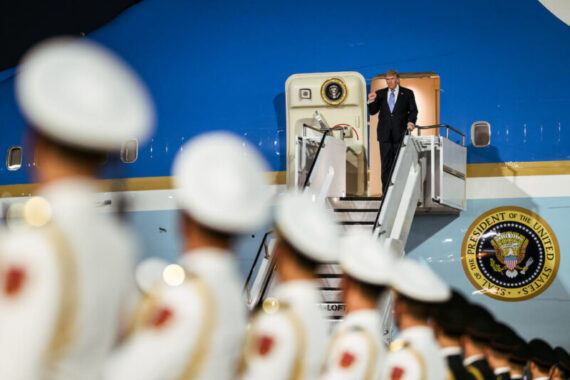
.S. President Donald Trump is expected to press Chinese leader Xi Jinping for assistance in ending the war with Iranduring high-level talks in Beijing this week, but analysts say China is unlikely to offer the decisive support Washington wants.
According to Reuters, Trump’s administration sees Beijing as one of the few governments with enough economic and political influence over Tehran to encourage Iranian leaders back toward negotiations. China remains Iran’s largest oil customer and an important economic lifeline amid Western sanctions.
However, experts say Beijing’s broader strategic interests make it reluctant to pressure Tehran too aggressively.
While China wants stability in the Middle East and an open Strait of Hormuz — through which much of its imported oil passes — Iran also serves as a key regional partner and a geopolitical counterweight to the United States.
Analysts note that the conflict has already benefited Beijing in some ways by shifting U.S. military and diplomatic attention away from the Indo-Pacific region, where China is focused on expanding its influence.
Henrietta Levin of the Council for Strategic and International Relations said Xi is approaching the summit with growing confidence, particularly after Trump eased back from last year’s aggressive tariff campaign against China.
Beijing faces competing priorities as the Iran war continues.
On one side, China depends heavily on energy imports passing through the Strait of Hormuz and has suffered economically from rising oil prices and disruptions caused by the conflict. Iranian military actions in the waterway have threatened a route carrying roughly one-fifth of global oil supplies.
On the other hand, China values its long-term relationship with Iran. Analysts say Beijing is unlikely to cut economic support or halt the supply of dual-use goods that Tehran’s military can use for both civilian and defense purposes.
Chinese officials have publicly rejected U.S. pressure tactics. Liu Pengyu, spokesperson for the Chinese Embassy in Washington, criticized what he described as “illicit unilateral sanctions” and called instead for preventing a renewed escalation in fighting.
Trump has insisted publicly that the United States does not depend on China to force Iranian concessions, arguing that the U.S. naval blockade around Iran already gives Washington leverage. Still, people briefed on the summit preparations told Reuters that U.S. officials privately hope Beijing can help stabilize the situation.
The report highlights the limited options available to the Trump administration in trying to force Chinese cooperation.
The United States has already sanctioned some Chinese firms accused of helping Iran evade restrictions or support military activities. However, experts say Washington has avoided taking action against the major Chinese banks facilitating trade with Iran because of fears of severe economic retaliation.
Brett Erickson of Obsidian Risk Advisors said existing sanctions have had little effect because the U.S. Treasury has avoided targeting the most important financial institutions involved.
Analysts warn that sanctions against major Chinese state-owned banks could trigger a wider economic confrontation between the world’s two largest economies, potentially reviving the tariff war that both sides paused last year.
Edward Fishman of the Council on Foreign Relations said even penalties against a smaller Chinese bank could spark a cycle of retaliatory measures damaging to both economies.
Such escalation could also worsen inflation inside the United States at a politically sensitive moment for Trump, whose approval ratings have already been hurt by the Iran conflict.
Recommended
Another major concern for Washington is China’s dominance in rare earth processing.
China controls much of the global refining capacity for rare earth minerals used in advanced electronics, electric vehicles and military technologies. During last year’s trade tensions, Beijing signaled it could restrict exports of those materials, alarming Western governments and industries.
Analysts say the threat of renewed Chinese export restrictions continues to limit how aggressively Washington is willing to confront Beijing economically.
Former U.S. Deputy Secretary of State Kurt Campbell said China has likely learned from watching previous American interventions in the Middle East and will avoid becoming deeply entangled in the conflict.
“They will want to be careful because they can see political quicksand,” Campbell told Reuters.
As Trump and Xi meet in Beijing, the summit is expected to reveal not only the limits of U.S.-China cooperation over Iran, but also the growing complexity of a relationship shaped simultaneously by rivalry, economic interdependence and competing global ambitions.
(Source: Reuters)

Politics Today is dedicated to publishing insightful analyses in order to understand the changing nature of contemporary politics. It aims to contribute to the sound and constructive discussion of international affairs.
You can see how this popup was set up in our step-by-step guide: https://wppopupmaker.com/guides/auto-opening-announcement-popups/

Stay informed by subscribing to
our weekly newsletter.
You can see how this popup was set up in our step-by-step guide: https://wppopupmaker.com/guides/auto-opening-announcement-popups/
You can see how this popup was set up in our step-by-step guide: https://wppopupmaker.com/guides/auto-opening-announcement-popups/
You can see how this popup was set up in our step-by-step guide: https://wppopupmaker.com/guides/auto-opening-announcement-popups/
You can see how this popup was set up in our step-by-step guide: https://wppopupmaker.com/guides/auto-opening-announcement-popups/