Trump: Ukraine Can Reclaim All Territory With NATO’s Support
Trump added that what was initially intended by Moscow as a “quick little skirmish” had turned into a long, humiliating quagmire.
September 24, 2025
P
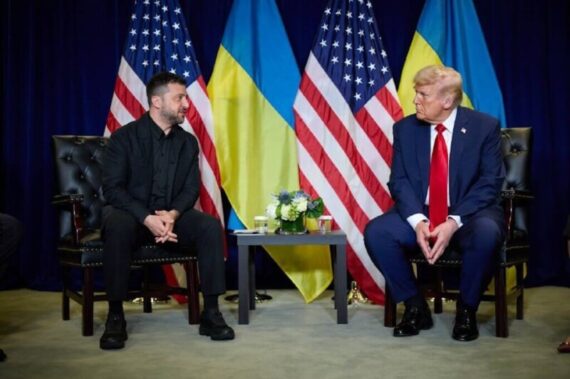
resident Donald Trump declared Tuesday that Ukraine can win back all of its territory seized by Russia, marking a striking reversal from his earlier calls for Kyiv to make concessions in order to end the war. The shift came during the United Nations General Assembly, where Trump met Ukrainian President Volodymyr Zelenskyy and sought to project renewed U.S. commitment to Ukraine’s sovereignty.
Trump, who just weeks ago suggested “land swaps” might be the only path to peace, said in a social media post following the bilateral meeting that Ukraine’s original borders could be fully restored. “I think Ukraine, with the support of the European Union, is in a position to fight and WIN all of Ukraine back in its original form,” Trump wrote. “With time, patience, and the financial support of Europe and, in particular, NATO, the original Borders from where this War started, is very much an option.”
The remarks came as Russia continued to bombard Ukrainian cities with missiles and drones, including new strikes on the Odesa region that left two civilians dead and others injured. Photos released by Ukraine’s Emergency Service showed firefighters battling flames from a missile strike in Tatarbunary.
For Zelenskyy, Trump’s declaration was a political victory. The Ukrainian leader has long pressed Washington to strengthen—not soften—its support for Kyiv, particularly as Russia shows no signs of relinquishing control over annexed territories including Crimea, seized in 2014.
“Trump is a game changer by himself,” Zelenskyy told reporters after their brief meeting. He welcomed Trump’s willingness to align U.S. policy more closely with Ukraine’s, calling it essential for keeping pressure on Russian President Vladimir Putin.
The Ukrainian leader also used his General Assembly platform to criticize both Russia and its ally China for undermining global security, and he lamented the U.N. Security Council’s lack of decisive action against Moscow.
The change in tone represents a dramatic departure from Trump’s longstanding skepticism over Ukraine’s battlefield prospects. During his 2024 presidential campaign and subsequent meetings with Putin, Trump repeatedly argued that Kyiv could not realistically regain all its lost land and should instead negotiate territorial concessions.
Before his high-profile summit with Putin in Alaska last month, Trump said any resolution would require “some land swapping,” a position that alarmed U.S. allies and disheartened Ukrainian officials.
Now, however, Trump’s assessment of Russia’s war effort is blunt. In his address to world leaders at the U.N., he said the conflict had exposed Moscow’s weaknesses. “Russia has been fighting aimlessly for three and a half years a war that should have taken a Real Military Power less than a week to win,” Trump said. “This is not distinguishing Russia. In fact, it is very much making them look like a paper tiger.”
He added that what was initially intended by Moscow as a “quick little skirmish” had turned into a long, humiliating quagmire.
Trump also signaled a tougher stance on sanctions, urging Europe to halt imports of Russian oil and natural gas—the economic lifeline that continues to fuel Moscow’s war machine. “In the event that Russia is not ready to make a deal to end the war, then the United States is fully prepared to impose a very strong round of powerful tariffs, which would stop the bloodshed, I believe, very quickly,” he told the General Assembly.
European leaders echoed his call. European Commission President Ursula von der Leyen announced that the EU would impose additional tariffs on Russia and accelerate the phase-out of Russian energy. French President Emmanuel Macron, after meeting both Trump and Zelenskyy, said he welcomed Trump’s recognition of Ukraine’s capacity not only to resist Russia but “to prevail.”
Meanwhile, NATO allies are preparing consultations at Estonia’s request after three Russian fighter jets reportedly entered its airspace without authorization. Trump said he would support NATO members in defending their skies, even suggesting they could shoot down Russian aircraft if necessary. Direct U.S. involvement, however, he said, would depend on the circumstances.
Recommended
The war’s human toll continues to mount. The U.N. Office of the High Commissioner for Human Rights reported this month that Ukrainian civilian casualties rose by 40% in the first eight months of 2025 compared with 2024. The increase reflects Russia’s intensifying use of missile and drone strikes on urban areas.
A new U.N. Human Rights Office report also accused Russian authorities of widespread torture, ill-treatment, and sexual violence against Ukrainian civilians detained in occupied territories. The report described these abuses as “systematic,” raising fears of potential war crimes.
Moscow dismissed the findings and denigrated the Security Council’s Ukraine-focused session as “just another stop in the world tour of a former actor,” a mocking reference to Zelenskyy. Russia’s deputy ambassador to the U.N., Dmitry Polyanskiy, said the meeting added “no value for peace.”
For all the fiery rhetoric, questions remain about Trump’s long-term strategy. His recent diplomatic efforts—including summits with Putin and European allies—have yet to yield tangible progress toward a ceasefire. Putin has shown little willingness to negotiate directly with Zelenskyy, and Russian bombardments have only intensified.
Still, Trump’s reversal could reshape calculations in Kyiv, Moscow, and European capitals. Analysts say his new position could embolden NATO to provide more sustained military and financial support to Ukraine, bolstering its chances on the battlefield.
“The only question now,” Trump said in his U.N. speech, “is how many lives will be needlessly lost on both sides.”
As the war grinds into its fourth year, Ukraine’s future—and Trump’s evolving role in shaping it—remains uncertain.
(Source: The Associated Press)

Politics Today is dedicated to publishing insightful analyses in order to understand the changing nature of contemporary politics. It aims to contribute to the sound and constructive discussion of international affairs.
You can see how this popup was set up in our step-by-step guide: https://wppopupmaker.com/guides/auto-opening-announcement-popups/

Stay informed by subscribing to
our weekly newsletter.
You can see how this popup was set up in our step-by-step guide: https://wppopupmaker.com/guides/auto-opening-announcement-popups/
You can see how this popup was set up in our step-by-step guide: https://wppopupmaker.com/guides/auto-opening-announcement-popups/
You can see how this popup was set up in our step-by-step guide: https://wppopupmaker.com/guides/auto-opening-announcement-popups/
You can see how this popup was set up in our step-by-step guide: https://wppopupmaker.com/guides/auto-opening-announcement-popups/