Türkiye Urges NATO to Turn Defense Spending into Military Capabilities

July 7, 2026

Ankara plans to prioritize investments in air and ballistic missile defense, long-range strike capabilities and unmanned military systems to meet both national defense requirements and NATO capability targets.
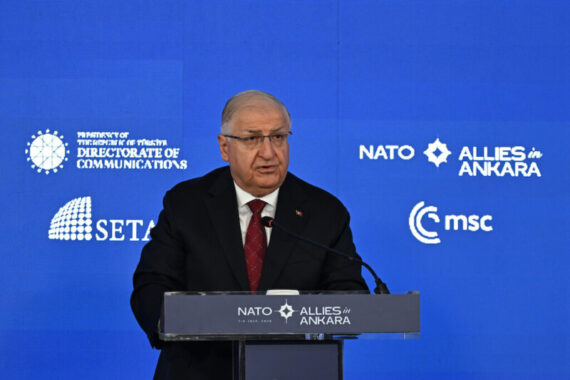
As part of the 36th NATO Summit of Heads of State and Government held in Ankara, the Presidency’s Communications Directorate, in collaboration with the Munich Security Conference (MSC) and the Foundation for Political, Economic, and Social Research (SETA), organized the “Allies in Ankara” program. During the program, Minister of National Defense Yaşar Güler delivered a speech. Photo by Anadolu Images.

T

ürkiye has called on NATO allies to convert rising defense spending into concrete military capabilities, warning that higher budgets alone will not guarantee deterrence as the alliance confronts an increasingly complex security environment.

Speaking at the NATO Allies in Ankara event on Tuesday, National Defense Minister Yasar Guler said NATO’s credibility would ultimately depend on whether member states could translate political commitments into operational military strength, resilient defense industries and integrated security capabilities.

The event, organized in cooperation with Türkiye’s Communications Directorate, the Foundation for Political, Economic and Social Research (SETA) and the Munich Security Conference, comes ahead of the NATO leaders’ summit in Ankara, where alliance members are expected to discuss defense investment, industrial cooperation and regional security challenges.

“Increasing defense spending is important, yet spending money alone does not produce deterrence,” Guler said.

He stressed that NATO must focus on building ready military forces, expanding ammunition stockpiles, strengthening logistics, improving integrated air and missile defense systems, enhancing command-and-control structures and increasing defense industrial production.

According to Guler, the alliance has entered a new strategic phase requiring both credible collective defense and the ability to respond rapidly to crises across multiple regions.

He said NATO’s role has evolved significantly since World War II, moving from collective defense during the Cold War toward crisis management and counterterrorism operations after the collapse of the Soviet Union. Today’s security environment, however, requires the alliance to maintain strong conventional deterrence while remaining prepared for emerging threats.


A stronger and more balanced NATO

The minister reiterated Türkiye’s support for a stronger and more balanced NATO in which European allies assume greater responsibility for their own defense while maintaining the transatlantic partnership and the United States’ security commitment as the foundation of the alliance.

However, he argued that burden-sharing should not be measured solely by defense budgets.

Instead, contributions should also reflect operational risks, geographical responsibilities, military readiness, participation in alliance missions, industrial production capacity and the ability to respond effectively during crises.

Guler highlighted Türkiye’s longstanding role within NATO, saying Ankara maintained one of the alliance’s largest and most capable armed forces while many European countries significantly reduced troop numbers, military stockpiles and defense manufacturing after the Cold War.

“Türkiye has never been merely a geographical frontline country,” he said.

“It has consistently assumed risks, carried responsibility in the field and contributed to deterrence when necessary.”

Türkiye, which joined NATO in 1952, currently fields the alliance’s second-largest army and possesses highly trained forces with extensive operational experience, joint operational capability and high readiness levels, he added.

The minister noted that Turkish forces continue contributing to NATO missions, exercises and deterrence operations across a wide geographic area stretching from the Baltic region to the Black Sea while also participating in maritime security, crisis management and military training activities.

Defense industry and regional security priorities

Guler also emphasized Türkiye’s expanding defense industry, describing it as an increasingly important contributor to NATO’s overall military capabilities.

He said the country has developed advanced technologies across multiple sectors, including unmanned systems, air defense, electronic warfare, precision-guided ammunition, naval platforms, aviation and command-and-control systems.

Over the next three years, Ankara plans to prioritize investments in air and ballistic missile defense, long-range strike capabilities and unmanned military systems to meet both national defense requirements and NATO capability targets.

These capabilities, he argued, should be viewed not only as national assets but also as resources capable of helping reduce NATO’s wider capability and production gaps if fully integrated into alliance planning.

Guler called for greater defense industrial cooperation among allies, arguing that joint production and technology sharing would strengthen NATO more effectively than restrictive policies.

“Türkiye favors cooperation over rivalry, joint production over exclusion and capability-based cooperation over restrictions in the defense industry,” he said.

Addressing European security, Guler welcomed initiatives aimed at strengthening Europe’s defense capacity but stressed that such efforts must reinforce rather than duplicate NATO’s existing structures.

“NATO-EU cooperation must be inclusive, integrating and mutually reinforcing,” he said.

Reinforcing unity

Looking ahead to the NATO summit in Ankara, Guler described the gathering as a critical opportunity for allies to reinforce unity and address key issues including defense investment, industrial production, support for Ukraine and the alliance’s future deterrence posture.

He said the summit should send a clear message that NATO’s collective defense commitment under Article 5 remains unwavering but must be supported by credible military power.

The minister also emphasized the importance of maintaining NATO’s 360-degree approach to security, arguing that the alliance must remain equally attentive to threats along both its eastern and southern flanks as well as challenges beyond the Euro-Atlantic region.

He identified the Strait of Hormuz, the Gulf, Syria, Iraq, the Eastern Mediterranean, North Africa, the Sahel, the Black Sea and the Caucasus as interconnected parts of the same strategic environment requiring coordinated allied attention.

Guler said modern security extends beyond conventional military assets such as tanks, aircraft and warships, encompassing secure digital infrastructure, resilient supply chains, protected critical infrastructure, societal resilience and the ability to respond faster than potential adversaries.

He concluded by reaffirming Türkiye’s commitment to NATO, saying Ankara would continue contributing to the alliance’s deterrence and defense posture while supporting its adaptation to evolving global security challenges.

(Source: Anadolu Agency)

Politics Today is dedicated to publishing insightful analyses in order to understand the changing nature of contemporary politics. It aims to contribute to the sound and constructive discussion of international affairs.