UN Calls for Restraint amid Deadly Youth Protests in Morocco
The European Union also issued a statement on the Morocco protests urging restraint, while reiterating its “partnership and friendship” with Morocco.
October 3, 2025
U
nited Nations Secretary-General Antonio Guterres on Thursday urged Morocco to uphold the rule of law and ensure accountability following a week of escalating youth-led protests that have left at least three people dead and hundreds injured, marking one of the country’s most significant outbreaks of unrest in over a decade.
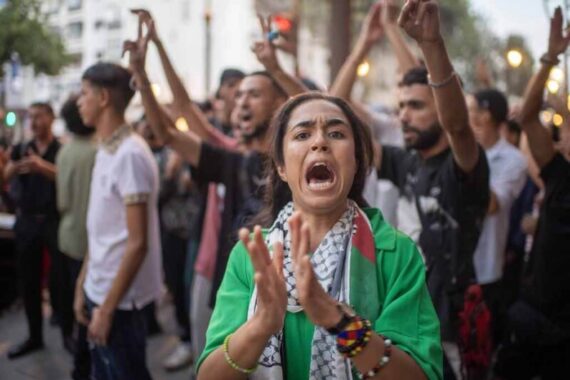
Guterres’ appeal came amid mounting tension in Moroccan cities, where demonstrators — mostly young people — have rallied for six consecutive nights against what they describe as widespread corruption, inequality, and government mismanagement of public resources.
“The Secretary-General deplores the violence during recent demonstrations in Morocco, reportedly resulting in three people killed and several hundred injured,” said UN spokesperson Farhan Haq at a press briefing in New York.
“He calls for protests to take place in a peaceful manner, respecting life, property, and the rule of law, and for a prompt and impartial investigation with a view to ensuring accountability,” Haq said.
Guterres also welcomed Moroccan Prime Minister Aziz Akhannouch’s pledge to engage in dialogue with the protesters, many of whom belong to a loosely organized online movement called GenZ 212 — a reference to Morocco’s international dialing code and the generation driving the movement.
The protests, which erupted late last week, were initially sparked by grievances over chronic underfunding in public education and health care — two sectors where many Moroccans say decades of neglect have deepened inequality.
Demonstrators have also expressed anger over the government’s lavish spending on preparations for the 2030 FIFA World Cup, which Morocco is set to co-host with Spain and Portugal. Protesters have accused authorities of diverting billions toward stadium projects while hospitals and schools crumble.
Videos shared widely on social media show crowds chanting: “Stadiums are here, but where are the hospitals?” and “We want dignity, not mega-projects.”
In several cities, including Rabat, Casablanca, Tangier, and Agadir, thousands of mostly young demonstrators have filled public squares. While many protests remained peaceful, clashes with police have broken out in some areas, particularly in Leqliaa, a small town outside Agadir, where security forces reportedly opened fire on protesters Wednesday, killing three people.
Morocco’s Interior Ministry said the three were shot during an alleged attempt by demonstrators to seize police weapons. However, the Moroccan Association for Human Rights (AMDH) and several eyewitnesses dispute that account, saying the shootings occurred as security forces used live ammunition to disperse crowds.
Human rights groups have demanded an independent investigation into the deaths, accusing authorities of using excessive force and mass arrests to suppress dissent.
The Interior Ministry said at least 354 people have been injured in the unrest, including 326 members of the security forces. Authorities also reported significant property damage — including 271 police vehicles, 175 private cars, and several banks, shops, and municipal buildings across 23 provinces.
The AMDH said that more than 1,000 people have been detained nationwide, though most were released within hours. Others reportedly remain in custody pending investigation on charges of “public disorder” and “property destruction.”
“The government must immediately stop using force against demonstrators and release all those detained for peacefully expressing their opinions,” said AMDH president Souad Benmoussa in a statement Thursday. “The state’s response risks deepening the rift between Moroccan youth and those in power.”
In a televised address, Prime Minister Akhannouch acknowledged public frustration and pledged to “listen to the concerns of Morocco’s youth.”
“The government is open to dialogue with all segments of society,” he said. “We must work together to ensure stability while addressing the legitimate expectations of our young people.”
Despite his appeal, protests appeared likely to continue through the weekend. GenZ 212 — which organizes through TikTok, Instagram, and the gaming platform Discord — posted a statement rejecting violence but vowed to persist with “peaceful and creative” demonstrations.
“We have no quarrel with the police, only with corruption and injustice,” the group said in a post on X (formerly Twitter). “We will not be silenced.”
Analysts say the protests reflect deeper social and economic frustrations in a country struggling with high youth unemployment, soaring living costs, and a sense of political stagnation. Nearly 30% of Moroccans under 30 are unemployed, according to official statistics, while inflation has eroded household incomes.
The discontent has been building for months, fueled by viral videos documenting poor conditions in hospitals and overcrowded classrooms. The World Bank recently warned that Morocco’s “youth employment crisis” could threaten social cohesion if left unaddressed.
Morocco last faced major unrest in 2011, during the Arab Spring, when protesters demanded constitutional reforms and an end to corruption. The monarchy weathered that wave of demonstrations with limited reforms, but the current movement appears to be driven by a younger, digitally organized generation less tied to traditional political groups.
Recommended
Beyond the UN, several international organizations have expressed concern about the situation. Amnesty International and Human Rights Watch called on Moroccan authorities to respect freedom of assembly and to avoid the use of lethal force against protesters.
The European Union also issued a statement urging restraint, while reiterating its “partnership and friendship” with Morocco.
Guterres’ call for an impartial investigation adds pressure on Rabat to respond transparently. The UN chief emphasized that peaceful dialogue — not repression — is the only sustainable path forward.
“The voices of Morocco’s young people must be heard,” Guterres’ office said. “Their aspirations for justice, opportunity, and dignity deserve a fair and lawful response.”
As night fell on Thursday, demonstrators again gathered in several cities, lighting candles in memory of those killed. Organizers said they would continue daily marches until the government takes concrete action on corruption and social reform.
For many protesters, the message remains clear: “We are the generation of change,” one banner read in Casablanca. “We will not be ignored.”
(Source: Anadolu Agency and Aljazeera)

Politics Today is dedicated to publishing insightful analyses in order to understand the changing nature of contemporary politics. It aims to contribute to the sound and constructive discussion of international affairs.
You can see how this popup was set up in our step-by-step guide: https://wppopupmaker.com/guides/auto-opening-announcement-popups/

Stay informed by subscribing to
our weekly newsletter.
You can see how this popup was set up in our step-by-step guide: https://wppopupmaker.com/guides/auto-opening-announcement-popups/
You can see how this popup was set up in our step-by-step guide: https://wppopupmaker.com/guides/auto-opening-announcement-popups/
You can see how this popup was set up in our step-by-step guide: https://wppopupmaker.com/guides/auto-opening-announcement-popups/
You can see how this popup was set up in our step-by-step guide: https://wppopupmaker.com/guides/auto-opening-announcement-popups/